

6.5 Interaction of Mo Species with Brønsted …
143
Si
O
O
O
O
O
Al
O
O
Si
O
O
O
O
O
Al
O
O
O
+ H 2 O
773 – 973 K
O 2
Si
O
O
O
O
O
Al
O
O
MoOH
Species (I)
O
O
+
-
+
Si
O
O
O
O
O
Al
O
O
MoOH
Species (I)
O
O
+
-
O
Mo O
O
Mo
O
Species (II)
(6.11)
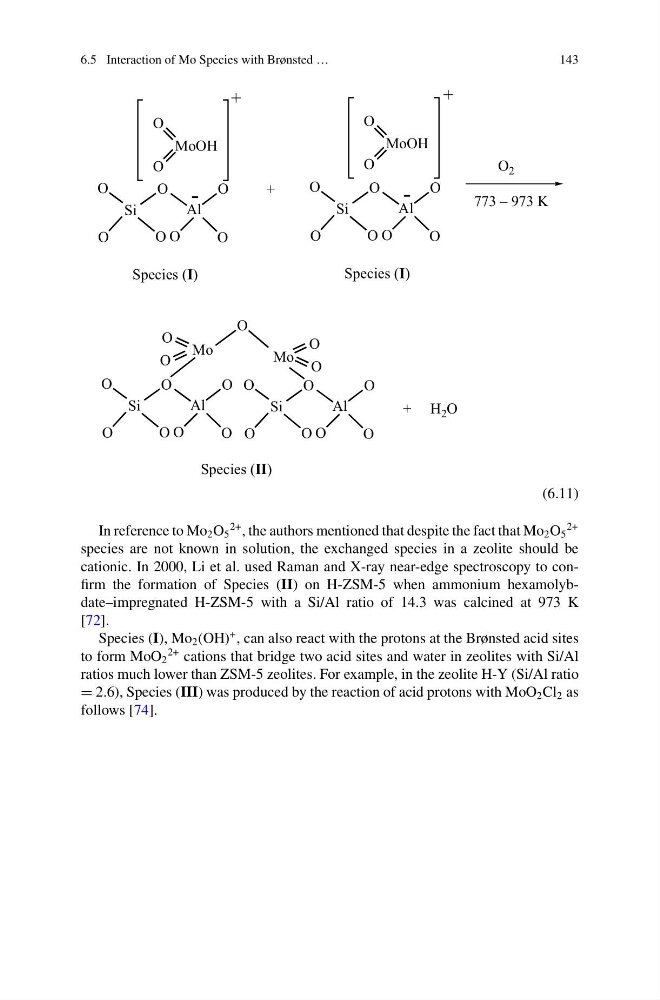
In reference to Mo 2 O 5
2+ , the authors mentioned that despite the fact that Mo 2 O 5
2+
species are not known in solution, the exchanged species in a zeolite should be
cationic. In 2000, Li et al. used Raman and X-ray near-edge spectroscopy to confirm the formation of Species (II) on H-ZSM-5 when ammonium hexamolybdate–impregnated H-ZSM-5 with a Si/Al ratio of 14.3 was calcined at 973 K
[72].
Species (I), Mo 2 (OH)
+ , can also react with the protons at the Brønsted acid sites
to form MoO 2
2+ cations that bridge two acid sites and water in zeolites with Si/Al
ratios much lower than ZSM-5 zeolites. For example, in the zeolite H-Y (Si/Al ratio
= 2.6), Species (III) was produced by the reaction of acid protons with MoO 2 Cl 2 as
follows [74].
143
Si
O
O
O
O
O
Al
O
O
Si
O
O
O
O
O
Al
O
O
O
+ H 2 O
773 – 973 K
O 2
Si
O
O
O
O
O
Al
O
O
MoOH
Species (I)
O
O
+
-
+
Si
O
O
O
O
O
Al
O
O
MoOH
Species (I)
O
O
+
-
O
Mo O
O
Mo
O
Species (II)
(6.11)
In reference to Mo 2 O 5
2+ , the authors mentioned that despite the fact that Mo 2 O 5
2+
species are not known in solution, the exchanged species in a zeolite should be
cationic. In 2000, Li et al. used Raman and X-ray near-edge spectroscopy to confirm the formation of Species (II) on H-ZSM-5 when ammonium hexamolybdate–impregnated H-ZSM-5 with a Si/Al ratio of 14.3 was calcined at 973 K
[72].
Species (I), Mo 2 (OH)
+ , can also react with the protons at the Brønsted acid sites
to form MoO 2
2+ cations that bridge two acid sites and water in zeolites with Si/Al
ratios much lower than ZSM-5 zeolites. For example, in the zeolite H-Y (Si/Al ratio
= 2.6), Species (III) was produced by the reaction of acid protons with MoO 2 Cl 2 as
follows [74].