

142
6 Conversion of Methane to Aromatic Hydrocarbons
6.5.2 Formation of Various Mo Species in H + -Exchanged
Zeolites
The catalytic performances of Mo-modified H-ZSM-5 (Mo/H-ZSM-5) for the MDA
reaction strongly depended on catalyst preparation conditions and/or preparation
methods. Furthermore, the formation of various Mo species could be observed by
analytical methods such as NMR, TPD (temperature-programed desorption) TG
(thermogravimetry), and UV-Raman spectroscopy [67, 69–74]. These results show
that Mo species probably interact with Brønsted acid sites on ZSM-5 and vary during
catalyst perpetration.
Xu et al. examined the Mo species on H-ZSM-5 during calcination treatment
in the air using infrared (IR) spectroscopy and differential thermal analysis (DTA).
They detected small MoO 3 crystallites on the exterior surface of ZSM-5 zeolites
during calcination at around 500–650 K [67, 70]. They further showed that the IR
bands associated with the MoO 3 crystallites on the external surface of the ZSM-5
crystals disappeared when the sample was further calcined at 773 K, followed by the
migration of (MoO 3 ) n oligomers into the zeolite channels (pores).
The Tamman temperature of MoO 3 is 534 K, and the sublimation of MoO 3
becomes detectable above 623–673 K. Thus, the surface migration of MoO 3 onto HZSM-5 occurs at high temperature, i.e., catalyst preparation temperatures of around
700–1000 K. Furthermore, the vapor pressure of MoO 3 as (MoO 3 ) n oligomers is
56 Pa at 973 K. Therefore, it is possible that MoO 3 molecules diffuse into the cavities (pores) in zeolite and can interact with the protons at the Brønsted acid sites in
the cavities.
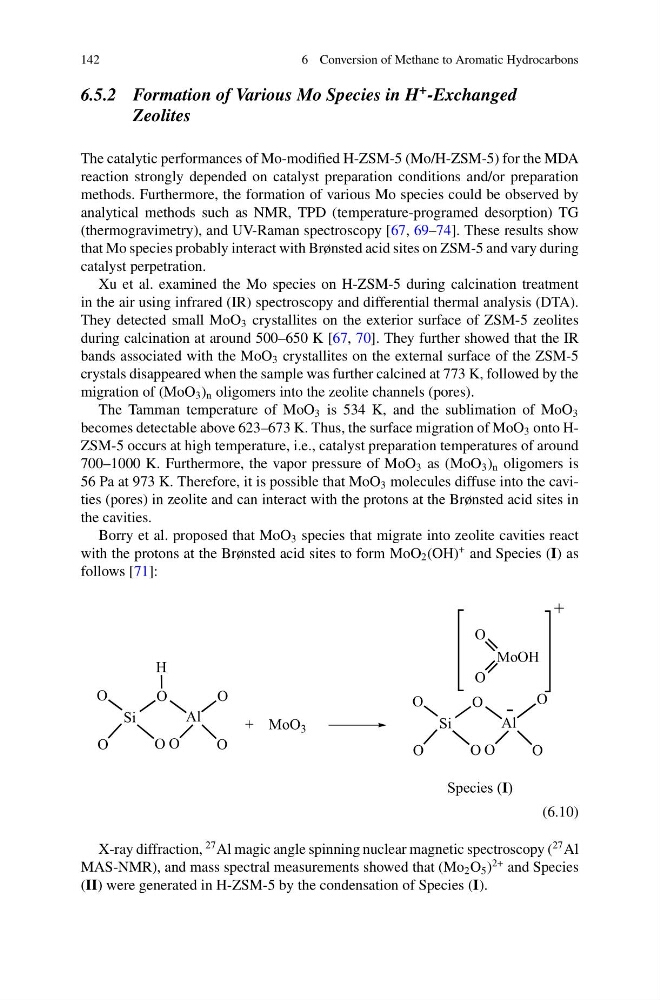
Borry et al. proposed that MoO 3 species that migrate into zeolite cavities react
with the protons at the Brønsted acid sites to form MoO 2 (OH)
+ and Species (I) as
follows [71]:
H
Si
O
O
O
O
O
Al
O
O
+ MoO 3
Si
O
O
O
O
O
Al
O
O
MoOH
Species (I)
O
O
+
-
(6.10)
X-ray diffraction,
27 Al magic angle spinning nuclear magnetic spectroscopy (
27 Al
MAS-NMR), and mass spectral measurements showed that (Mo 2 O 5 )
2+ and Species
(II) were generated in H-ZSM-5 by the condensation of Species (I).
6 Conversion of Methane to Aromatic Hydrocarbons
6.5.2 Formation of Various Mo Species in H + -Exchanged
Zeolites
The catalytic performances of Mo-modified H-ZSM-5 (Mo/H-ZSM-5) for the MDA
reaction strongly depended on catalyst preparation conditions and/or preparation
methods. Furthermore, the formation of various Mo species could be observed by
analytical methods such as NMR, TPD (temperature-programed desorption) TG
(thermogravimetry), and UV-Raman spectroscopy [67, 69–74]. These results show
that Mo species probably interact with Brønsted acid sites on ZSM-5 and vary during
catalyst perpetration.
Xu et al. examined the Mo species on H-ZSM-5 during calcination treatment
in the air using infrared (IR) spectroscopy and differential thermal analysis (DTA).
They detected small MoO 3 crystallites on the exterior surface of ZSM-5 zeolites
during calcination at around 500–650 K [67, 70]. They further showed that the IR
bands associated with the MoO 3 crystallites on the external surface of the ZSM-5
crystals disappeared when the sample was further calcined at 773 K, followed by the
migration of (MoO 3 ) n oligomers into the zeolite channels (pores).
The Tamman temperature of MoO 3 is 534 K, and the sublimation of MoO 3
becomes detectable above 623–673 K. Thus, the surface migration of MoO 3 onto HZSM-5 occurs at high temperature, i.e., catalyst preparation temperatures of around
700–1000 K. Furthermore, the vapor pressure of MoO 3 as (MoO 3 ) n oligomers is
56 Pa at 973 K. Therefore, it is possible that MoO 3 molecules diffuse into the cavities (pores) in zeolite and can interact with the protons at the Brønsted acid sites in
the cavities.
Borry et al. proposed that MoO 3 species that migrate into zeolite cavities react
with the protons at the Brønsted acid sites to form MoO 2 (OH)
+ and Species (I) as
follows [71]:
H
Si
O
O
O
O
O
Al
O
O
+ MoO 3
Si
O
O
O
O
O
Al
O
O
MoOH
Species (I)
O
O
+
-
(6.10)
X-ray diffraction,
27 Al magic angle spinning nuclear magnetic spectroscopy (
27 Al
MAS-NMR), and mass spectral measurements showed that (Mo 2 O 5 )
2+ and Species
(II) were generated in H-ZSM-5 by the condensation of Species (I).