

48
2 Wind Tunnels and Other Aerodynamic Test Facilities
Today, machining accuracies of the order of a few microns can be achieved using
high-speed steels, but these processes are expensive. Additive manufacturing techniques should open up new design possibilities and reduce costs and cycle times, but
the structural integrity remains a concern and the use of more robust material drives
the cost.
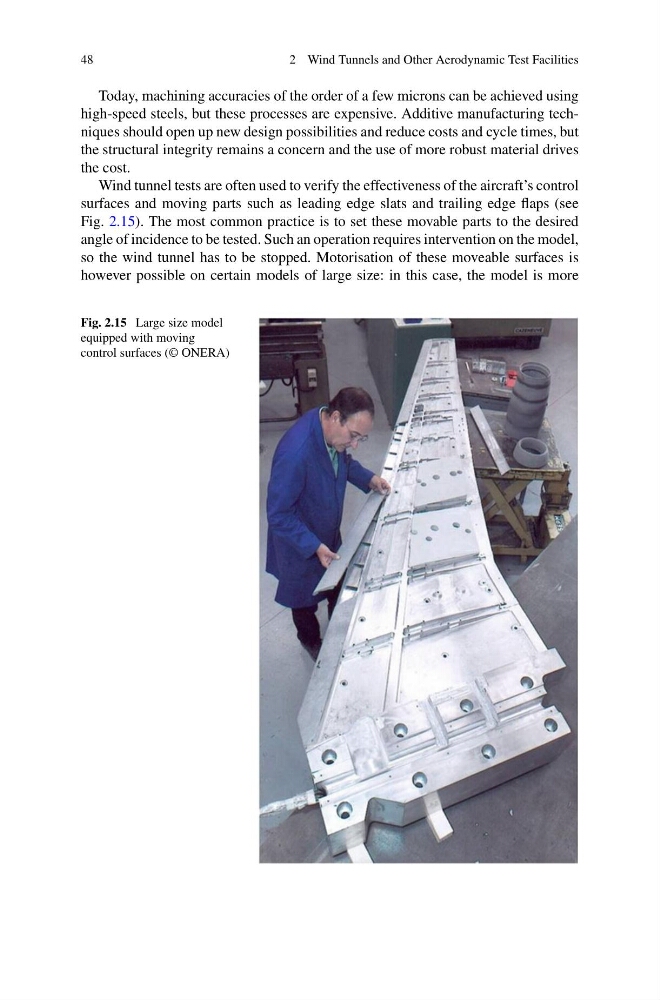
Wind tunnel tests are often used to verify the effectiveness of the aircraft’s control
surfaces and moving parts such as leading edge slats and trailing edge flaps (see
Fig. 2.15). The most common practice is to set these movable parts to the desired
angle of incidence to be tested. Such an operation requires intervention on the model,
so the wind tunnel has to be stopped. Motorisation of these moveable surfaces is
however possible on certain models of large size: in this case, the model is more
Fig. 2.15 Large size model
equipped with moving
control surfaces (© ONERA)
2 Wind Tunnels and Other Aerodynamic Test Facilities
Today, machining accuracies of the order of a few microns can be achieved using
high-speed steels, but these processes are expensive. Additive manufacturing techniques should open up new design possibilities and reduce costs and cycle times, but
the structural integrity remains a concern and the use of more robust material drives
the cost.
Wind tunnel tests are often used to verify the effectiveness of the aircraft’s control
surfaces and moving parts such as leading edge slats and trailing edge flaps (see
Fig. 2.15). The most common practice is to set these movable parts to the desired
angle of incidence to be tested. Such an operation requires intervention on the model,
so the wind tunnel has to be stopped. Motorisation of these moveable surfaces is
however possible on certain models of large size: in this case, the model is more
Fig. 2.15 Large size model
equipped with moving
control surfaces (© ONERA)