

2.5 Constraints of Testing in a Wind Tunnel
37
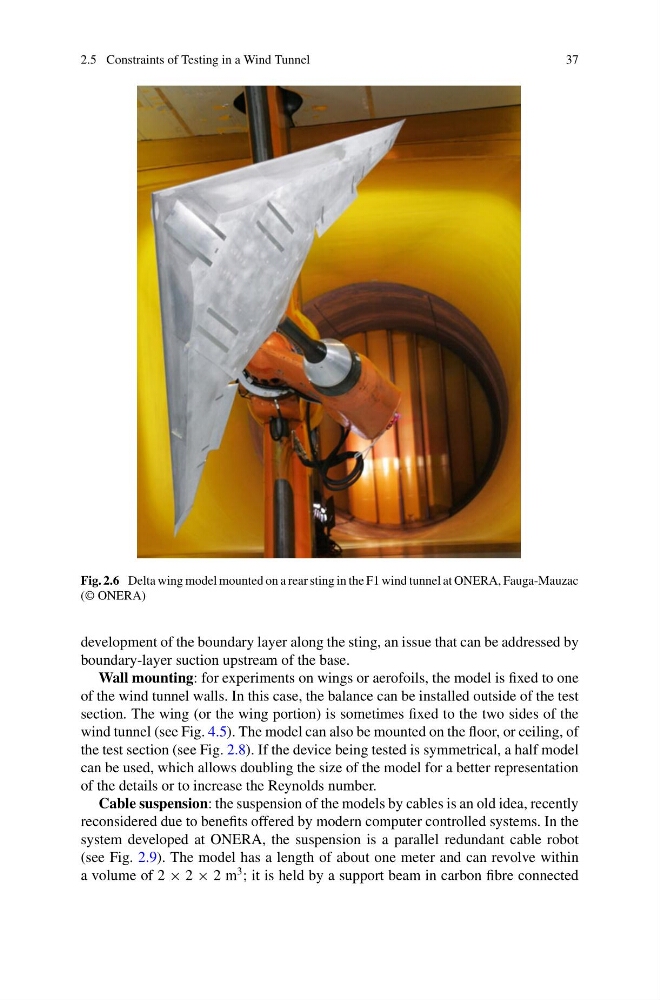
Fig. 2.6 Delta wing model mounted on a rear sting in the F1 wind tunnel at ONERA, Fauga-Mauzac
(© ONERA)
development of the boundary layer along the sting, an issue that can be addressed by
boundary-layer suction upstream of the base.
Wall mounting: for experiments on wings or aerofoils, the model is fixed to one
of the wind tunnel walls. In this case, the balance can be installed outside of the test
section. The wing (or the wing portion) is sometimes fixed to the two sides of the
wind tunnel (see Fig. 4.5). The model can also be mounted on the floor, or ceiling, of
the test section (see Fig. 2.8). If the device being tested is symmetrical, a half model
can be used, which allows doubling the size of the model for a better representation
of the details or to increase the Reynolds number.
Cable suspension: the suspension of the models by cables is an old idea, recently
reconsidered due to benefits offered by modern computer controlled systems. In the
system developed at ONERA, the suspension is a parallel redundant cable robot
(see Fig. 2.9). The model has a length of about one meter and can revolve within
a volume of 2 × 2 × 2 m
3 ; it is held by a support beam in carbon fibre connected
37
Fig. 2.6 Delta wing model mounted on a rear sting in the F1 wind tunnel at ONERA, Fauga-Mauzac
(© ONERA)
development of the boundary layer along the sting, an issue that can be addressed by
boundary-layer suction upstream of the base.
Wall mounting: for experiments on wings or aerofoils, the model is fixed to one
of the wind tunnel walls. In this case, the balance can be installed outside of the test
section. The wing (or the wing portion) is sometimes fixed to the two sides of the
wind tunnel (see Fig. 4.5). The model can also be mounted on the floor, or ceiling, of
the test section (see Fig. 2.8). If the device being tested is symmetrical, a half model
can be used, which allows doubling the size of the model for a better representation
of the details or to increase the Reynolds number.
Cable suspension: the suspension of the models by cables is an old idea, recently
reconsidered due to benefits offered by modern computer controlled systems. In the
system developed at ONERA, the suspension is a parallel redundant cable robot
(see Fig. 2.9). The model has a length of about one meter and can revolve within
a volume of 2 × 2 × 2 m
3 ; it is held by a support beam in carbon fibre connected