

1.2 Review of the Theory
7
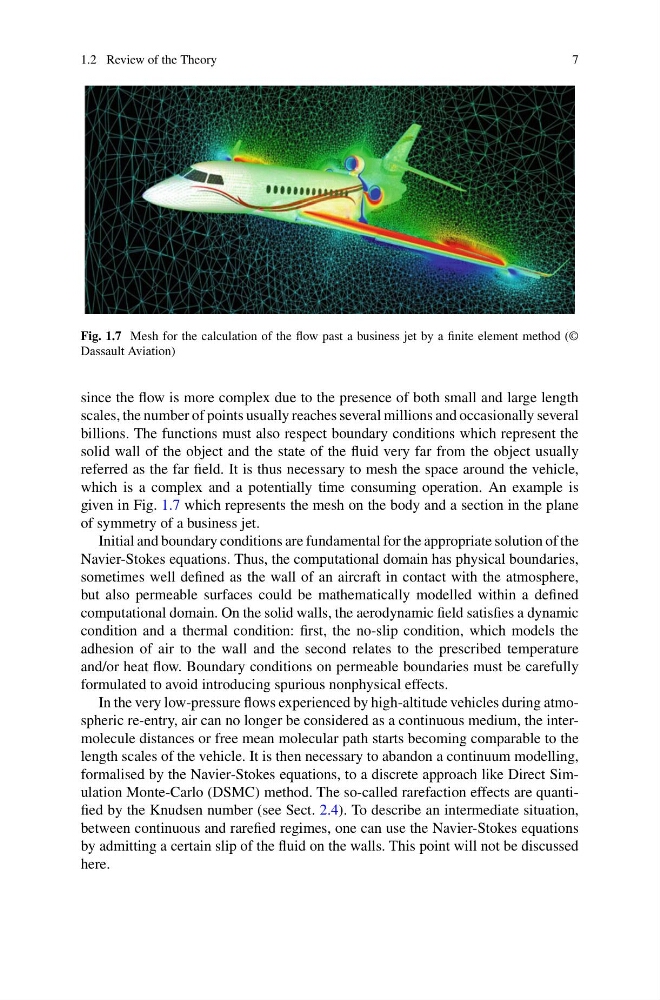
Fig. 1.7 Mesh for the calculation of the flow past a business jet by a finite element method (©
Dassault Aviation)
since the flow is more complex due to the presence of both small and large length
scales, the number of points usually reaches several millions and occasionally several
billions. The functions must also respect boundary conditions which represent the
solid wall of the object and the state of the fluid very far from the object usually
referred as the far field. It is thus necessary to mesh the space around the vehicle,
which is a complex and a potentially time consuming operation. An example is
given in Fig. 1.7 which represents the mesh on the body and a section in the plane
of symmetry of a business jet.
Initial and boundary conditions are fundamental for the appropriate solution of the
Navier-Stokes equations. Thus, the computational domain has physical boundaries,
sometimes well defined as the wall of an aircraft in contact with the atmosphere,
but also permeable surfaces could be mathematically modelled within a defined
computational domain. On the solid walls, the aerodynamic field satisfies a dynamic
condition and a thermal condition: first, the no-slip condition, which models the
adhesion of air to the wall and the second relates to the prescribed temperature
and/or heat flow. Boundary conditions on permeable boundaries must be carefully
formulated to avoid introducing spurious nonphysical effects.
In the very low-pressure flows experienced by high-altitude vehicles during atmospheric re-entry, air can no longer be considered as a continuous medium, the intermolecule distances or free mean molecular path starts becoming comparable to the
length scales of the vehicle. It is then necessary to abandon a continuum modelling,
formalised by the Navier-Stokes equations, to a discrete approach like Direct Simulation Monte-Carlo (DSMC) method. The so-called rarefaction effects are quantified by the Knudsen number (see Sect. 2.4). To describe an intermediate situation,
between continuous and rarefied regimes, one can use the Navier-Stokes equations
by admitting a certain slip of the fluid on the walls. This point will not be discussed
here.
7
Fig. 1.7 Mesh for the calculation of the flow past a business jet by a finite element method (©
Dassault Aviation)
since the flow is more complex due to the presence of both small and large length
scales, the number of points usually reaches several millions and occasionally several
billions. The functions must also respect boundary conditions which represent the
solid wall of the object and the state of the fluid very far from the object usually
referred as the far field. It is thus necessary to mesh the space around the vehicle,
which is a complex and a potentially time consuming operation. An example is
given in Fig. 1.7 which represents the mesh on the body and a section in the plane
of symmetry of a business jet.
Initial and boundary conditions are fundamental for the appropriate solution of the
Navier-Stokes equations. Thus, the computational domain has physical boundaries,
sometimes well defined as the wall of an aircraft in contact with the atmosphere,
but also permeable surfaces could be mathematically modelled within a defined
computational domain. On the solid walls, the aerodynamic field satisfies a dynamic
condition and a thermal condition: first, the no-slip condition, which models the
adhesion of air to the wall and the second relates to the prescribed temperature
and/or heat flow. Boundary conditions on permeable boundaries must be carefully
formulated to avoid introducing spurious nonphysical effects.
In the very low-pressure flows experienced by high-altitude vehicles during atmospheric re-entry, air can no longer be considered as a continuous medium, the intermolecule distances or free mean molecular path starts becoming comparable to the
length scales of the vehicle. It is then necessary to abandon a continuum modelling,
formalised by the Navier-Stokes equations, to a discrete approach like Direct Simulation Monte-Carlo (DSMC) method. The so-called rarefaction effects are quantified by the Knudsen number (see Sect. 2.4). To describe an intermediate situation,
between continuous and rarefied regimes, one can use the Navier-Stokes equations
by admitting a certain slip of the fluid on the walls. This point will not be discussed
here.