

264
12 Laser Spectroscopy and Electron Beam Excitation
absorbing species must be present with sufficient density to have enough absorption
for accurate measurements at high signal to noise ratio.
Among the laser absorption methods, the laser diode absorption technique is a
powerful tool for the time-resolved measurement of temperature, velocity and concentration in a flow where requirements in terms of spatial resolution are not strict
and where the line of integration inherent to this technique is not a problem. The technique consists of illuminating a cross section of the gas to be studied by an infrared
light beam. Doppler broadening and shift in wavelength of the species absorption
lines are used to determine the translation temperature and the flow velocity. With
proper calibration, the area beneath the absorption lines gives a measurement of
species concentration.
12.3 Rayleigh Scattering
Rayleigh scattering is through elastic radiative interaction (scattering) with the gas
where the light from a laser beam is scattered at approximately the same frequency
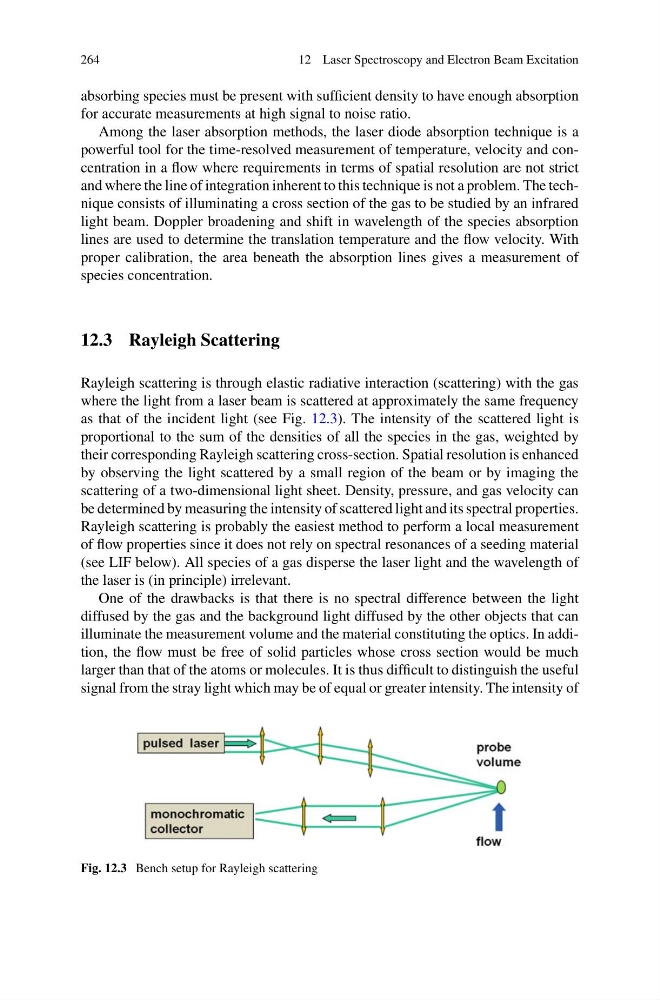
as that of the incident light (see Fig. 12.3). The intensity of the scattered light is
proportional to the sum of the densities of all the species in the gas, weighted by
their corresponding Rayleigh scattering cross-section. Spatial resolution is enhanced
by observing the light scattered by a small region of the beam or by imaging the
scattering of a two-dimensional light sheet. Density, pressure, and gas velocity can
be determined by measuring the intensity of scattered light and its spectral properties.
Rayleigh scattering is probably the easiest method to perform a local measurement
of flow properties since it does not rely on spectral resonances of a seeding material
(see LIF below). All species of a gas disperse the laser light and the wavelength of
the laser is (in principle) irrelevant.
One of the drawbacks is that there is no spectral difference between the light
diffused by the gas and the background light diffused by the other objects that can
illuminate the measurement volume and the material constituting the optics. In addition, the flow must be free of solid particles whose cross section would be much
larger than that of the atoms or molecules. It is thus difficult to distinguish the useful
signal from the stray light which may be of equal or greater intensity. The intensity of
Fig. 12.3 Bench setup for Rayleigh scattering
12 Laser Spectroscopy and Electron Beam Excitation
absorbing species must be present with sufficient density to have enough absorption
for accurate measurements at high signal to noise ratio.
Among the laser absorption methods, the laser diode absorption technique is a
powerful tool for the time-resolved measurement of temperature, velocity and concentration in a flow where requirements in terms of spatial resolution are not strict
and where the line of integration inherent to this technique is not a problem. The technique consists of illuminating a cross section of the gas to be studied by an infrared
light beam. Doppler broadening and shift in wavelength of the species absorption
lines are used to determine the translation temperature and the flow velocity. With
proper calibration, the area beneath the absorption lines gives a measurement of
species concentration.
12.3 Rayleigh Scattering
Rayleigh scattering is through elastic radiative interaction (scattering) with the gas
where the light from a laser beam is scattered at approximately the same frequency
as that of the incident light (see Fig. 12.3). The intensity of the scattered light is
proportional to the sum of the densities of all the species in the gas, weighted by
their corresponding Rayleigh scattering cross-section. Spatial resolution is enhanced
by observing the light scattered by a small region of the beam or by imaging the
scattering of a two-dimensional light sheet. Density, pressure, and gas velocity can
be determined by measuring the intensity of scattered light and its spectral properties.
Rayleigh scattering is probably the easiest method to perform a local measurement
of flow properties since it does not rely on spectral resonances of a seeding material
(see LIF below). All species of a gas disperse the laser light and the wavelength of
the laser is (in principle) irrelevant.
One of the drawbacks is that there is no spectral difference between the light
diffused by the gas and the background light diffused by the other objects that can
illuminate the measurement volume and the material constituting the optics. In addition, the flow must be free of solid particles whose cross section would be much
larger than that of the atoms or molecules. It is thus difficult to distinguish the useful
signal from the stray light which may be of equal or greater intensity. The intensity of
Fig. 12.3 Bench setup for Rayleigh scattering