

262
12 Laser Spectroscopy and Electron Beam Excitation
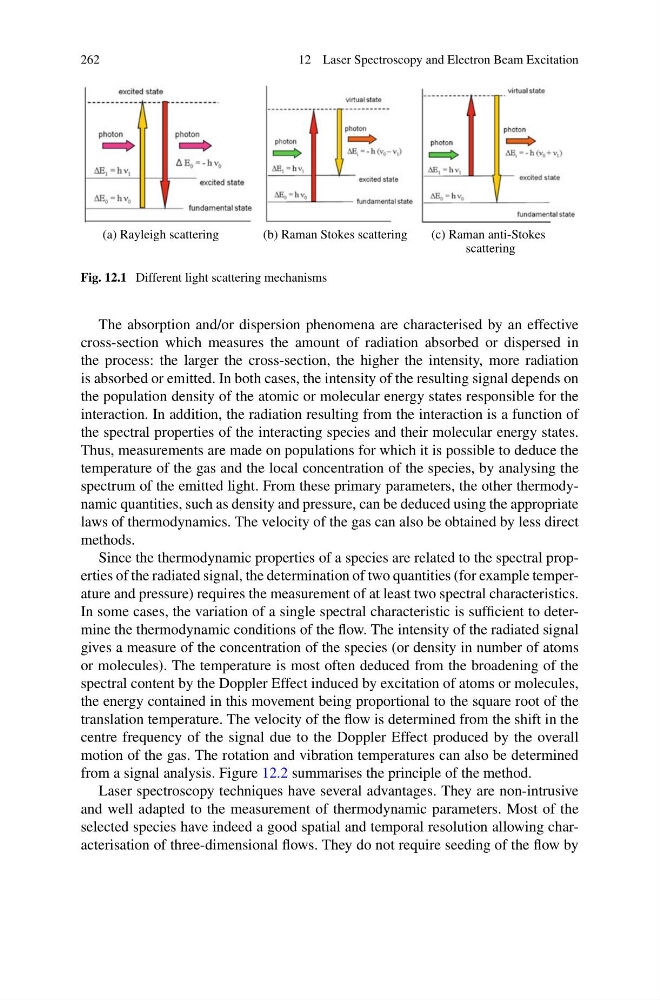
(a) Rayleigh scattering
(b) Raman Stokes scattering
(c) Raman anti-Stokes
scattering
Fig. 12.1 Different light scattering mechanisms
The absorption and/or dispersion phenomena are characterised by an effective
cross-section which measures the amount of radiation absorbed or dispersed in
the process: the larger the cross-section, the higher the intensity, more radiation
is absorbed or emitted. In both cases, the intensity of the resulting signal depends on
the population density of the atomic or molecular energy states responsible for the
interaction. In addition, the radiation resulting from the interaction is a function of
the spectral properties of the interacting species and their molecular energy states.
Thus, measurements are made on populations for which it is possible to deduce the
temperature of the gas and the local concentration of the species, by analysing the
spectrum of the emitted light. From these primary parameters, the other thermodynamic quantities, such as density and pressure, can be deduced using the appropriate
laws of thermodynamics. The velocity of the gas can also be obtained by less direct
methods.
Since the thermodynamic properties of a species are related to the spectral properties of the radiated signal, the determination of two quantities (for example temperature and pressure) requires the measurement of at least two spectral characteristics.
In some cases, the variation of a single spectral characteristic is sufficient to determine the thermodynamic conditions of the flow. The intensity of the radiated signal
gives a measure of the concentration of the species (or density in number of atoms
or molecules). The temperature is most often deduced from the broadening of the
spectral content by the Doppler Effect induced by excitation of atoms or molecules,
the energy contained in this movement being proportional to the square root of the
translation temperature. The velocity of the flow is determined from the shift in the
centre frequency of the signal due to the Doppler Effect produced by the overall
motion of the gas. The rotation and vibration temperatures can also be determined
from a signal analysis. Figure 12.2 summarises the principle of the method.
Laser spectroscopy techniques have several advantages. They are non-intrusive
and well adapted to the measurement of thermodynamic parameters. Most of the
selected species have indeed a good spatial and temporal resolution allowing characterisation of three-dimensional flows. They do not require seeding of the flow by
12 Laser Spectroscopy and Electron Beam Excitation
(a) Rayleigh scattering
(b) Raman Stokes scattering
(c) Raman anti-Stokes
scattering
Fig. 12.1 Different light scattering mechanisms
The absorption and/or dispersion phenomena are characterised by an effective
cross-section which measures the amount of radiation absorbed or dispersed in
the process: the larger the cross-section, the higher the intensity, more radiation
is absorbed or emitted. In both cases, the intensity of the resulting signal depends on
the population density of the atomic or molecular energy states responsible for the
interaction. In addition, the radiation resulting from the interaction is a function of
the spectral properties of the interacting species and their molecular energy states.
Thus, measurements are made on populations for which it is possible to deduce the
temperature of the gas and the local concentration of the species, by analysing the
spectrum of the emitted light. From these primary parameters, the other thermodynamic quantities, such as density and pressure, can be deduced using the appropriate
laws of thermodynamics. The velocity of the gas can also be obtained by less direct
methods.
Since the thermodynamic properties of a species are related to the spectral properties of the radiated signal, the determination of two quantities (for example temperature and pressure) requires the measurement of at least two spectral characteristics.
In some cases, the variation of a single spectral characteristic is sufficient to determine the thermodynamic conditions of the flow. The intensity of the radiated signal
gives a measure of the concentration of the species (or density in number of atoms
or molecules). The temperature is most often deduced from the broadening of the
spectral content by the Doppler Effect induced by excitation of atoms or molecules,
the energy contained in this movement being proportional to the square root of the
translation temperature. The velocity of the flow is determined from the shift in the
centre frequency of the signal due to the Doppler Effect produced by the overall
motion of the gas. The rotation and vibration temperatures can also be determined
from a signal analysis. Figure 12.2 summarises the principle of the method.
Laser spectroscopy techniques have several advantages. They are non-intrusive
and well adapted to the measurement of thermodynamic parameters. Most of the
selected species have indeed a good spatial and temporal resolution allowing characterisation of three-dimensional flows. They do not require seeding of the flow by