

252
11 Non-intrusive Measurement Techniques
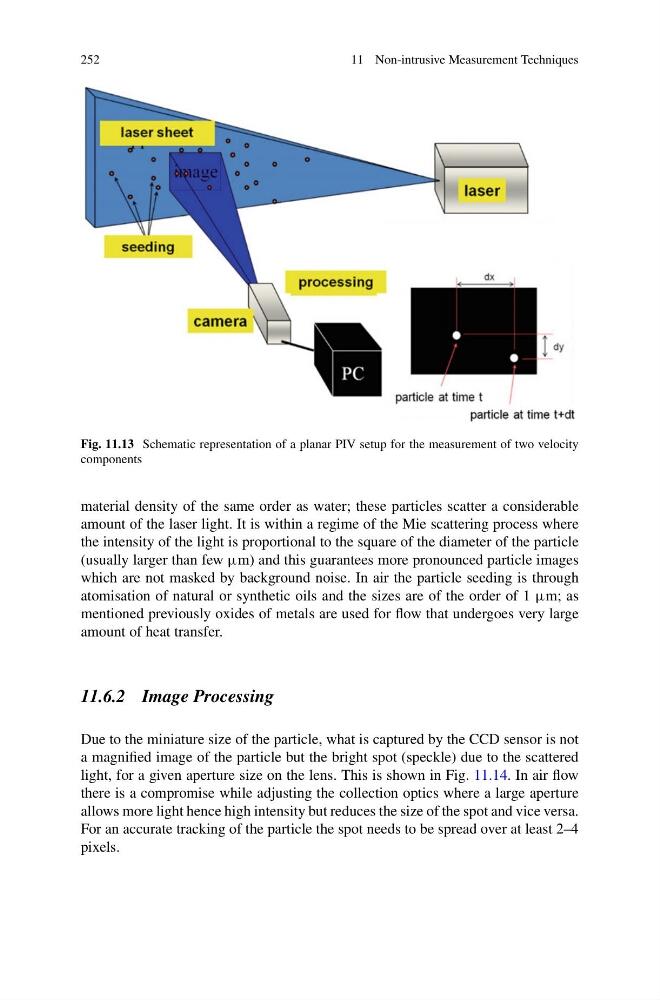
Fig. 11.13 Schematic representation of a planar PIV setup for the measurement of two velocity
components
material density of the same order as water; these particles scatter a considerable
amount of the laser light. It is within a regime of the Mie scattering process where
the intensity of the light is proportional to the square of the diameter of the particle
(usually larger than few µm) and this guarantees more pronounced particle images
which are not masked by background noise. In air the particle seeding is through
atomisation of natural or synthetic oils and the sizes are of the order of 1 µm; as
mentioned previously oxides of metals are used for flow that undergoes very large
amount of heat transfer.
11.6.2 Image Processing
Due to the miniature size of the particle, what is captured by the CCD sensor is not
a magnified image of the particle but the bright spot (speckle) due to the scattered
light, for a given aperture size on the lens. This is shown in Fig. 11.14. In air flow
there is a compromise while adjusting the collection optics where a large aperture
allows more light hence high intensity but reduces the size of the spot and vice versa.
For an accurate tracking of the particle the spot needs to be spread over at least 2–4
pixels.
11 Non-intrusive Measurement Techniques
Fig. 11.13 Schematic representation of a planar PIV setup for the measurement of two velocity
components
material density of the same order as water; these particles scatter a considerable
amount of the laser light. It is within a regime of the Mie scattering process where
the intensity of the light is proportional to the square of the diameter of the particle
(usually larger than few µm) and this guarantees more pronounced particle images
which are not masked by background noise. In air the particle seeding is through
atomisation of natural or synthetic oils and the sizes are of the order of 1 µm; as
mentioned previously oxides of metals are used for flow that undergoes very large
amount of heat transfer.
11.6.2 Image Processing
Due to the miniature size of the particle, what is captured by the CCD sensor is not
a magnified image of the particle but the bright spot (speckle) due to the scattered
light, for a given aperture size on the lens. This is shown in Fig. 11.14. In air flow
there is a compromise while adjusting the collection optics where a large aperture
allows more light hence high intensity but reduces the size of the spot and vice versa.
For an accurate tracking of the particle the spot needs to be spread over at least 2–4
pixels.