

250
11 Non-intrusive Measurement Techniques
with a propulsive jet at the centre. The bottom figure shows the streamlines deduced
from the measurement of the base flow.
11.5 Doppler Global Velocimetry
Planar Doppler velocimetry or Doppler Global Velocimetry (DGV) is a flow velocity
measurement technique based on particle interference similar to LDV. However,
unlike LDV which is a pointwise measurement technique, DGV can resolve the flow
velocity over multiple points (of the order of hundreds of thousands) within a larger
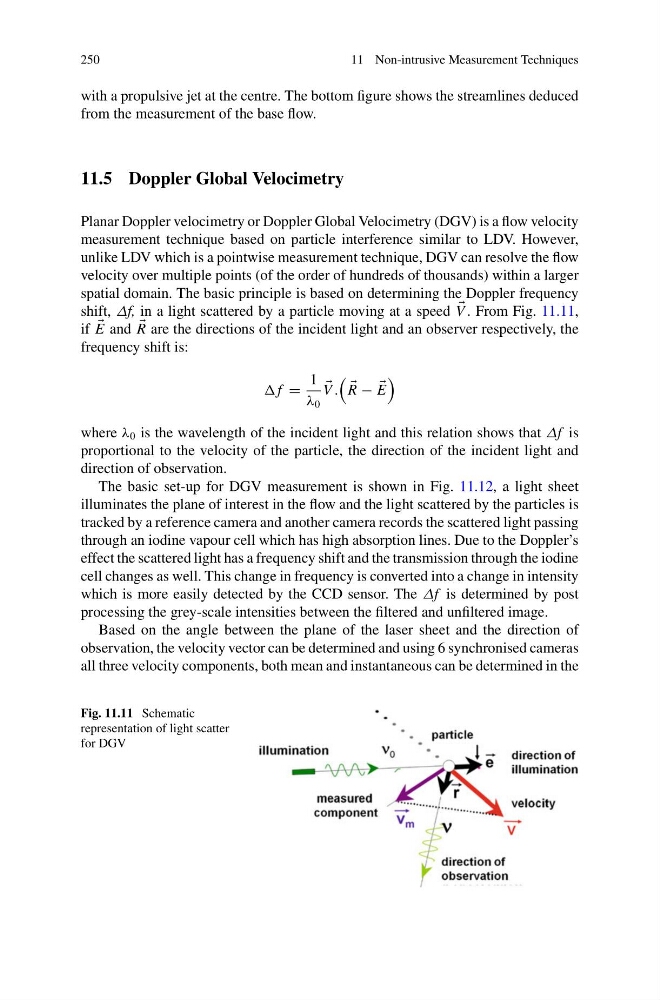
spatial domain. The basic principle is based on determining the Doppler frequency
shift, Δf, in a light scattered by a particle moving at a speed
V . From Fig. 11.11,
if
E and
R are the directions of the incident light and an observer respectively, the
frequency shift is:
f =
1
λ 0
V .
R −
E
where λ 0 is the wavelength of the incident light and this relation shows that Δf is
proportional to the velocity of the particle, the direction of the incident light and
direction of observation.
The basic set-up for DGV measurement is shown in Fig. 11.12, a light sheet
illuminates the plane of interest in the flow and the light scattered by the particles is
tracked by a reference camera and another camera records the scattered light passing
through an iodine vapour cell which has high absorption lines. Due to the Doppler’s
effect the scattered light has a frequency shift and the transmission through the iodine
cell changes as well. This change in frequency is converted into a change in intensity
which is more easily detected by the CCD sensor. The Δf is determined by post
processing the grey-scale intensities between the filtered and unfiltered image.
Based on the angle between the plane of the laser sheet and the direction of
observation, the velocity vector can be determined and using 6 synchronised cameras
all three velocity components, both mean and instantaneous can be determined in the
Fig. 11.11 Schematic
representation of light scatter
for DGV
11 Non-intrusive Measurement Techniques
with a propulsive jet at the centre. The bottom figure shows the streamlines deduced
from the measurement of the base flow.
11.5 Doppler Global Velocimetry
Planar Doppler velocimetry or Doppler Global Velocimetry (DGV) is a flow velocity
measurement technique based on particle interference similar to LDV. However,
unlike LDV which is a pointwise measurement technique, DGV can resolve the flow
velocity over multiple points (of the order of hundreds of thousands) within a larger
spatial domain. The basic principle is based on determining the Doppler frequency
shift, Δf, in a light scattered by a particle moving at a speed
V . From Fig. 11.11,
if
E and
R are the directions of the incident light and an observer respectively, the
frequency shift is:
f =
1
λ 0
V .
R −
E
where λ 0 is the wavelength of the incident light and this relation shows that Δf is
proportional to the velocity of the particle, the direction of the incident light and
direction of observation.
The basic set-up for DGV measurement is shown in Fig. 11.12, a light sheet
illuminates the plane of interest in the flow and the light scattered by the particles is
tracked by a reference camera and another camera records the scattered light passing
through an iodine vapour cell which has high absorption lines. Due to the Doppler’s
effect the scattered light has a frequency shift and the transmission through the iodine
cell changes as well. This change in frequency is converted into a change in intensity
which is more easily detected by the CCD sensor. The Δf is determined by post
processing the grey-scale intensities between the filtered and unfiltered image.
Based on the angle between the plane of the laser sheet and the direction of
observation, the velocity vector can be determined and using 6 synchronised cameras
all three velocity components, both mean and instantaneous can be determined in the
Fig. 11.11 Schematic
representation of light scatter
for DGV