

226
10 Intrusive Measurement Techniques
10.2 Pressure Probes
10.2.1 Measurement of Stagnation or Total Pressure, Pitot
Probe
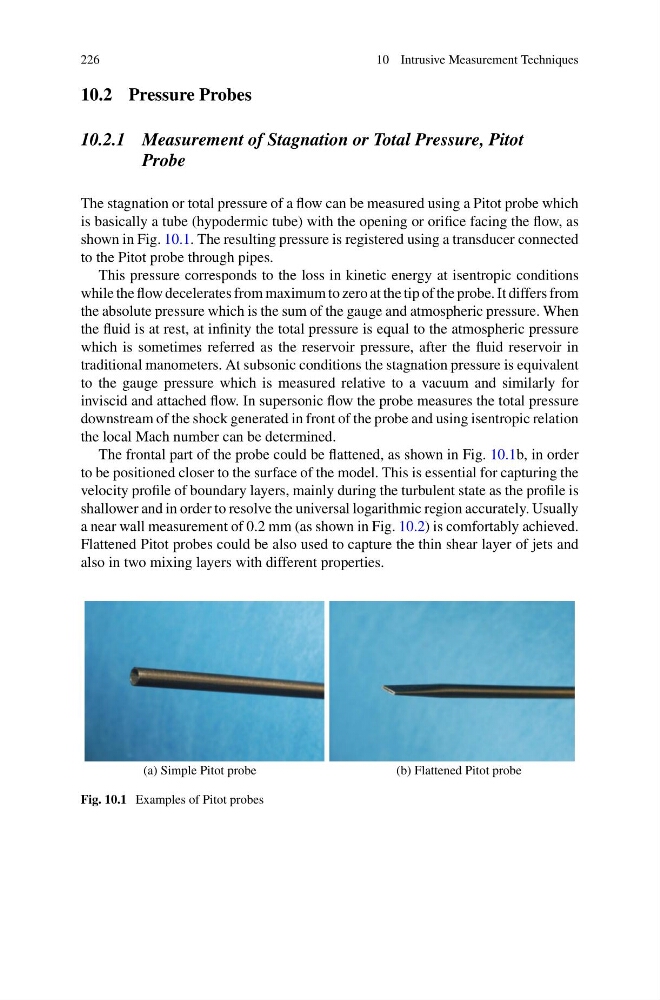
The stagnation or total pressure of a flow can be measured using a Pitot probe which
is basically a tube (hypodermic tube) with the opening or orifice facing the flow, as
shown in Fig. 10.1. The resulting pressure is registered using a transducer connected
to the Pitot probe through pipes.
This pressure corresponds to the loss in kinetic energy at isentropic conditions
while the flow decelerates from maximum to zero at the tip of the probe. It differs from
the absolute pressure which is the sum of the gauge and atmospheric pressure. When
the fluid is at rest, at infinity the total pressure is equal to the atmospheric pressure
which is sometimes referred as the reservoir pressure, after the fluid reservoir in
traditional manometers. At subsonic conditions the stagnation pressure is equivalent
to the gauge pressure which is measured relative to a vacuum and similarly for
inviscid and attached flow. In supersonic flow the probe measures the total pressure
downstream of the shock generated in front of the probe and using isentropic relation
the local Mach number can be determined.
The frontal part of the probe could be flattened, as shown in Fig. 10.1b, in order
to be positioned closer to the surface of the model. This is essential for capturing the
velocity profile of boundary layers, mainly during the turbulent state as the profile is
shallower and in order to resolve the universal logarithmic region accurately. Usually
a near wall measurement of 0.2 mm (as shown in Fig. 10.2) is comfortably achieved.
Flattened Pitot probes could be also used to capture the thin shear layer of jets and
also in two mixing layers with different properties.
(a) Simple Pitot probe
(b) Flattened Pitot probe
Fig. 10.1 Examples of Pitot probes
10 Intrusive Measurement Techniques
10.2 Pressure Probes
10.2.1 Measurement of Stagnation or Total Pressure, Pitot
Probe
The stagnation or total pressure of a flow can be measured using a Pitot probe which
is basically a tube (hypodermic tube) with the opening or orifice facing the flow, as
shown in Fig. 10.1. The resulting pressure is registered using a transducer connected
to the Pitot probe through pipes.
This pressure corresponds to the loss in kinetic energy at isentropic conditions
while the flow decelerates from maximum to zero at the tip of the probe. It differs from
the absolute pressure which is the sum of the gauge and atmospheric pressure. When
the fluid is at rest, at infinity the total pressure is equal to the atmospheric pressure
which is sometimes referred as the reservoir pressure, after the fluid reservoir in
traditional manometers. At subsonic conditions the stagnation pressure is equivalent
to the gauge pressure which is measured relative to a vacuum and similarly for
inviscid and attached flow. In supersonic flow the probe measures the total pressure
downstream of the shock generated in front of the probe and using isentropic relation
the local Mach number can be determined.
The frontal part of the probe could be flattened, as shown in Fig. 10.1b, in order
to be positioned closer to the surface of the model. This is essential for capturing the
velocity profile of boundary layers, mainly during the turbulent state as the profile is
shallower and in order to resolve the universal logarithmic region accurately. Usually
a near wall measurement of 0.2 mm (as shown in Fig. 10.2) is comfortably achieved.
Flattened Pitot probes could be also used to capture the thin shear layer of jets and
also in two mixing layers with different properties.
(a) Simple Pitot probe
(b) Flattened Pitot probe
Fig. 10.1 Examples of Pitot probes