

208
9 Characterisation of Flow Properties at the Surface
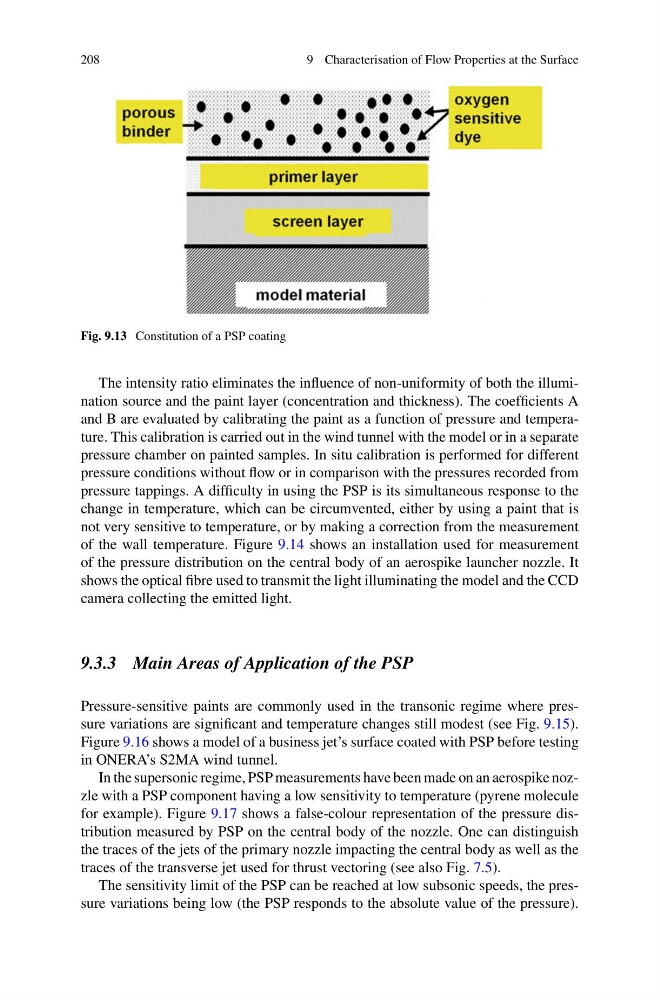
Fig. 9.13 Constitution of a PSP coating
The intensity ratio eliminates the influence of non-uniformity of both the illumination source and the paint layer (concentration and thickness). The coefficients A
and B are evaluated by calibrating the paint as a function of pressure and temperature. This calibration is carried out in the wind tunnel with the model or in a separate
pressure chamber on painted samples. In situ calibration is performed for different
pressure conditions without flow or in comparison with the pressures recorded from
pressure tappings. A difficulty in using the PSP is its simultaneous response to the
change in temperature, which can be circumvented, either by using a paint that is
not very sensitive to temperature, or by making a correction from the measurement
of the wall temperature. Figure 9.14 shows an installation used for measurement
of the pressure distribution on the central body of an aerospike launcher nozzle. It
shows the optical fibre used to transmit the light illuminating the model and the CCD
camera collecting the emitted light.
9.3.3 Main Areas of Application of the PSP
Pressure-sensitive paints are commonly used in the transonic regime where pressure variations are significant and temperature changes still modest (see Fig. 9.15).
Figure 9.16 shows a model of a business jet’s surface coated with PSP before testing
in ONERA’s S2MA wind tunnel.
In the supersonic regime, PSP measurements have been made on an aerospike nozzle with a PSP component having a low sensitivity to temperature (pyrene molecule
for example). Figure 9.17 shows a false-colour representation of the pressure distribution measured by PSP on the central body of the nozzle. One can distinguish
the traces of the jets of the primary nozzle impacting the central body as well as the
traces of the transverse jet used for thrust vectoring (see also Fig. 7.5).
The sensitivity limit of the PSP can be reached at low subsonic speeds, the pressure variations being low (the PSP responds to the absolute value of the pressure).
9 Characterisation of Flow Properties at the Surface
Fig. 9.13 Constitution of a PSP coating
The intensity ratio eliminates the influence of non-uniformity of both the illumination source and the paint layer (concentration and thickness). The coefficients A
and B are evaluated by calibrating the paint as a function of pressure and temperature. This calibration is carried out in the wind tunnel with the model or in a separate
pressure chamber on painted samples. In situ calibration is performed for different
pressure conditions without flow or in comparison with the pressures recorded from
pressure tappings. A difficulty in using the PSP is its simultaneous response to the
change in temperature, which can be circumvented, either by using a paint that is
not very sensitive to temperature, or by making a correction from the measurement
of the wall temperature. Figure 9.14 shows an installation used for measurement
of the pressure distribution on the central body of an aerospike launcher nozzle. It
shows the optical fibre used to transmit the light illuminating the model and the CCD
camera collecting the emitted light.
9.3.3 Main Areas of Application of the PSP
Pressure-sensitive paints are commonly used in the transonic regime where pressure variations are significant and temperature changes still modest (see Fig. 9.15).
Figure 9.16 shows a model of a business jet’s surface coated with PSP before testing
in ONERA’s S2MA wind tunnel.
In the supersonic regime, PSP measurements have been made on an aerospike nozzle with a PSP component having a low sensitivity to temperature (pyrene molecule
for example). Figure 9.17 shows a false-colour representation of the pressure distribution measured by PSP on the central body of the nozzle. One can distinguish
the traces of the jets of the primary nozzle impacting the central body as well as the
traces of the transverse jet used for thrust vectoring (see also Fig. 7.5).
The sensitivity limit of the PSP can be reached at low subsonic speeds, the pressure variations being low (the PSP responds to the absolute value of the pressure).