

206
9 Characterisation of Flow Properties at the Surface
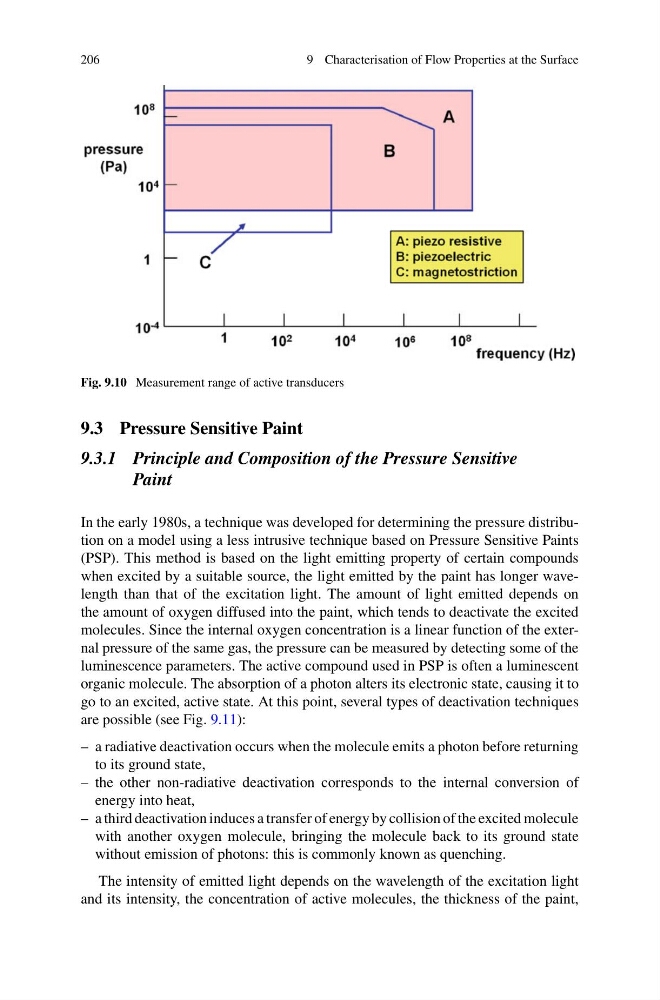
Fig. 9.10 Measurement range of active transducers
9.3 Pressure Sensitive Paint
9.3.1 Principle and Composition of the Pressure Sensitive
Paint
In the early 1980s, a technique was developed for determining the pressure distribution on a model using a less intrusive technique based on Pressure Sensitive Paints
(PSP). This method is based on the light emitting property of certain compounds
when excited by a suitable source, the light emitted by the paint has longer wavelength than that of the excitation light. The amount of light emitted depends on
the amount of oxygen diffused into the paint, which tends to deactivate the excited
molecules. Since the internal oxygen concentration is a linear function of the external pressure of the same gas, the pressure can be measured by detecting some of the
luminescence parameters. The active compound used in PSP is often a luminescent
organic molecule. The absorption of a photon alters its electronic state, causing it to
go to an excited, active state. At this point, several types of deactivation techniques
are possible (see Fig. 9.11):
– a radiative deactivation occurs when the molecule emits a photon before returning
to its ground state,
– the other non-radiative deactivation corresponds to the internal conversion of
energy into heat,
– a third deactivation induces a transfer of energy by collision of the excited molecule
with another oxygen molecule, bringing the molecule back to its ground state
without emission of photons: this is commonly known as quenching.
The intensity of emitted light depends on the wavelength of the excitation light
and its intensity, the concentration of active molecules, the thickness of the paint,
9 Characterisation of Flow Properties at the Surface
Fig. 9.10 Measurement range of active transducers
9.3 Pressure Sensitive Paint
9.3.1 Principle and Composition of the Pressure Sensitive
Paint
In the early 1980s, a technique was developed for determining the pressure distribution on a model using a less intrusive technique based on Pressure Sensitive Paints
(PSP). This method is based on the light emitting property of certain compounds
when excited by a suitable source, the light emitted by the paint has longer wavelength than that of the excitation light. The amount of light emitted depends on
the amount of oxygen diffused into the paint, which tends to deactivate the excited
molecules. Since the internal oxygen concentration is a linear function of the external pressure of the same gas, the pressure can be measured by detecting some of the
luminescence parameters. The active compound used in PSP is often a luminescent
organic molecule. The absorption of a photon alters its electronic state, causing it to
go to an excited, active state. At this point, several types of deactivation techniques
are possible (see Fig. 9.11):
– a radiative deactivation occurs when the molecule emits a photon before returning
to its ground state,
– the other non-radiative deactivation corresponds to the internal conversion of
energy into heat,
– a third deactivation induces a transfer of energy by collision of the excited molecule
with another oxygen molecule, bringing the molecule back to its ground state
without emission of photons: this is commonly known as quenching.
The intensity of emitted light depends on the wavelength of the excitation light
and its intensity, the concentration of active molecules, the thickness of the paint,