

7.5 Visualisation by Optical Imaging
173
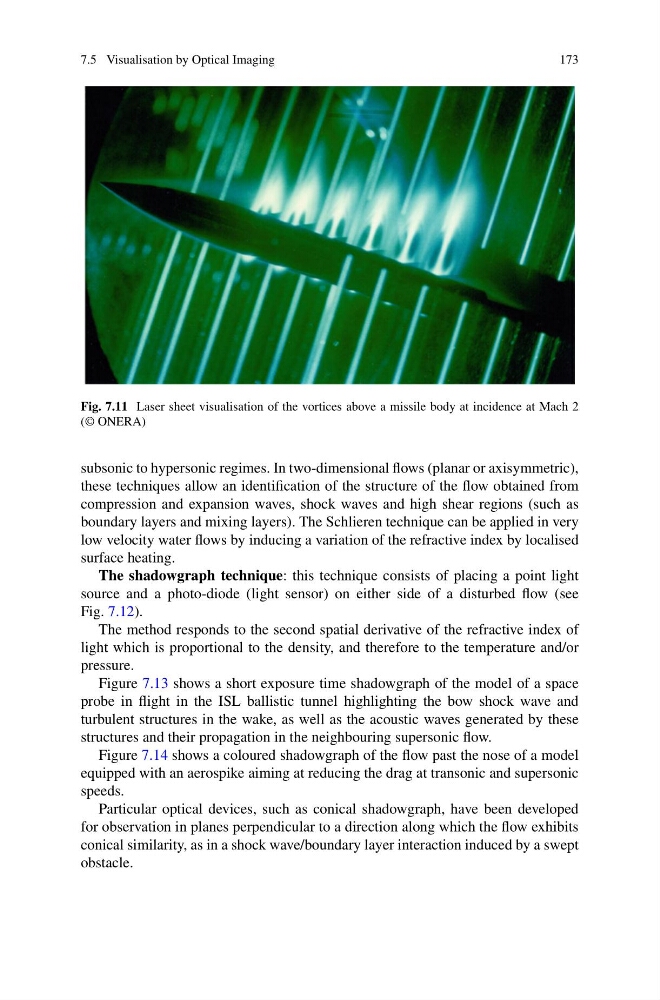
Fig. 7.11 Laser sheet visualisation of the vortices above a missile body at incidence at Mach 2
(© ONERA)
subsonic to hypersonic regimes. In two-dimensional flows (planar or axisymmetric),
these techniques allow an identification of the structure of the flow obtained from
compression and expansion waves, shock waves and high shear regions (such as
boundary layers and mixing layers). The Schlieren technique can be applied in very
low velocity water flows by inducing a variation of the refractive index by localised
surface heating.
The shadowgraph technique: this technique consists of placing a point light
source and a photo-diode (light sensor) on either side of a disturbed flow (see
Fig. 7.12).
The method responds to the second spatial derivative of the refractive index of
light which is proportional to the density, and therefore to the temperature and/or
pressure.
Figure 7.13 shows a short exposure time shadowgraph of the model of a space
probe in flight in the ISL ballistic tunnel highlighting the bow shock wave and
turbulent structures in the wake, as well as the acoustic waves generated by these
structures and their propagation in the neighbouring supersonic flow.
Figure 7.14 shows a coloured shadowgraph of the flow past the nose of a model
equipped with an aerospike aiming at reducing the drag at transonic and supersonic
speeds.
Particular optical devices, such as conical shadowgraph, have been developed
for observation in planes perpendicular to a direction along which the flow exhibits
conical similarity, as in a shock wave/boundary layer interaction induced by a swept
obstacle.
173
Fig. 7.11 Laser sheet visualisation of the vortices above a missile body at incidence at Mach 2
(© ONERA)
subsonic to hypersonic regimes. In two-dimensional flows (planar or axisymmetric),
these techniques allow an identification of the structure of the flow obtained from
compression and expansion waves, shock waves and high shear regions (such as
boundary layers and mixing layers). The Schlieren technique can be applied in very
low velocity water flows by inducing a variation of the refractive index by localised
surface heating.
The shadowgraph technique: this technique consists of placing a point light
source and a photo-diode (light sensor) on either side of a disturbed flow (see
Fig. 7.12).
The method responds to the second spatial derivative of the refractive index of
light which is proportional to the density, and therefore to the temperature and/or
pressure.
Figure 7.13 shows a short exposure time shadowgraph of the model of a space
probe in flight in the ISL ballistic tunnel highlighting the bow shock wave and
turbulent structures in the wake, as well as the acoustic waves generated by these
structures and their propagation in the neighbouring supersonic flow.
Figure 7.14 shows a coloured shadowgraph of the flow past the nose of a model
equipped with an aerospike aiming at reducing the drag at transonic and supersonic
speeds.
Particular optical devices, such as conical shadowgraph, have been developed
for observation in planes perpendicular to a direction along which the flow exhibits
conical similarity, as in a shock wave/boundary layer interaction induced by a swept
obstacle.