

154
6 Hypersonic Wind Tunnels
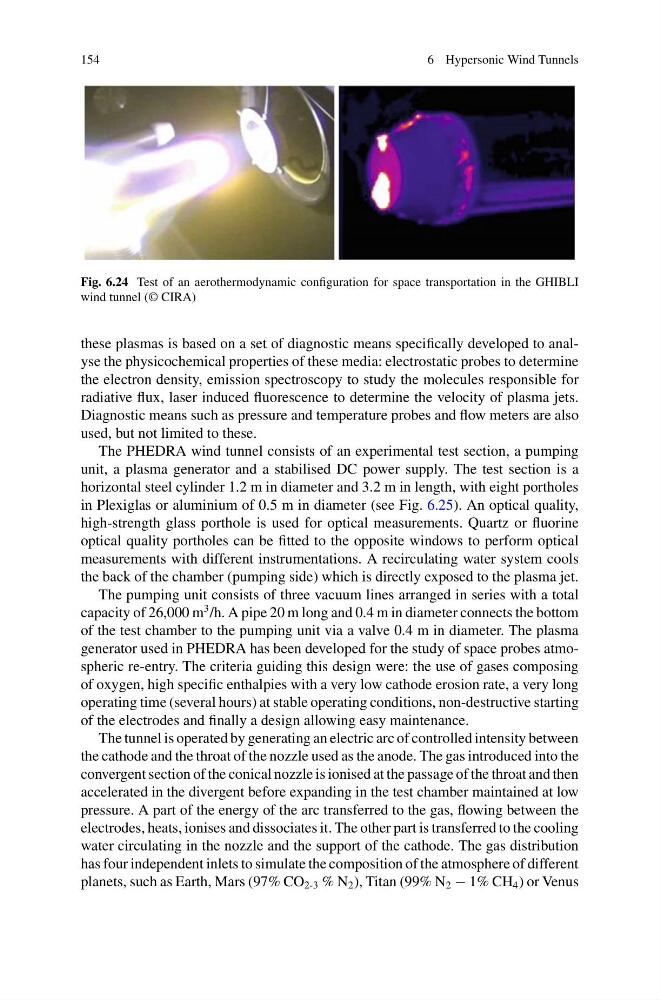
Fig. 6.24 Test of an aerothermodynamic configuration for space transportation in the GHIBLI
wind tunnel (© CIRA)
these plasmas is based on a set of diagnostic means specifically developed to analyse the physicochemical properties of these media: electrostatic probes to determine
the electron density, emission spectroscopy to study the molecules responsible for
radiative flux, laser induced fluorescence to determine the velocity of plasma jets.
Diagnostic means such as pressure and temperature probes and flow meters are also
used, but not limited to these.
The PHEDRA wind tunnel consists of an experimental test section, a pumping
unit, a plasma generator and a stabilised DC power supply. The test section is a
horizontal steel cylinder 1.2 m in diameter and 3.2 m in length, with eight portholes
in Plexiglas or aluminium of 0.5 m in diameter (see Fig. 6.25). An optical quality,
high-strength glass porthole is used for optical measurements. Quartz or fluorine
optical quality portholes can be fitted to the opposite windows to perform optical
measurements with different instrumentations. A recirculating water system cools
the back of the chamber (pumping side) which is directly exposed to the plasma jet.
The pumping unit consists of three vacuum lines arranged in series with a total
capacity of 26,000 m
3 /h. A pipe 20 m long and 0.4 m in diameter connects the bottom
of the test chamber to the pumping unit via a valve 0.4 m in diameter. The plasma
generator used in PHEDRA has been developed for the study of space probes atmospheric re-entry. The criteria guiding this design were: the use of gases composing
of oxygen, high specific enthalpies with a very low cathode erosion rate, a very long
operating time (several hours) at stable operating conditions, non-destructive starting
of the electrodes and finally a design allowing easy maintenance.
The tunnel is operated by generating an electric arc of controlled intensity between
the cathode and the throat of the nozzle used as the anode. The gas introduced into the
convergent section of the conical nozzle is ionised at the passage of the throat and then
accelerated in the divergent before expanding in the test chamber maintained at low
pressure. A part of the energy of the arc transferred to the gas, flowing between the
electrodes, heats, ionises and dissociates it. The other part is transferred to the cooling
water circulating in the nozzle and the support of the cathode. The gas distribution
has four independent inlets to simulate the composition of the atmosphere of different
planets, such as Earth, Mars (97% CO 2-3 % N 2 ), Titan (99% N 2 − 1% CH 4 ) or Venus
6 Hypersonic Wind Tunnels
Fig. 6.24 Test of an aerothermodynamic configuration for space transportation in the GHIBLI
wind tunnel (© CIRA)
these plasmas is based on a set of diagnostic means specifically developed to analyse the physicochemical properties of these media: electrostatic probes to determine
the electron density, emission spectroscopy to study the molecules responsible for
radiative flux, laser induced fluorescence to determine the velocity of plasma jets.
Diagnostic means such as pressure and temperature probes and flow meters are also
used, but not limited to these.
The PHEDRA wind tunnel consists of an experimental test section, a pumping
unit, a plasma generator and a stabilised DC power supply. The test section is a
horizontal steel cylinder 1.2 m in diameter and 3.2 m in length, with eight portholes
in Plexiglas or aluminium of 0.5 m in diameter (see Fig. 6.25). An optical quality,
high-strength glass porthole is used for optical measurements. Quartz or fluorine
optical quality portholes can be fitted to the opposite windows to perform optical
measurements with different instrumentations. A recirculating water system cools
the back of the chamber (pumping side) which is directly exposed to the plasma jet.
The pumping unit consists of three vacuum lines arranged in series with a total
capacity of 26,000 m
3 /h. A pipe 20 m long and 0.4 m in diameter connects the bottom
of the test chamber to the pumping unit via a valve 0.4 m in diameter. The plasma
generator used in PHEDRA has been developed for the study of space probes atmospheric re-entry. The criteria guiding this design were: the use of gases composing
of oxygen, high specific enthalpies with a very low cathode erosion rate, a very long
operating time (several hours) at stable operating conditions, non-destructive starting
of the electrodes and finally a design allowing easy maintenance.
The tunnel is operated by generating an electric arc of controlled intensity between
the cathode and the throat of the nozzle used as the anode. The gas introduced into the
convergent section of the conical nozzle is ionised at the passage of the throat and then
accelerated in the divergent before expanding in the test chamber maintained at low
pressure. A part of the energy of the arc transferred to the gas, flowing between the
electrodes, heats, ionises and dissociates it. The other part is transferred to the cooling
water circulating in the nozzle and the support of the cathode. The gas distribution
has four independent inlets to simulate the composition of the atmosphere of different
planets, such as Earth, Mars (97% CO 2-3 % N 2 ), Titan (99% N 2 − 1% CH 4 ) or Venus