

6.3 Hypersonic “Hot” or Hyper-enthalpic Wind Tunnels
141
6.3 Hypersonic “Hot” or Hyper-enthalpic Wind Tunnels
To attain stagnation temperatures higher than 2500 K, with pressures that can exceed
1000 bar, considerable power is required. The duration of a run in this type of wind
tunnel is most often extremely short, also limited at high temperature by the mechanical strength of the materials constituting the upstream part of the nozzle. Then hot
shot wind tunnels type solutions are considered. In this category also enters the
plasma wind tunnels using a gas ionised by the passage of an electric current.
6.3.1 Hot Shot Wind Tunnels
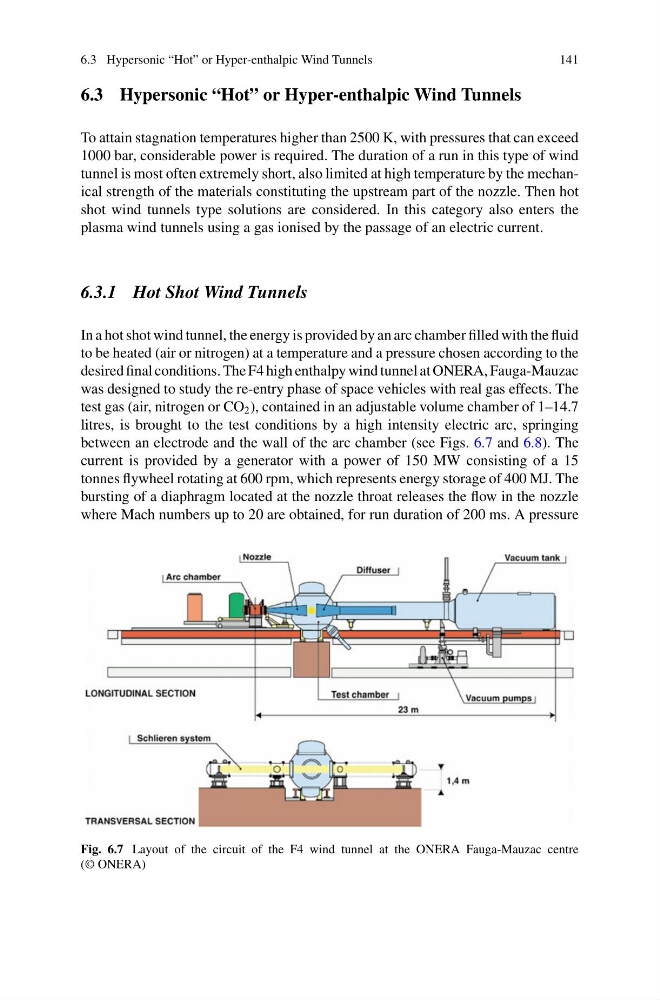
In a hot shot wind tunnel, the energy is provided by an arc chamber filled with the fluid
to be heated (air or nitrogen) at a temperature and a pressure chosen according to the
desired final conditions. The F4 high enthalpy wind tunnel at ONERA, Fauga-Mauzac
was designed to study the re-entry phase of space vehicles with real gas effects. The
test gas (air, nitrogen or CO 2 ), contained in an adjustable volume chamber of 1–14.7
litres, is brought to the test conditions by a high intensity electric arc, springing
between an electrode and the wall of the arc chamber (see Figs. 6.7 and 6.8). The
current is provided by a generator with a power of 150 MW consisting of a 15
tonnes flywheel rotating at 600 rpm, which represents energy storage of 400 MJ. The
bursting of a diaphragm located at the nozzle throat releases the flow in the nozzle
where Mach numbers up to 20 are obtained, for run duration of 200 ms. A pressure
Fig. 6.7 Layout of the circuit of the F4 wind tunnel at the ONERA Fauga-Mauzac centre
(© ONERA)
141
6.3 Hypersonic “Hot” or Hyper-enthalpic Wind Tunnels
To attain stagnation temperatures higher than 2500 K, with pressures that can exceed
1000 bar, considerable power is required. The duration of a run in this type of wind
tunnel is most often extremely short, also limited at high temperature by the mechanical strength of the materials constituting the upstream part of the nozzle. Then hot
shot wind tunnels type solutions are considered. In this category also enters the
plasma wind tunnels using a gas ionised by the passage of an electric current.
6.3.1 Hot Shot Wind Tunnels
In a hot shot wind tunnel, the energy is provided by an arc chamber filled with the fluid
to be heated (air or nitrogen) at a temperature and a pressure chosen according to the
desired final conditions. The F4 high enthalpy wind tunnel at ONERA, Fauga-Mauzac
was designed to study the re-entry phase of space vehicles with real gas effects. The
test gas (air, nitrogen or CO 2 ), contained in an adjustable volume chamber of 1–14.7
litres, is brought to the test conditions by a high intensity electric arc, springing
between an electrode and the wall of the arc chamber (see Figs. 6.7 and 6.8). The
current is provided by a generator with a power of 150 MW consisting of a 15
tonnes flywheel rotating at 600 rpm, which represents energy storage of 400 MJ. The
bursting of a diaphragm located at the nozzle throat releases the flow in the nozzle
where Mach numbers up to 20 are obtained, for run duration of 200 ms. A pressure
Fig. 6.7 Layout of the circuit of the F4 wind tunnel at the ONERA Fauga-Mauzac centre
(© ONERA)