

132
5 Supersonic Wind Tunnels
tunnel. Upstream of the nozzle throat, the heaters, corners, diffusers, compressors,
filters, are the source of disturbances in the form of entropy spots of thermal origin
or freestream disturbance which constitutes of vortices and acoustic waves. Downstream of the throat, the nozzle’s divergent wall is the main cause of disturbances due
to surface non-uniformity generating Mach waves, roughness and turbulent boundary
layer. A first condition to ensure a flow with low disturbances consists in generating
upstream conditions as undisturbed as possible using so-called silent valves. The
quiet wind tunnel of Purdue University uses a Ludwieg tube producing a very clean
flow but for a short duration. An axisymmetric nozzle is also preferred to avoid
instabilities related to perturbations produced by corners.
Thus, supersonic/hypersonic wind tunnels and shock tunnels (see Chap. 6) are
affected by high levels of upstream flow fluctuations, typically one or two orders
of magnitude higher than the real flight cases. These fluctuations are most often
dominated by the noise radiated by the turbulent boundary layers developing on the
wall of the nozzle whose turbulent structures radiate acoustic waves. Although often
weak and negligible, this noise has a considerable effect on the laminar to turbulent
transition on the models. It can also have a significant influence on other phenomena,
such as separation. Quiet wind tunnels have been developed to minimise upstream
disturbances and provide a laminar nozzle boundary layer to produce uniform flow
at supersonic and hypersonic velocities with comparable noise levels encountered in
real flight.
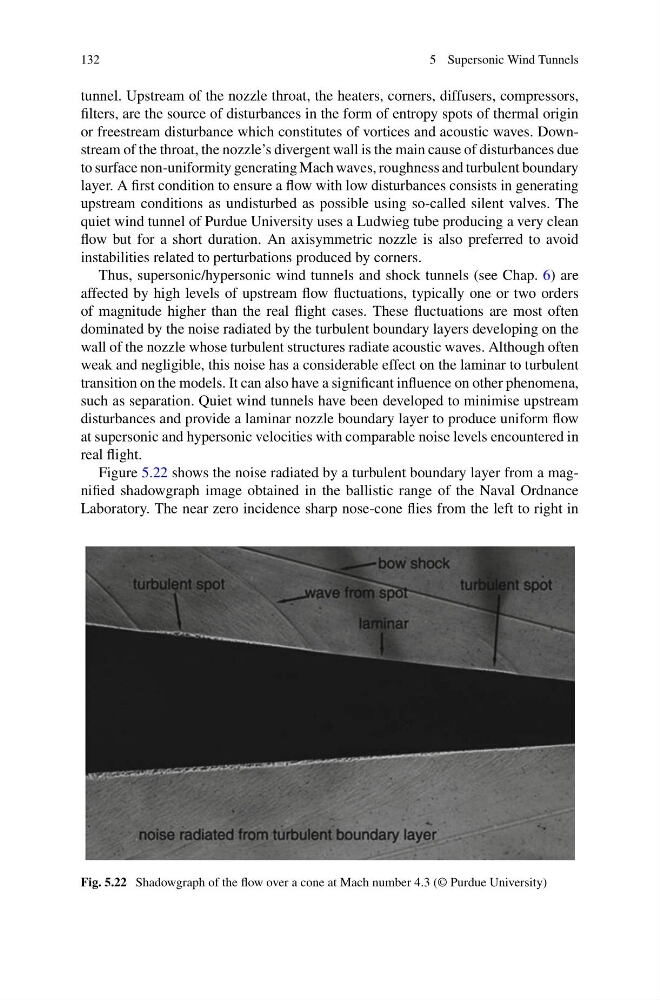
Figure 5.22 shows the noise radiated by a turbulent boundary layer from a magnified shadowgraph image obtained in the ballistic range of the Naval Ordnance
Laboratory. The near zero incidence sharp nose-cone flies from the left to right in
Fig. 5.22 Shadowgraph of the flow over a cone at Mach number 4.3 (© Purdue University)
5 Supersonic Wind Tunnels
tunnel. Upstream of the nozzle throat, the heaters, corners, diffusers, compressors,
filters, are the source of disturbances in the form of entropy spots of thermal origin
or freestream disturbance which constitutes of vortices and acoustic waves. Downstream of the throat, the nozzle’s divergent wall is the main cause of disturbances due
to surface non-uniformity generating Mach waves, roughness and turbulent boundary
layer. A first condition to ensure a flow with low disturbances consists in generating
upstream conditions as undisturbed as possible using so-called silent valves. The
quiet wind tunnel of Purdue University uses a Ludwieg tube producing a very clean
flow but for a short duration. An axisymmetric nozzle is also preferred to avoid
instabilities related to perturbations produced by corners.
Thus, supersonic/hypersonic wind tunnels and shock tunnels (see Chap. 6) are
affected by high levels of upstream flow fluctuations, typically one or two orders
of magnitude higher than the real flight cases. These fluctuations are most often
dominated by the noise radiated by the turbulent boundary layers developing on the
wall of the nozzle whose turbulent structures radiate acoustic waves. Although often
weak and negligible, this noise has a considerable effect on the laminar to turbulent
transition on the models. It can also have a significant influence on other phenomena,
such as separation. Quiet wind tunnels have been developed to minimise upstream
disturbances and provide a laminar nozzle boundary layer to produce uniform flow
at supersonic and hypersonic velocities with comparable noise levels encountered in
real flight.
Figure 5.22 shows the noise radiated by a turbulent boundary layer from a magnified shadowgraph image obtained in the ballistic range of the Naval Ordnance
Laboratory. The near zero incidence sharp nose-cone flies from the left to right in
Fig. 5.22 Shadowgraph of the flow over a cone at Mach number 4.3 (© Purdue University)