

5.1 Convergent-Divergent Nozzle
117
Due to the cooling of the air during the isentropic expansion in the nozzle, the
water vapour present in the ambient air condenses in the form of condensation shocks
resulting from the abrupt passage to the liquid state. This results in a perturbation
of the flow from the transonic regime which requires equipping the supersonic wind
tunnels with a dryer in order to eliminate humidity from the ambient air. In transonic/supersonic wind tunnels, the compressed air is desiccated (dried) before storage in the tanks. In high supersonic wind tunnels, it is also necessary to heat the air
due to the cooling produced by the adiabatic expansion in the nozzle in order to avoid
liquefaction.
5.2 Defining of the Contour of a Supersonic Nozzle
To obtain a uniform flow in the test section at the nozzle exit, it is necessary to give the
contour of the nozzle a particular shape ensuring a progressive supersonic expansion.
Such a nozzle will be called contoured. Because of its accuracy and very low cost of
calculation time, the method of characteristics is well suited for the determination
of the flow in supersonic planar or axisymmetric nozzles equipping wind tunnels or
space launcher’s rocket engines. As mentioned above, a supersonic nozzle has three
parts:
– a subsonic domain where the non-viscous part of the flow (outside the boundary
layers) is governed by a system of elliptic differential equations,
– a transonic domain,
– and a supersonic domain where the system of equations is hyperbolic and which
can be computed by the method of characteristics.
The method of characteristics is well documented in compressible aerodynamic
textbooks to which the reader is referred. Since this method cannot be applied to
the entire flow, the calculation procedure consists of adopting a particular treatment
for the transonic domain which makes it possible to determine the initial part of the
supersonic domain from which the method of characteristics is applied.
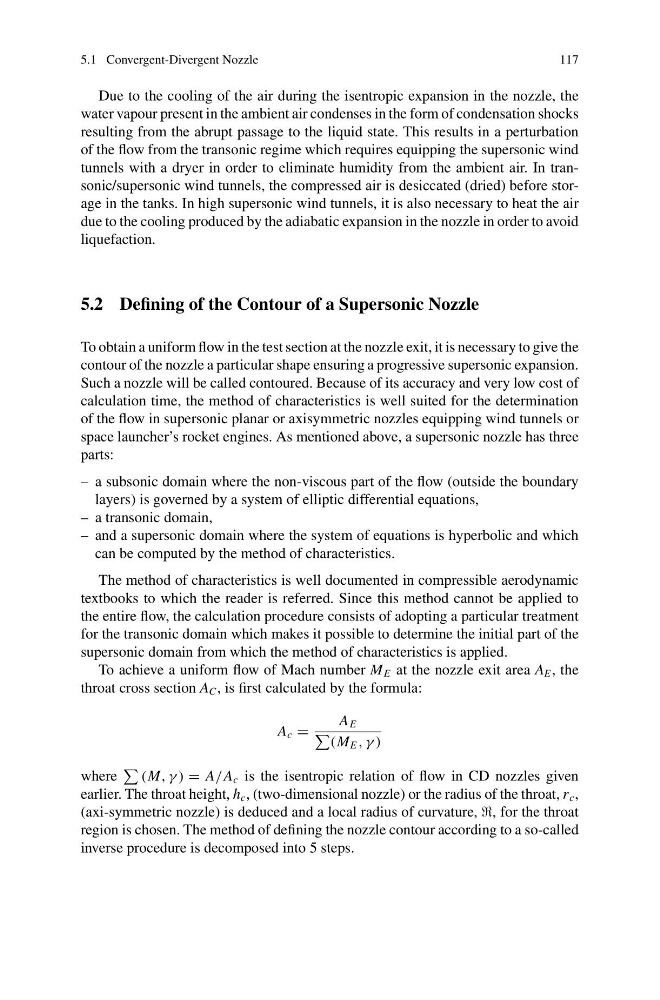
To achieve a uniform flow of Mach number M E at the nozzle exit area A E , the
throat cross section A C , is first calculated by the formula:
A c =
A E
(M E , γ )
where
(M, γ ) = A/A c is the isentropic relation of flow in CD nozzles given
earlier. The throat height, h c , (two-dimensional nozzle) or the radius of the throat, r c ,
(axi-symmetric nozzle) is deduced and a local radius of curvature, , for the throat
region is chosen. The method of defining the nozzle contour according to a so-called
inverse procedure is decomposed into 5 steps.
117
Due to the cooling of the air during the isentropic expansion in the nozzle, the
water vapour present in the ambient air condenses in the form of condensation shocks
resulting from the abrupt passage to the liquid state. This results in a perturbation
of the flow from the transonic regime which requires equipping the supersonic wind
tunnels with a dryer in order to eliminate humidity from the ambient air. In transonic/supersonic wind tunnels, the compressed air is desiccated (dried) before storage in the tanks. In high supersonic wind tunnels, it is also necessary to heat the air
due to the cooling produced by the adiabatic expansion in the nozzle in order to avoid
liquefaction.
5.2 Defining of the Contour of a Supersonic Nozzle
To obtain a uniform flow in the test section at the nozzle exit, it is necessary to give the
contour of the nozzle a particular shape ensuring a progressive supersonic expansion.
Such a nozzle will be called contoured. Because of its accuracy and very low cost of
calculation time, the method of characteristics is well suited for the determination
of the flow in supersonic planar or axisymmetric nozzles equipping wind tunnels or
space launcher’s rocket engines. As mentioned above, a supersonic nozzle has three
parts:
– a subsonic domain where the non-viscous part of the flow (outside the boundary
layers) is governed by a system of elliptic differential equations,
– a transonic domain,
– and a supersonic domain where the system of equations is hyperbolic and which
can be computed by the method of characteristics.
The method of characteristics is well documented in compressible aerodynamic
textbooks to which the reader is referred. Since this method cannot be applied to
the entire flow, the calculation procedure consists of adopting a particular treatment
for the transonic domain which makes it possible to determine the initial part of the
supersonic domain from which the method of characteristics is applied.
To achieve a uniform flow of Mach number M E at the nozzle exit area A E , the
throat cross section A C , is first calculated by the formula:
A c =
A E
(M E , γ )
where
(M, γ ) = A/A c is the isentropic relation of flow in CD nozzles given
earlier. The throat height, h c , (two-dimensional nozzle) or the radius of the throat, r c ,
(axi-symmetric nozzle) is deduced and a local radius of curvature, , for the throat
region is chosen. The method of defining the nozzle contour according to a so-called
inverse procedure is decomposed into 5 steps.