

3.2 Special Purpose Wind Tunnels
79
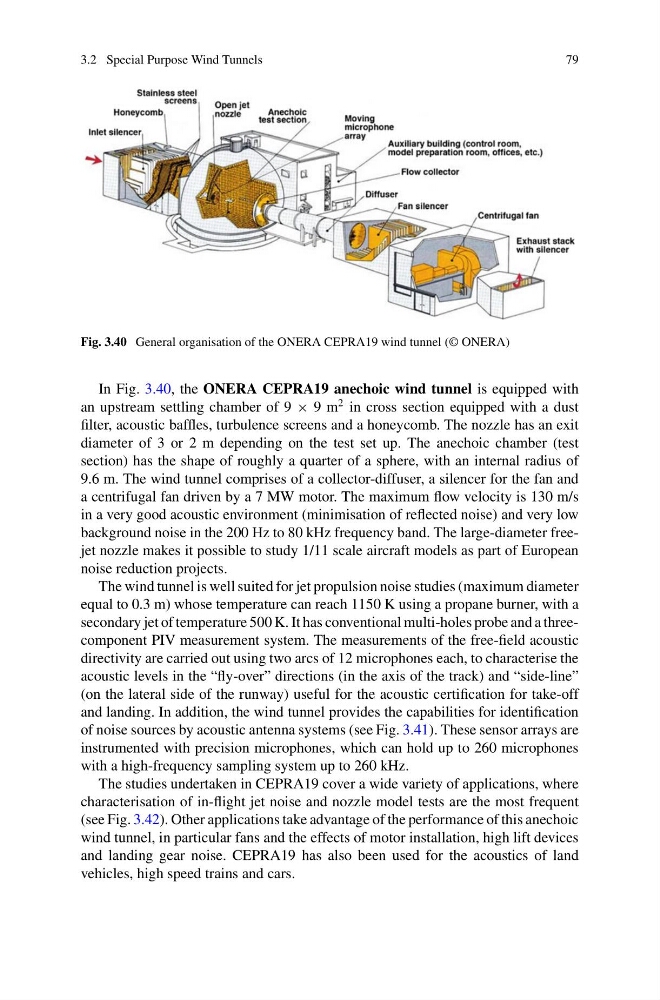
Fig. 3.40 General organisation of the ONERA CEPRA19 wind tunnel (© ONERA)
In Fig. 3.40, the ONERA CEPRA19 anechoic wind tunnel is equipped with
an upstream settling chamber of 9 × 9 m
2 in cross section equipped with a dust
filter, acoustic baffles, turbulence screens and a honeycomb. The nozzle has an exit
diameter of 3 or 2 m depending on the test set up. The anechoic chamber (test
section) has the shape of roughly a quarter of a sphere, with an internal radius of
9.6 m. The wind tunnel comprises of a collector-diffuser, a silencer for the fan and
a centrifugal fan driven by a 7 MW motor. The maximum flow velocity is 130 m/s
in a very good acoustic environment (minimisation of reflected noise) and very low
background noise in the 200 Hz to 80 kHz frequency band. The large-diameter freejet nozzle makes it possible to study 1/11 scale aircraft models as part of European
noise reduction projects.
The wind tunnel is well suited for jet propulsion noise studies (maximum diameter
equal to 0.3 m) whose temperature can reach 1150 K using a propane burner, with a
secondary jet of temperature 500 K. It has conventional multi-holes probe and a threecomponent PIV measurement system. The measurements of the free-field acoustic
directivity are carried out using two arcs of 12 microphones each, to characterise the
acoustic levels in the “fly-over” directions (in the axis of the track) and “side-line”
(on the lateral side of the runway) useful for the acoustic certification for take-off
and landing. In addition, the wind tunnel provides the capabilities for identification
of noise sources by acoustic antenna systems (see Fig. 3.41). These sensor arrays are
instrumented with precision microphones, which can hold up to 260 microphones
with a high-frequency sampling system up to 260 kHz.
The studies undertaken in CEPRA19 cover a wide variety of applications, where
characterisation of in-flight jet noise and nozzle model tests are the most frequent
(see Fig. 3.42). Other applications take advantage of the performance of this anechoic
wind tunnel, in particular fans and the effects of motor installation, high lift devices
and landing gear noise. CEPRA19 has also been used for the acoustics of land
vehicles, high speed trains and cars.
79
Fig. 3.40 General organisation of the ONERA CEPRA19 wind tunnel (© ONERA)
In Fig. 3.40, the ONERA CEPRA19 anechoic wind tunnel is equipped with
an upstream settling chamber of 9 × 9 m
2 in cross section equipped with a dust
filter, acoustic baffles, turbulence screens and a honeycomb. The nozzle has an exit
diameter of 3 or 2 m depending on the test set up. The anechoic chamber (test
section) has the shape of roughly a quarter of a sphere, with an internal radius of
9.6 m. The wind tunnel comprises of a collector-diffuser, a silencer for the fan and
a centrifugal fan driven by a 7 MW motor. The maximum flow velocity is 130 m/s
in a very good acoustic environment (minimisation of reflected noise) and very low
background noise in the 200 Hz to 80 kHz frequency band. The large-diameter freejet nozzle makes it possible to study 1/11 scale aircraft models as part of European
noise reduction projects.
The wind tunnel is well suited for jet propulsion noise studies (maximum diameter
equal to 0.3 m) whose temperature can reach 1150 K using a propane burner, with a
secondary jet of temperature 500 K. It has conventional multi-holes probe and a threecomponent PIV measurement system. The measurements of the free-field acoustic
directivity are carried out using two arcs of 12 microphones each, to characterise the
acoustic levels in the “fly-over” directions (in the axis of the track) and “side-line”
(on the lateral side of the runway) useful for the acoustic certification for take-off
and landing. In addition, the wind tunnel provides the capabilities for identification
of noise sources by acoustic antenna systems (see Fig. 3.41). These sensor arrays are
instrumented with precision microphones, which can hold up to 260 microphones
with a high-frequency sampling system up to 260 kHz.
The studies undertaken in CEPRA19 cover a wide variety of applications, where
characterisation of in-flight jet noise and nozzle model tests are the most frequent
(see Fig. 3.42). Other applications take advantage of the performance of this anechoic
wind tunnel, in particular fans and the effects of motor installation, high lift devices
and landing gear noise. CEPRA19 has also been used for the acoustics of land
vehicles, high speed trains and cars.