

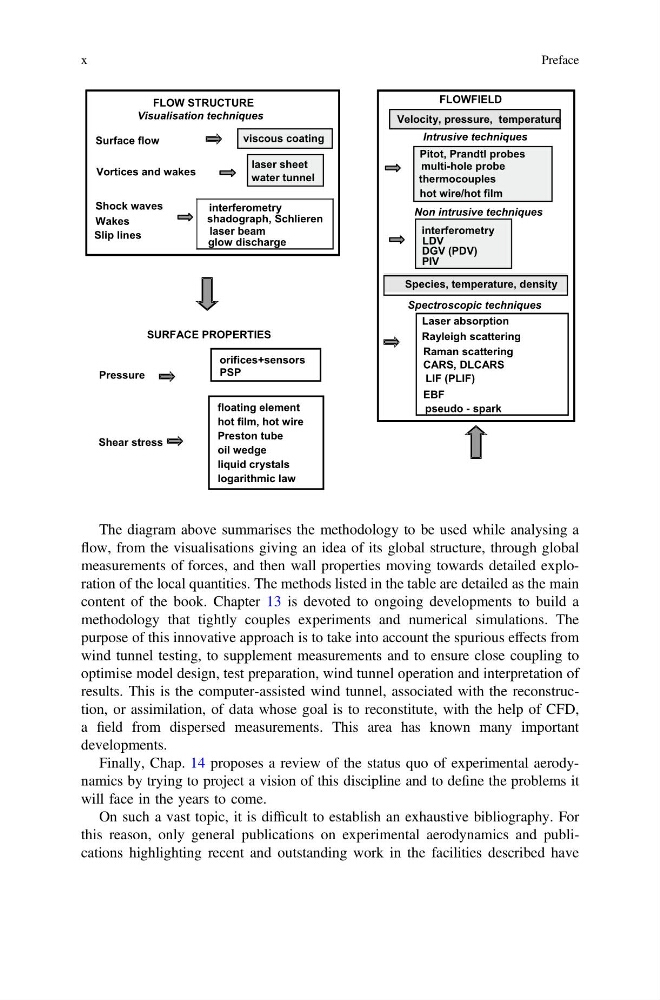
The diagram above summarises the methodology to be used while analysing a
flow, from the visualisations giving an idea of its global structure, through global
measurements of forces, and then wall properties moving towards detailed exploration of the local quantities. The methods listed in the table are detailed as the main
content of the book. Chapter 13 is devoted to ongoing developments to build a
methodology that tightly couples experiments and numerical simulations. The
purpose of this innovative approach is to take into account the spurious effects from
wind tunnel testing, to supplement measurements and to ensure close coupling to
optimise model design, test preparation, wind tunnel operation and interpretation of
results. This is the computer-assisted wind tunnel, associated with the reconstruction, or assimilation, of data whose goal is to reconstitute, with the help of CFD,
a field from dispersed measurements. This area has known many important
developments.
Finally, Chap. 14 proposes a review of the status quo of experimental aerodynamics by trying to project a vision of this discipline and to define the problems it
will face in the years to come.
On such a vast topic, it is difficult to establish an exhaustive bibliography. For
this reason, only general publications on experimental aerodynamics and publications highlighting recent and outstanding work in the facilities described have
SURFACE PROPERTIES
Pressure
Shear stress
FLOW STRUCTURE
Surface flow
viscous coating
Vortices and wakes
laser sheet
water tunnel
Visualisation techniques
FLOWFIELD
Velocity, pressure, temperature
Intrusive techniques
Pitot, Prandtl probes
thermocouples
Non intrusive techniques
LDV
DGV (PDV)
PIV
Species, temperature, density
Spectroscopic techniques
Rayleigh scattering
Raman scattering
CARS, DLCARS
LIF (PLIF)
EBF
pseudo - spark
interferometry
Laser absorption
Shock waves
Wakes
Slip lines
interferometry
shadograph, Schlieren
laser beam
glow discharge
floating element
hot film, hot wire
Preston tube
oil wedge
liquid crystals
logarithmic law
orifices+sensors
PSP
multi-hole probe
hot wire/hot film
x
Preface
flow, from the visualisations giving an idea of its global structure, through global
measurements of forces, and then wall properties moving towards detailed exploration of the local quantities. The methods listed in the table are detailed as the main
content of the book. Chapter 13 is devoted to ongoing developments to build a
methodology that tightly couples experiments and numerical simulations. The
purpose of this innovative approach is to take into account the spurious effects from
wind tunnel testing, to supplement measurements and to ensure close coupling to
optimise model design, test preparation, wind tunnel operation and interpretation of
results. This is the computer-assisted wind tunnel, associated with the reconstruction, or assimilation, of data whose goal is to reconstitute, with the help of CFD,
a field from dispersed measurements. This area has known many important
developments.
Finally, Chap. 14 proposes a review of the status quo of experimental aerodynamics by trying to project a vision of this discipline and to define the problems it
will face in the years to come.
On such a vast topic, it is difficult to establish an exhaustive bibliography. For
this reason, only general publications on experimental aerodynamics and publications highlighting recent and outstanding work in the facilities described have
SURFACE PROPERTIES
Pressure
Shear stress
FLOW STRUCTURE
Surface flow
viscous coating
Vortices and wakes
laser sheet
water tunnel
Visualisation techniques
FLOWFIELD
Velocity, pressure, temperature
Intrusive techniques
Pitot, Prandtl probes
thermocouples
Non intrusive techniques
LDV
DGV (PDV)
PIV
Species, temperature, density
Spectroscopic techniques
Rayleigh scattering
Raman scattering
CARS, DLCARS
LIF (PLIF)
EBF
pseudo - spark
interferometry
Laser absorption
Shock waves
Wakes
Slip lines
interferometry
shadograph, Schlieren
laser beam
glow discharge
floating element
hot film, hot wire
Preston tube
oil wedge
liquid crystals
logarithmic law
orifices+sensors
PSP
multi-hole probe
hot wire/hot film
x
Preface