

5.7 Processus non homog` enes
143
E
F
ξ
(Δ,N )
tn
ξ
(Δ,N )
tn−1 = x
=
(R d ) N
⎡
⎣
1≤i≤N
P
Δ
tn−1,m(x)
x
i , dy
i
⎤
⎦ F (y
1 , . . . , y
N )
= F (x
1 , . . . , x
N )
+
1≤i≤N
L tn−1,m(x) (F (x
1 , . . . , x
i−1 , .,x
i+1 , . . . , x
N ))(x
i ) Δt + o(Δt)
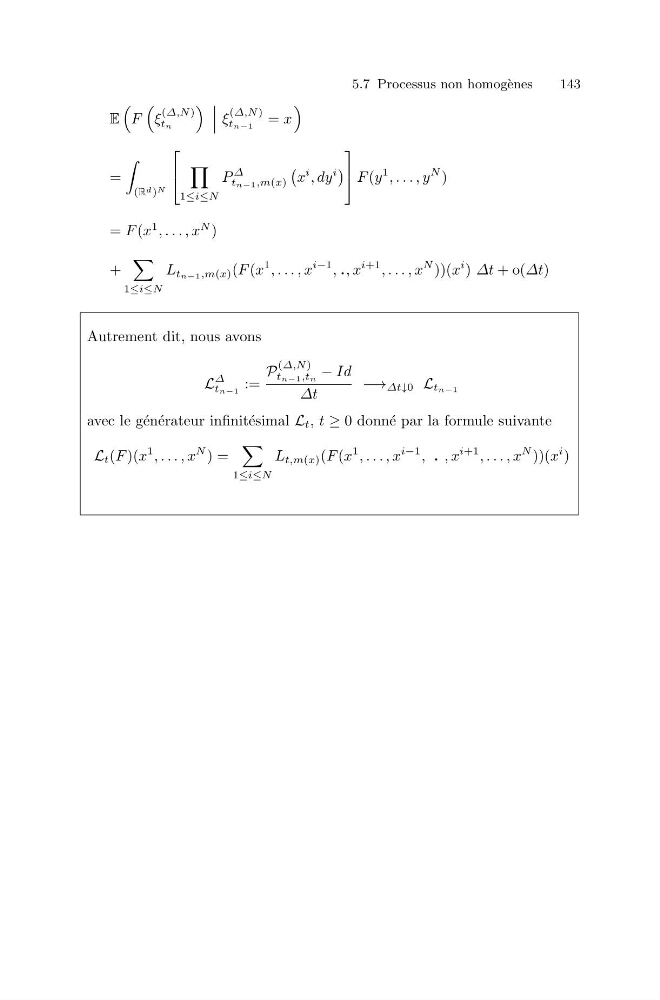
Autrement dit, nous avons
L
Δ
tn−1 :=
P
(Δ,N )
tn−1,tn − Id
Δt
−→ Δt↓0 L tn−1
avec le g´ en´ erateur infinit´ esimal L t , t ≥ 0 donn´ e par la formule suivante
L t (F )(x
1 , . . . , x
N ) =
1≤i≤N
L t,m(x) (F (x
1 , . . . , x
i−1 , . , x
i+1 , . . . , x
N ))(x
i )
143
E
F
ξ
(Δ,N )
tn
ξ
(Δ,N )
tn−1 = x
=
(R d ) N
⎡
⎣
1≤i≤N
P
Δ
tn−1,m(x)
x
i , dy
i
⎤
⎦ F (y
1 , . . . , y
N )
= F (x
1 , . . . , x
N )
+
1≤i≤N
L tn−1,m(x) (F (x
1 , . . . , x
i−1 , .,x
i+1 , . . . , x
N ))(x
i ) Δt + o(Δt)
Autrement dit, nous avons
L
Δ
tn−1 :=
P
(Δ,N )
tn−1,tn − Id
Δt
−→ Δt↓0 L tn−1
avec le g´ en´ erateur infinit´ esimal L t , t ≥ 0 donn´ e par la formule suivante
L t (F )(x
1 , . . . , x
N ) =
1≤i≤N
L t,m(x) (F (x
1 , . . . , x
i−1 , . , x
i+1 , . . . , x
N ))(x
i )