

88
T. Szidarovszky et al.
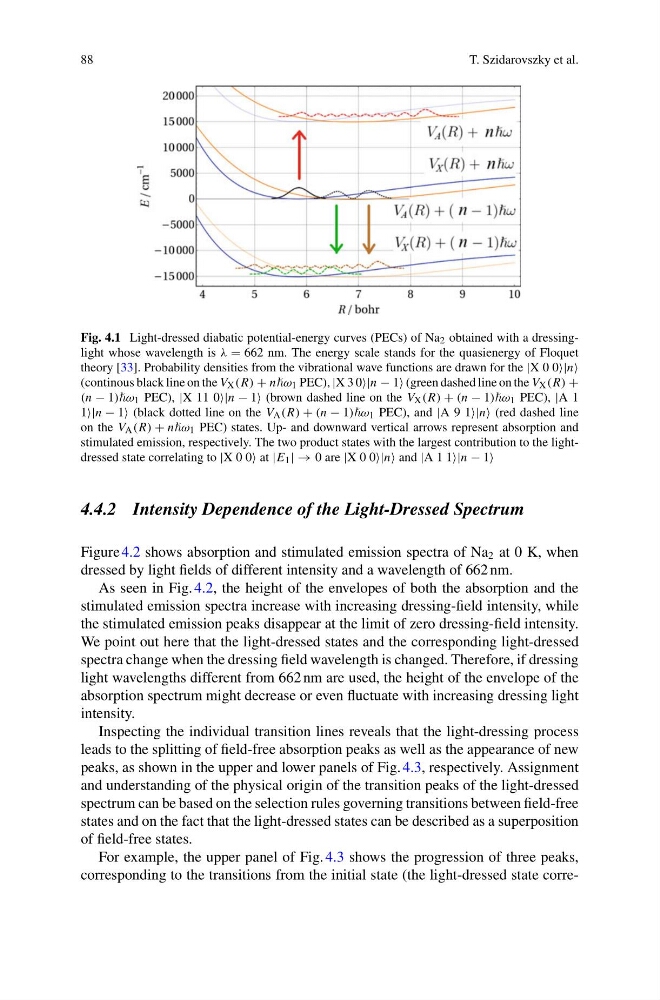
Fig. 4.1 Light-dressed diabatic potential-energy curves (PECs) of Na 2 obtained with a dressinglight whose wavelength is λ = 662 nm. The energy scale stands for the quasienergy of Floquet
theory [33]. Probability densities from the vibrational wave functions are drawn for the |X 0 0|n
(continous black line on the V X (R) + nω 1 PEC), |X 3 0|n − 1 (green dashed line on the V X (R) +
(n − 1)ω 1 PEC), |X 11 0|n − 1 (brown dashed line on the V X (R) + (n − 1)ω 1 PEC), |A 1
1|n − 1 (black dotted line on the V A (R) + (n − 1)ω 1 PEC), and |A 9 1|n (red dashed line
on the V A (R) + nω 1 PEC) states. Up- and downward vertical arrows represent absorption and
stimulated emission, respectively. The two product states with the largest contribution to the lightdressed state correlating to |X 0 0 at |E 1 | → 0 are |X 0 0|n and |A 1 1|n − 1
4.4.2 Intensity Dependence of the Light-Dressed Spectrum
Figure 4.2 shows absorption and stimulated emission spectra of Na 2 at 0 K, when
dressed by light fields of different intensity and a wavelength of 662 nm.
As seen in Fig. 4.2, the height of the envelopes of both the absorption and the
stimulated emission spectra increase with increasing dressing-field intensity, while
the stimulated emission peaks disappear at the limit of zero dressing-field intensity.
We point out here that the light-dressed states and the corresponding light-dressed
spectra change when the dressing field wavelength is changed. Therefore, if dressing
light wavelengths different from 662 nm are used, the height of the envelope of the
absorption spectrum might decrease or even fluctuate with increasing dressing light
intensity.
Inspecting the individual transition lines reveals that the light-dressing process
leads to the splitting of field-free absorption peaks as well as the appearance of new
peaks, as shown in the upper and lower panels of Fig. 4.3, respectively. Assignment
and understanding of the physical origin of the transition peaks of the light-dressed
spectrum can be based on the selection rules governing transitions between field-free
states and on the fact that the light-dressed states can be described as a superposition
of field-free states.
For example, the upper panel of Fig. 4.3 shows the progression of three peaks,
corresponding to the transitions from the initial state (the light-dressed state corre-
T. Szidarovszky et al.
Fig. 4.1 Light-dressed diabatic potential-energy curves (PECs) of Na 2 obtained with a dressinglight whose wavelength is λ = 662 nm. The energy scale stands for the quasienergy of Floquet
theory [33]. Probability densities from the vibrational wave functions are drawn for the |X 0 0|n
(continous black line on the V X (R) + nω 1 PEC), |X 3 0|n − 1 (green dashed line on the V X (R) +
(n − 1)ω 1 PEC), |X 11 0|n − 1 (brown dashed line on the V X (R) + (n − 1)ω 1 PEC), |A 1
1|n − 1 (black dotted line on the V A (R) + (n − 1)ω 1 PEC), and |A 9 1|n (red dashed line
on the V A (R) + nω 1 PEC) states. Up- and downward vertical arrows represent absorption and
stimulated emission, respectively. The two product states with the largest contribution to the lightdressed state correlating to |X 0 0 at |E 1 | → 0 are |X 0 0|n and |A 1 1|n − 1
4.4.2 Intensity Dependence of the Light-Dressed Spectrum
Figure 4.2 shows absorption and stimulated emission spectra of Na 2 at 0 K, when
dressed by light fields of different intensity and a wavelength of 662 nm.
As seen in Fig. 4.2, the height of the envelopes of both the absorption and the
stimulated emission spectra increase with increasing dressing-field intensity, while
the stimulated emission peaks disappear at the limit of zero dressing-field intensity.
We point out here that the light-dressed states and the corresponding light-dressed
spectra change when the dressing field wavelength is changed. Therefore, if dressing
light wavelengths different from 662 nm are used, the height of the envelope of the
absorption spectrum might decrease or even fluctuate with increasing dressing light
intensity.
Inspecting the individual transition lines reveals that the light-dressing process
leads to the splitting of field-free absorption peaks as well as the appearance of new
peaks, as shown in the upper and lower panels of Fig. 4.3, respectively. Assignment
and understanding of the physical origin of the transition peaks of the light-dressed
spectrum can be based on the selection rules governing transitions between field-free
states and on the fact that the light-dressed states can be described as a superposition
of field-free states.
For example, the upper panel of Fig. 4.3 shows the progression of three peaks,
corresponding to the transitions from the initial state (the light-dressed state corre-