

84
T. Szidarovszky et al.
i∂ t |(t) = ( ˆ
H mol + ˆ
W 1 (t) + ˆ
W 2 (t))|(t) = ( ˆ
H d (t) + ˆ
W 2 (t))|(t). (4.24)
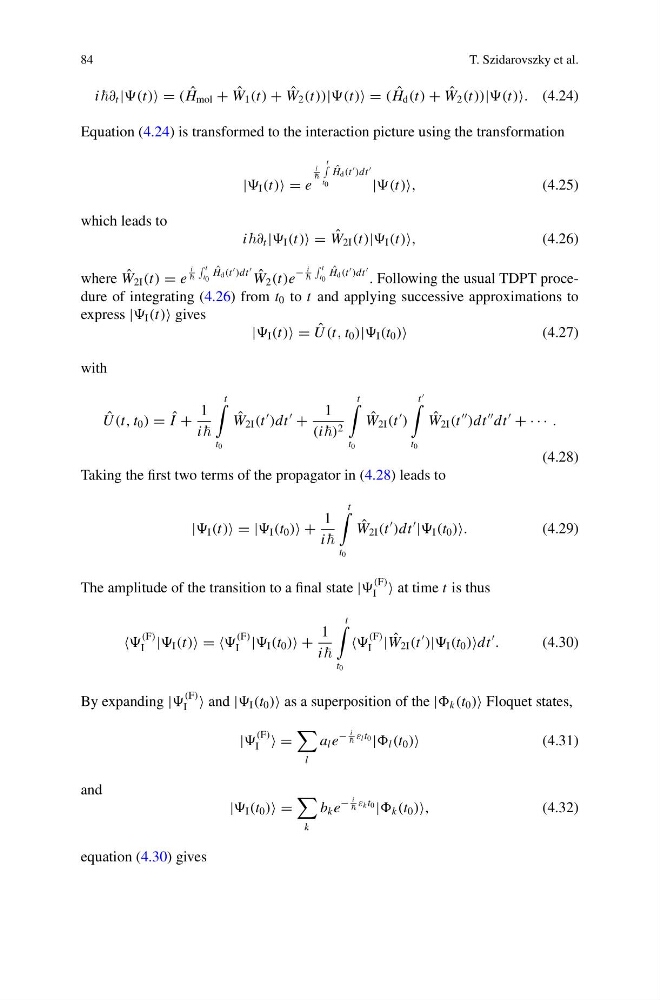
Equation (4.24) is transformed to the interaction picture using the transformation
| I (t) = e
i
t
t 0
ˆ
H d (t
)dt
|(t),
(4.25)
which leads to
i∂ t | I (t) = ˆ
W 2I (t)| I (t),
(4.26)
where ˆ
W 2I (t) = e
i
t
t 0
ˆ
H d (t
)dt
ˆ
W 2 (t)e
−
i
t
t 0
ˆ
H d (t
)dt
. Following the usual TDPT procedure of integrating (4.26) from t 0 to t and applying successive approximations to
express | I (t) gives
| I (t) = ˆ
U (t, t 0 )| I (t 0 )
(4.27)
with
ˆ
U (t, t 0 ) = ˆ
I +
1
i
t
t 0
ˆ
W 2I (t
)dt
+
1
(i) 2
t
t 0
ˆ
W 2I (t
)
t
t 0
ˆ
W 2I (t
)dt
dt
+ · · · .
(4.28)
Taking the first two terms of the propagator in (4.28) leads to
| I (t) = | I (t 0 ) +
1
i
t
t 0
ˆ
W 2I (t
)dt
| I (t 0 ).
(4.29)
The amplitude of the transition to a final state |
(F)
I at time t is thus
(F)
I | I (t) = =
(F)
I | I (t 0 ) +
1
i
t
t 0
(F)
I | ˆ
W 2I (t
)| I (t 0 )dt
.
(4.30)
By expanding |
(F)
I and | I (t 0 ) as a superposition of the | k (t 0 ) Floquet states,
|
(F)
I =
l
a l e
−
i
ε l t 0 | l (t 0 )
(4.31)
and
| I (t 0 ) =
k
b k e
−
i
ε k t 0 | k (t 0 ),
(4.32)
equation (4.30) gives
T. Szidarovszky et al.
i∂ t |(t) = ( ˆ
H mol + ˆ
W 1 (t) + ˆ
W 2 (t))|(t) = ( ˆ
H d (t) + ˆ
W 2 (t))|(t). (4.24)
Equation (4.24) is transformed to the interaction picture using the transformation
| I (t) = e
i
t
t 0
ˆ
H d (t
)dt
|(t),
(4.25)
which leads to
i∂ t | I (t) = ˆ
W 2I (t)| I (t),
(4.26)
where ˆ
W 2I (t) = e
i
t
t 0
ˆ
H d (t
)dt
ˆ
W 2 (t)e
−
i
t
t 0
ˆ
H d (t
)dt
. Following the usual TDPT procedure of integrating (4.26) from t 0 to t and applying successive approximations to
express | I (t) gives
| I (t) = ˆ
U (t, t 0 )| I (t 0 )
(4.27)
with
ˆ
U (t, t 0 ) = ˆ
I +
1
i
t
t 0
ˆ
W 2I (t
)dt
+
1
(i) 2
t
t 0
ˆ
W 2I (t
)
t
t 0
ˆ
W 2I (t
)dt
dt
+ · · · .
(4.28)
Taking the first two terms of the propagator in (4.28) leads to
| I (t) = | I (t 0 ) +
1
i
t
t 0
ˆ
W 2I (t
)dt
| I (t 0 ).
(4.29)
The amplitude of the transition to a final state |
(F)
I at time t is thus
(F)
I | I (t) = =
(F)
I | I (t 0 ) +
1
i
t
t 0
(F)
I | ˆ
W 2I (t
)| I (t 0 )dt
.
(4.30)
By expanding |
(F)
I and | I (t 0 ) as a superposition of the | k (t 0 ) Floquet states,
|
(F)
I =
l
a l e
−
i
ε l t 0 | l (t 0 )
(4.31)
and
| I (t 0 ) =
k
b k e
−
i
ε k t 0 | k (t 0 ),
(4.32)
equation (4.30) gives