

82
T. Szidarovszky et al.
where we adopt the notation called “Floquet-state nomenclature” [33], in which
t|n = e
inω 1 t and ω 1 = 2π/T with | k (t + T ) = | k (t).
4.2.1.2 Simplifying Assumptions
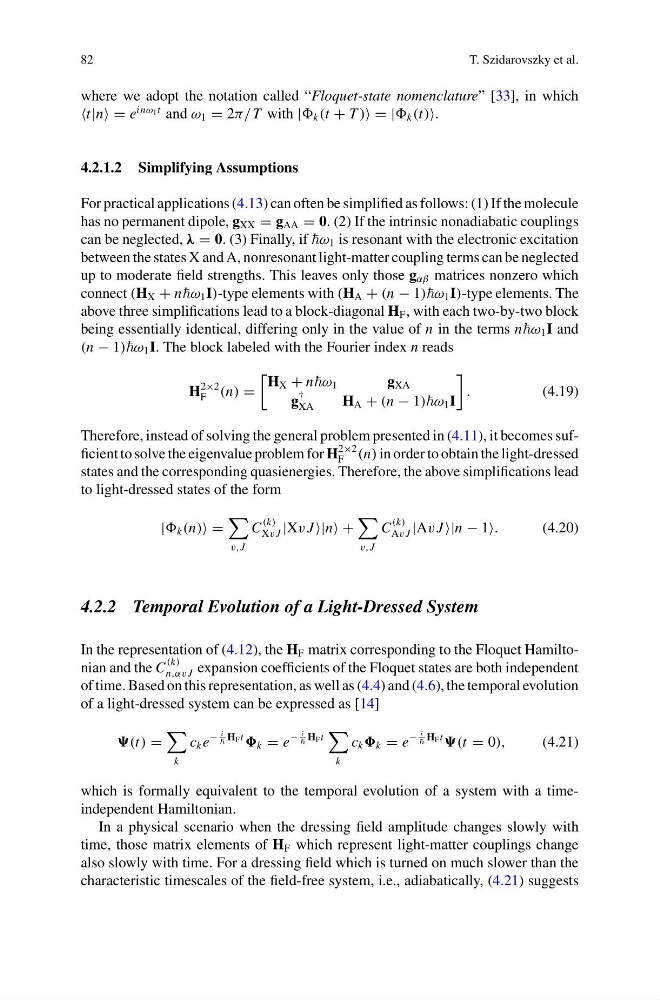
For practical applications (4.13) can often be simplified as follows: (1) If the molecule
has no permanent dipole, g XX = g AA = 0. (2) If the intrinsic nonadiabatic couplings
can be neglected, λ = 0. (3) Finally, if ω 1 is resonant with the electronic excitation
between the states X and A, nonresonant light-matter coupling terms can be neglected
up to moderate field strengths. This leaves only those g αβ matrices nonzero which
connect (H X + nω 1 I)-type elements with (H A + (n − 1)ω 1 I)-type elements. The
above three simplifications lead to a block-diagonal H F , with each two-by-two block
being essentially identical, differing only in the value of n in the terms nω 1 I and
(n − 1)ω 1 I. The block labeled with the Fourier index n reads
H
2×2
F (n) =
H X + nω 1
g XA
g
†
XA
H A + (n − 1)ω 1 I
.
(4.19)
Therefore, instead of solving the general problem presented in (4.11), it becomes sufficient to solve the eigenvalue problem for H
2×2
F (n) in order to obtain the light-dressed
states and the corresponding quasienergies. Therefore, the above simplifications lead
to light-dressed states of the form
| k (n) =
v,J
C
(k)
Xv J |Xv J |n +
v,J
C
(k)
Av J |Av J |n − 1.
(4.20)
4.2.2 Temporal Evolution of a Light-Dressed System
In the representation of (4.12), the H F matrix corresponding to the Floquet Hamiltonian and the C
(k)
n,αv J expansion coefficients of the Floquet states are both independent
of time. Based on this representation, as well as (4.4) and (4.6), the temporal evolution
of a light-dressed system can be expressed as [14]
(t) =
k
c k e
−
i
H F t
k = e
−
i
H F t
k
c k k = e
−
i
H F t
(t = 0),
(4.21)
which is formally equivalent to the temporal evolution of a system with a timeindependent Hamiltonian.
In a physical scenario when the dressing field amplitude changes slowly with
time, those matrix elements of H F which represent light-matter couplings change
also slowly with time. For a dressing field which is turned on much slower than the
characteristic timescales of the field-free system, i.e., adiabatically, (4.21) suggests
T. Szidarovszky et al.
where we adopt the notation called “Floquet-state nomenclature” [33], in which
t|n = e
inω 1 t and ω 1 = 2π/T with | k (t + T ) = | k (t).
4.2.1.2 Simplifying Assumptions
For practical applications (4.13) can often be simplified as follows: (1) If the molecule
has no permanent dipole, g XX = g AA = 0. (2) If the intrinsic nonadiabatic couplings
can be neglected, λ = 0. (3) Finally, if ω 1 is resonant with the electronic excitation
between the states X and A, nonresonant light-matter coupling terms can be neglected
up to moderate field strengths. This leaves only those g αβ matrices nonzero which
connect (H X + nω 1 I)-type elements with (H A + (n − 1)ω 1 I)-type elements. The
above three simplifications lead to a block-diagonal H F , with each two-by-two block
being essentially identical, differing only in the value of n in the terms nω 1 I and
(n − 1)ω 1 I. The block labeled with the Fourier index n reads
H
2×2
F (n) =
H X + nω 1
g XA
g
†
XA
H A + (n − 1)ω 1 I
.
(4.19)
Therefore, instead of solving the general problem presented in (4.11), it becomes sufficient to solve the eigenvalue problem for H
2×2
F (n) in order to obtain the light-dressed
states and the corresponding quasienergies. Therefore, the above simplifications lead
to light-dressed states of the form
| k (n) =
v,J
C
(k)
Xv J |Xv J |n +
v,J
C
(k)
Av J |Av J |n − 1.
(4.20)
4.2.2 Temporal Evolution of a Light-Dressed System
In the representation of (4.12), the H F matrix corresponding to the Floquet Hamiltonian and the C
(k)
n,αv J expansion coefficients of the Floquet states are both independent
of time. Based on this representation, as well as (4.4) and (4.6), the temporal evolution
of a light-dressed system can be expressed as [14]
(t) =
k
c k e
−
i
H F t
k = e
−
i
H F t
k
c k k = e
−
i
H F t
(t = 0),
(4.21)
which is formally equivalent to the temporal evolution of a system with a timeindependent Hamiltonian.
In a physical scenario when the dressing field amplitude changes slowly with
time, those matrix elements of H F which represent light-matter couplings change
also slowly with time. For a dressing field which is turned on much slower than the
characteristic timescales of the field-free system, i.e., adiabatically, (4.21) suggests