

64
S. Kerbstadt et al.
packet oscillating along the radial coordinate [6, 74–76]. Rydberg wave packets have
long been investigated by theory [74, 75] and in experiments [76–79]. In addition,
Rydberg atoms are anticipated for future technologies, e.g., as media for data storage
and retrieval [80, 81] or as quantum simulators [82, 83].
Here, we employ (3ω:4ω) PLP pulse sequences (cf. Fig. 3.3e) to perform shaperbased two-color pump-probe studies on the dynamics of multiple Rydberg wave
packets created by multiphoton excitation of K atoms. The experimental strategy
is presented in Fig. 3.11a. The red pulse serves as a pump to create the Rydberg
wave packets by three-photon excitation. The blue pulse is time-delayed and serves
as a probe to map the dynamics into the continuum via one-photon ionization.
The center frequencies of the bichromatic field are chosen to be ω 1 ≈ 2.125 rad/fs
(λ 1 = 886 nm) and ω 2 ≈
4
3
ω 1 = 2.850 rad/fs (λ 2 = 661 nm). Both colors have a
spectral width of ω 1 = ω 2 ≈ 0.05 rad/fs corresponding to a pulse duration
of t 1 = t 2 ≈ 55 fs. Linear spectral phase modulation of the blue band with
ϕ 2 (ω) = τ · (ω − ω 2 ) temporally advances (τ > 0) or delays (τ < 0) the blue relatively to the low-frequency (red) pulse, in order to create phase-locked bichromatic
pulse sequences for the two-color pump-probe studies. VMI images are measured
as a function of τ varied in the interval τ = −100, . . . , 1000 fs with a step size of
τ = 10 fs.
According to the dipole selection rule = ±1 (cf. Sect. 3.3.1), the red pump
pulse addresses the np-series via two different three-photon excitation pathways
proceeding via the intermediate resonances 5s and 3d. In addition, the n f -series is
addressed by a single three-photon pathway via the 3d-resonance. Therefore, the
excited Rydberg wave packets can be described as a superposition of wave functions
from the np- and n f -series
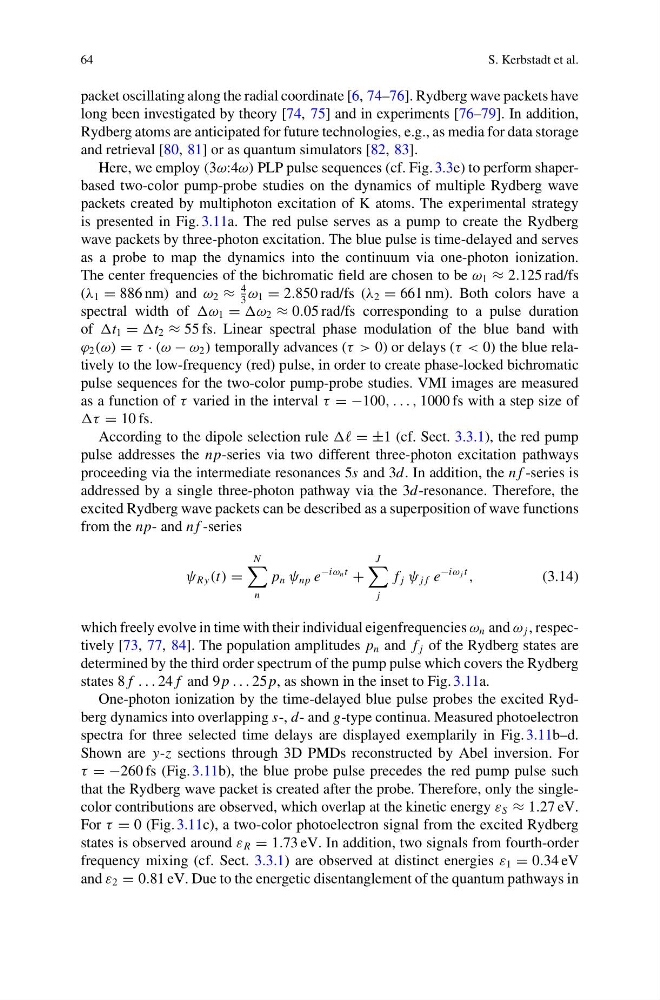
ψ Ry (t) =
N
n
p n ψ np e
−iω n t
+
J
j
f j ψ j f e
−iω j t
,
(3.14)
which freely evolve in time with their individual eigenfrequencies ω n and ω j , respectively [73, 77, 84]. The population amplitudes p n and f j of the Rydberg states are
determined by the third order spectrum of the pump pulse which covers the Rydberg
states 8 f . . . 24 f and 9 p . . . 25 p, as shown in the inset to Fig. 3.11a.
One-photon ionization by the time-delayed blue pulse probes the excited Rydberg dynamics into overlapping s-, d- and g-type continua. Measured photoelectron
spectra for three selected time delays are displayed exemplarily in Fig. 3.11b–d.
Shown are y-z sections through 3D PMDs reconstructed by Abel inversion. For
τ = −260 fs (Fig. 3.11b), the blue probe pulse precedes the red pump pulse such
that the Rydberg wave packet is created after the probe. Therefore, only the singlecolor contributions are observed, which overlap at the kinetic energy ε S ≈ 1.27 eV.
For τ = 0 (Fig. 3.11c), a two-color photoelectron signal from the excited Rydberg
states is observed around ε R = 1.73 eV. In addition, two signals from fourth-order
frequency mixing (cf. Sect. 3.3.1) are observed at distinct energies ε 1 = 0.34 eV
and ε 2 = 0.81 eV. Due to the energetic disentanglement of the quantum pathways in
S. Kerbstadt et al.
packet oscillating along the radial coordinate [6, 74–76]. Rydberg wave packets have
long been investigated by theory [74, 75] and in experiments [76–79]. In addition,
Rydberg atoms are anticipated for future technologies, e.g., as media for data storage
and retrieval [80, 81] or as quantum simulators [82, 83].
Here, we employ (3ω:4ω) PLP pulse sequences (cf. Fig. 3.3e) to perform shaperbased two-color pump-probe studies on the dynamics of multiple Rydberg wave
packets created by multiphoton excitation of K atoms. The experimental strategy
is presented in Fig. 3.11a. The red pulse serves as a pump to create the Rydberg
wave packets by three-photon excitation. The blue pulse is time-delayed and serves
as a probe to map the dynamics into the continuum via one-photon ionization.
The center frequencies of the bichromatic field are chosen to be ω 1 ≈ 2.125 rad/fs
(λ 1 = 886 nm) and ω 2 ≈
4
3
ω 1 = 2.850 rad/fs (λ 2 = 661 nm). Both colors have a
spectral width of ω 1 = ω 2 ≈ 0.05 rad/fs corresponding to a pulse duration
of t 1 = t 2 ≈ 55 fs. Linear spectral phase modulation of the blue band with
ϕ 2 (ω) = τ · (ω − ω 2 ) temporally advances (τ > 0) or delays (τ < 0) the blue relatively to the low-frequency (red) pulse, in order to create phase-locked bichromatic
pulse sequences for the two-color pump-probe studies. VMI images are measured
as a function of τ varied in the interval τ = −100, . . . , 1000 fs with a step size of
τ = 10 fs.
According to the dipole selection rule = ±1 (cf. Sect. 3.3.1), the red pump
pulse addresses the np-series via two different three-photon excitation pathways
proceeding via the intermediate resonances 5s and 3d. In addition, the n f -series is
addressed by a single three-photon pathway via the 3d-resonance. Therefore, the
excited Rydberg wave packets can be described as a superposition of wave functions
from the np- and n f -series
ψ Ry (t) =
N
n
p n ψ np e
−iω n t
+
J
j
f j ψ j f e
−iω j t
,
(3.14)
which freely evolve in time with their individual eigenfrequencies ω n and ω j , respectively [73, 77, 84]. The population amplitudes p n and f j of the Rydberg states are
determined by the third order spectrum of the pump pulse which covers the Rydberg
states 8 f . . . 24 f and 9 p . . . 25 p, as shown in the inset to Fig. 3.11a.
One-photon ionization by the time-delayed blue pulse probes the excited Rydberg dynamics into overlapping s-, d- and g-type continua. Measured photoelectron
spectra for three selected time delays are displayed exemplarily in Fig. 3.11b–d.
Shown are y-z sections through 3D PMDs reconstructed by Abel inversion. For
τ = −260 fs (Fig. 3.11b), the blue probe pulse precedes the red pump pulse such
that the Rydberg wave packet is created after the probe. Therefore, only the singlecolor contributions are observed, which overlap at the kinetic energy ε S ≈ 1.27 eV.
For τ = 0 (Fig. 3.11c), a two-color photoelectron signal from the excited Rydberg
states is observed around ε R = 1.73 eV. In addition, two signals from fourth-order
frequency mixing (cf. Sect. 3.3.1) are observed at distinct energies ε 1 = 0.34 eV
and ε 2 = 0.81 eV. Due to the energetic disentanglement of the quantum pathways in