

48
S. Kerbstadt et al.
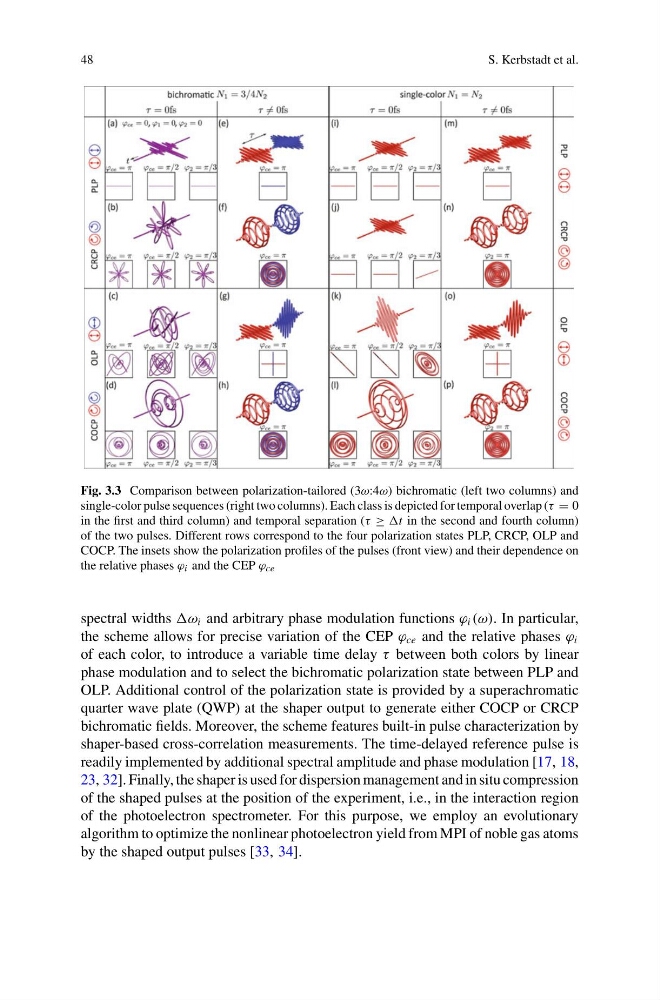
Fig. 3.3 Comparison between polarization-tailored (3ω:4ω) bichromatic (left two columns) and
single-color pulse sequences (right two columns). Each class is depicted for temporal overlap (τ = 0
in the first and third column) and temporal separation (τ ≥ t in the second and fourth column)
of the two pulses. Different rows correspond to the four polarization states PLP, CRCP, OLP and
COCP. The insets show the polarization profiles of the pulses (front view) and their dependence on
the relative phases ϕ i and the CEP ϕ ce
spectral widths ω i and arbitrary phase modulation functions ϕ i (ω). In particular,
the scheme allows for precise variation of the CEP ϕ ce and the relative phases ϕ i
of each color, to introduce a variable time delay τ between both colors by linear
phase modulation and to select the bichromatic polarization state between PLP and
OLP. Additional control of the polarization state is provided by a superachromatic
quarter wave plate (QWP) at the shaper output to generate either COCP or CRCP
bichromatic fields. Moreover, the scheme features built-in pulse characterization by
shaper-based cross-correlation measurements. The time-delayed reference pulse is
readily implemented by additional spectral amplitude and phase modulation [17, 18,
23, 32]. Finally, the shaper is used for dispersion management and in situ compression
of the shaped pulses at the position of the experiment, i.e., in the interaction region
of the photoelectron spectrometer. For this purpose, we employ an evolutionary
algorithm to optimize the nonlinear photoelectron yield from MPI of noble gas atoms
by the shaped output pulses [33, 34].
S. Kerbstadt et al.
Fig. 3.3 Comparison between polarization-tailored (3ω:4ω) bichromatic (left two columns) and
single-color pulse sequences (right two columns). Each class is depicted for temporal overlap (τ = 0
in the first and third column) and temporal separation (τ ≥ t in the second and fourth column)
of the two pulses. Different rows correspond to the four polarization states PLP, CRCP, OLP and
COCP. The insets show the polarization profiles of the pulses (front view) and their dependence on
the relative phases ϕ i and the CEP ϕ ce
spectral widths ω i and arbitrary phase modulation functions ϕ i (ω). In particular,
the scheme allows for precise variation of the CEP ϕ ce and the relative phases ϕ i
of each color, to introduce a variable time delay τ between both colors by linear
phase modulation and to select the bichromatic polarization state between PLP and
OLP. Additional control of the polarization state is provided by a superachromatic
quarter wave plate (QWP) at the shaper output to generate either COCP or CRCP
bichromatic fields. Moreover, the scheme features built-in pulse characterization by
shaper-based cross-correlation measurements. The time-delayed reference pulse is
readily implemented by additional spectral amplitude and phase modulation [17, 18,
23, 32]. Finally, the shaper is used for dispersion management and in situ compression
of the shaped pulses at the position of the experiment, i.e., in the interaction region
of the photoelectron spectrometer. For this purpose, we employ an evolutionary
algorithm to optimize the nonlinear photoelectron yield from MPI of noble gas atoms
by the shaped output pulses [33, 34].