

3 Bichromatic Control of Free Electron Wave Packets
47
3.2.1 Bichromatic Polarization Shaping
Traditional 4 f polarization pulse shaping based on a dual-layer liquid crystal spatial
light modulator (LC-SLM) in the Fourier plane of a 4 f setup [26–29] enables either
independent amplitude and phase or phase and polarization pulse shaping. However,
the combination of all three modes is generally not supported. To overcome this
limitation, several schemes have been devised which extend conventional 4 f pulse
shapers and enable full vector control over the electric field of ultrashort laser pulses
[12–15, 30, 31].
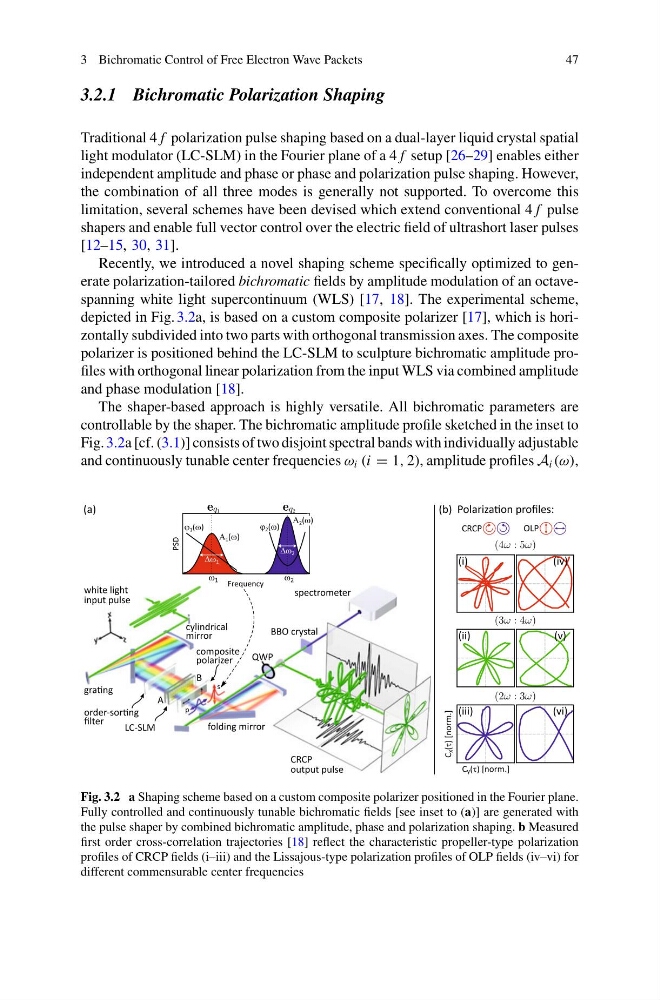
Recently, we introduced a novel shaping scheme specifically optimized to generate polarization-tailored bichromatic fields by amplitude modulation of an octavespanning white light supercontinuum (WLS) [17, 18]. The experimental scheme,
depicted in Fig. 3.2a, is based on a custom composite polarizer [17], which is horizontally subdivided into two parts with orthogonal transmission axes. The composite
polarizer is positioned behind the LC-SLM to sculpture bichromatic amplitude profiles with orthogonal linear polarization from the input WLS via combined amplitude
and phase modulation [18].
The shaper-based approach is highly versatile. All bichromatic parameters are
controllable by the shaper. The bichromatic amplitude profile sketched in the inset to
Fig. 3.2a [cf. (3.1)] consists of two disjoint spectral bands with individually adjustable
and continuously tunable center frequencies ω i (i = 1, 2), amplitude profiles A i (ω),
Fig. 3.2 a Shaping scheme based on a custom composite polarizer positioned in the Fourier plane.
Fully controlled and continuously tunable bichromatic fields [see inset to (a)] are generated with
the pulse shaper by combined bichromatic amplitude, phase and polarization shaping. b Measured
first order cross-correlation trajectories [18] reflect the characteristic propeller-type polarization
profiles of CRCP fields (i–iii) and the Lissajous-type polarization profiles of OLP fields (iv–vi) for
different commensurable center frequencies
47
3.2.1 Bichromatic Polarization Shaping
Traditional 4 f polarization pulse shaping based on a dual-layer liquid crystal spatial
light modulator (LC-SLM) in the Fourier plane of a 4 f setup [26–29] enables either
independent amplitude and phase or phase and polarization pulse shaping. However,
the combination of all three modes is generally not supported. To overcome this
limitation, several schemes have been devised which extend conventional 4 f pulse
shapers and enable full vector control over the electric field of ultrashort laser pulses
[12–15, 30, 31].
Recently, we introduced a novel shaping scheme specifically optimized to generate polarization-tailored bichromatic fields by amplitude modulation of an octavespanning white light supercontinuum (WLS) [17, 18]. The experimental scheme,
depicted in Fig. 3.2a, is based on a custom composite polarizer [17], which is horizontally subdivided into two parts with orthogonal transmission axes. The composite
polarizer is positioned behind the LC-SLM to sculpture bichromatic amplitude profiles with orthogonal linear polarization from the input WLS via combined amplitude
and phase modulation [18].
The shaper-based approach is highly versatile. All bichromatic parameters are
controllable by the shaper. The bichromatic amplitude profile sketched in the inset to
Fig. 3.2a [cf. (3.1)] consists of two disjoint spectral bands with individually adjustable
and continuously tunable center frequencies ω i (i = 1, 2), amplitude profiles A i (ω),
Fig. 3.2 a Shaping scheme based on a custom composite polarizer positioned in the Fourier plane.
Fully controlled and continuously tunable bichromatic fields [see inset to (a)] are generated with
the pulse shaper by combined bichromatic amplitude, phase and polarization shaping. b Measured
first order cross-correlation trajectories [18] reflect the characteristic propeller-type polarization
profiles of CRCP fields (i–iii) and the Lissajous-type polarization profiles of OLP fields (iv–vi) for
different commensurable center frequencies