

36
Y. Zhang et al.
0
0.1
0.2
0.3
0.4
0.5
Field strength parameter (a)
0
10
20
30
40
50
60
70
80
90
Angle of molecular axis and field ( )
-0.8
-0
.8
-0
.8
-0.6
-0
.6
- 0 .6
-0 .4
- 0 .4
- 0 .4
-0 .4
-0 .2
- 0 . 2
- 0 .2
-0 .2
0
0
0
0
0 .2
-1
-0.8
-0.6
-0.4
-0.2
0
0.2
0.4
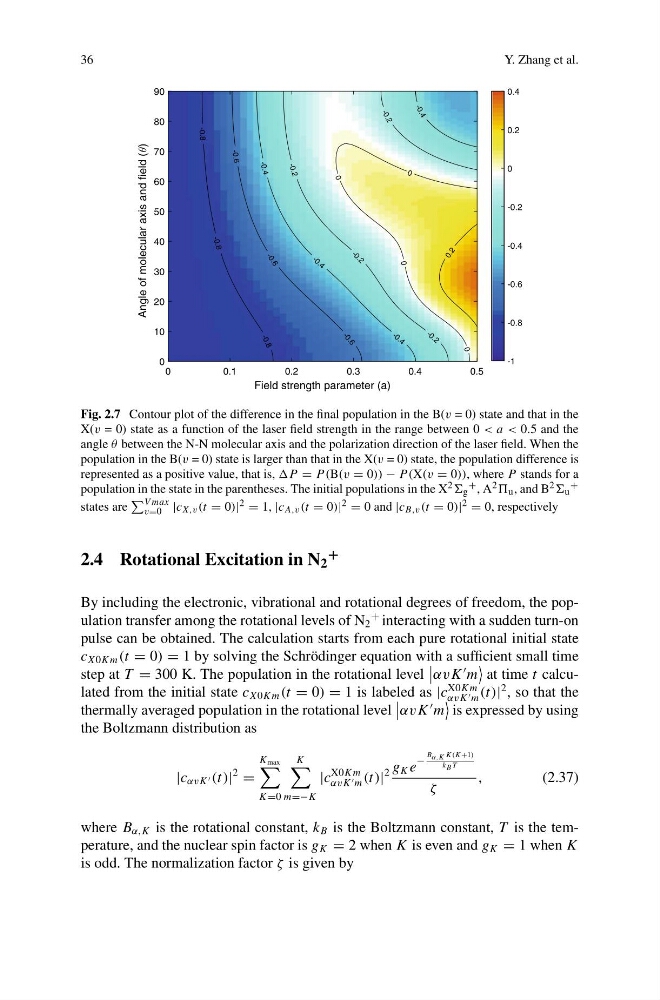
Fig. 2.7 Contour plot of the difference in the final population in the B(v = 0) state and that in the
X(v = 0) state as a function of the laser field strength in the range between 0 < a < 0.5 and the
angle θ between the N-N molecular axis and the polarization direction of the laser field. When the
population in the B(v = 0) state is larger than that in the X(v = 0) state, the population difference is
represented as a positive value, that is, = P(B(v = 0)) − P(X(v = 0)), where P stands for a
population in the state in the parentheses. The initial populations in the X 2 g
+ , A 2 u , and B 2 u
+
states are
V max
v=0 |c X,v (t = 0)| 2 = 1, |c A,v (t = 0)| 2 = 0 and |c B,v (t = 0)| 2 = 0, respectively
2.4 Rotational Excitation in N 2
+
By including the electronic, vibrational and rotational degrees of freedom, the population transfer among the rotational levels of N 2
+ interacting with a sudden turn-on
pulse can be obtained. The calculation starts from each pure rotational initial state
c X 0K m (t = 0) = 1 by solving the Schrödinger equation with a sufficient small time
step at T = 300 K. The population in the rotational level
αvK
m
at time t calculated from the initial state c X 0K m (t = 0) = 1 is labeled as |c
X0K m
αvK m (t)|
2 , so that the
thermally averaged population in the rotational level
αvK
m
is expressed by using
the Boltzmann distribution as
|c αvK (t)|
2
=
K max
K =0
K
m=−K
|c
X0K m
αvK m (t)|
2 g K e
−
B α,K K (K +1)
k B T
ζ
,
(2.37)
where B α,K is the rotational constant, k B is the Boltzmann constant, T is the temperature, and the nuclear spin factor is g K = 2 when K is even and g K = 1 when K
is odd. The normalization factor ζ is given by
Y. Zhang et al.
0
0.1
0.2
0.3
0.4
0.5
Field strength parameter (a)
0
10
20
30
40
50
60
70
80
90
Angle of molecular axis and field ( )
-0.8
-0
.8
-0
.8
-0.6
-0
.6
- 0 .6
-0 .4
- 0 .4
- 0 .4
-0 .4
-0 .2
- 0 . 2
- 0 .2
-0 .2
0
0
0
0
0 .2
-1
-0.8
-0.6
-0.4
-0.2
0
0.2
0.4
Fig. 2.7 Contour plot of the difference in the final population in the B(v = 0) state and that in the
X(v = 0) state as a function of the laser field strength in the range between 0 < a < 0.5 and the
angle θ between the N-N molecular axis and the polarization direction of the laser field. When the
population in the B(v = 0) state is larger than that in the X(v = 0) state, the population difference is
represented as a positive value, that is, = P(B(v = 0)) − P(X(v = 0)), where P stands for a
population in the state in the parentheses. The initial populations in the X 2 g
+ , A 2 u , and B 2 u
+
states are
V max
v=0 |c X,v (t = 0)| 2 = 1, |c A,v (t = 0)| 2 = 0 and |c B,v (t = 0)| 2 = 0, respectively
2.4 Rotational Excitation in N 2
+
By including the electronic, vibrational and rotational degrees of freedom, the population transfer among the rotational levels of N 2
+ interacting with a sudden turn-on
pulse can be obtained. The calculation starts from each pure rotational initial state
c X 0K m (t = 0) = 1 by solving the Schrödinger equation with a sufficient small time
step at T = 300 K. The population in the rotational level
αvK
m
at time t calculated from the initial state c X 0K m (t = 0) = 1 is labeled as |c
X0K m
αvK m (t)|
2 , so that the
thermally averaged population in the rotational level
αvK
m
is expressed by using
the Boltzmann distribution as
|c αvK (t)|
2
=
K max
K =0
K
m=−K
|c
X0K m
αvK m (t)|
2 g K e
−
B α,K K (K +1)
k B T
ζ
,
(2.37)
where B α,K is the rotational constant, k B is the Boltzmann constant, T is the temperature, and the nuclear spin factor is g K = 2 when K is even and g K = 1 when K
is odd. The normalization factor ζ is given by