

2 Mechanism of Population Inversion in N 2
+
35
0
5
10
15
20
25
30
35
40
45
50
0
0.05
Contribution from photon dressed state
in B(0) Floquet state
Time (fs)
-39
0
39
Electric field (GV/m)
0.9
0.95
1
(a)
(b)
Laser field
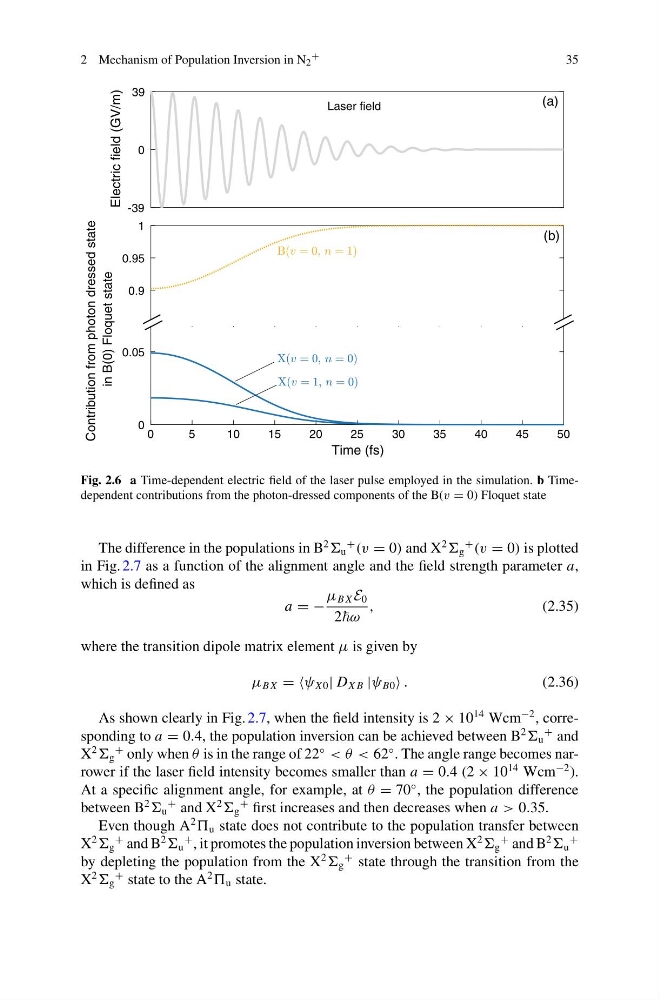
Fig. 2.6 a Time-dependent electric field of the laser pulse employed in the simulation. b Timedependent contributions from the photon-dressed components of the B(v = 0) Floquet state
The difference in the populations in B
2
u
+
(v = 0) and X
2
g
+
(v = 0) is plotted
in Fig. 2.7 as a function of the alignment angle and the field strength parameter a,
which is defined as
a = −
μ B X E 0
2
,
(2.35)
where the transition dipole matrix element μ is given by
μ B X = ψ X 0 | D X B |ψ B0 .
(2.36)
As shown clearly in Fig. 2.7, when the field intensity is 2 × 10
14 Wcm
−2 , corresponding to a = 0.4, the population inversion can be achieved between B
2
u
+ and
X
2
g
+ only when θ is in the range of 22
◦
< θ < 62
◦ . The angle range becomes narrower if the laser field intensity becomes smaller than a = 0.4 (2 × 10
14 Wcm
−2 ).
At a specific alignment angle, for example, at θ = 70
◦ , the population difference
between B
2
u
+ and X
2
g
+ first increases and then decreases when a > 0.35.
Even though A
2
u state does not contribute to the population transfer between
X
2
g
+ and B
2
u
+ , it promotes the population inversion between X
2
g
+ and B
2
u
+
by depleting the population from the X
2
g
+ state through the transition from the
X
2
g
+ state to the A
2
u state.
+
35
0
5
10
15
20
25
30
35
40
45
50
0
0.05
Contribution from photon dressed state
in B(0) Floquet state
Time (fs)
-39
0
39
Electric field (GV/m)
0.9
0.95
1
(a)
(b)
Laser field
Fig. 2.6 a Time-dependent electric field of the laser pulse employed in the simulation. b Timedependent contributions from the photon-dressed components of the B(v = 0) Floquet state
The difference in the populations in B
2
u
+
(v = 0) and X
2
g
+
(v = 0) is plotted
in Fig. 2.7 as a function of the alignment angle and the field strength parameter a,
which is defined as
a = −
μ B X E 0
2
,
(2.35)
where the transition dipole matrix element μ is given by
μ B X = ψ X 0 | D X B |ψ B0 .
(2.36)
As shown clearly in Fig. 2.7, when the field intensity is 2 × 10
14 Wcm
−2 , corresponding to a = 0.4, the population inversion can be achieved between B
2
u
+ and
X
2
g
+ only when θ is in the range of 22
◦
< θ < 62
◦ . The angle range becomes narrower if the laser field intensity becomes smaller than a = 0.4 (2 × 10
14 Wcm
−2 ).
At a specific alignment angle, for example, at θ = 70
◦ , the population difference
between B
2
u
+ and X
2
g
+ first increases and then decreases when a > 0.35.
Even though A
2
u state does not contribute to the population transfer between
X
2
g
+ and B
2
u
+ , it promotes the population inversion between X
2
g
+ and B
2
u
+
by depleting the population from the X
2
g
+ state through the transition from the
X
2
g
+ state to the A
2
u state.