

8 Towards Laser Intensity Calibration Using High-Field Ionization
171
dc 32
dt
=
1
3
c 31 {w(ν 31 , 1, 0; t)
+ 2w(ν 31 , 1, ±1; t)} − 2c 32 w(ν 32 , 0, 0; t),
(B36)
dc 33
dt
= 2c 32 w(ν 32 , 0, 0; t) − c 33 w(ν 33 , 0, 0; t),
(B37)
dc 34
dt
= c 33 w(ν 33 , 0, 0; t) − 2c 34 w(ν 34 , 0, 0; t).
(B38)
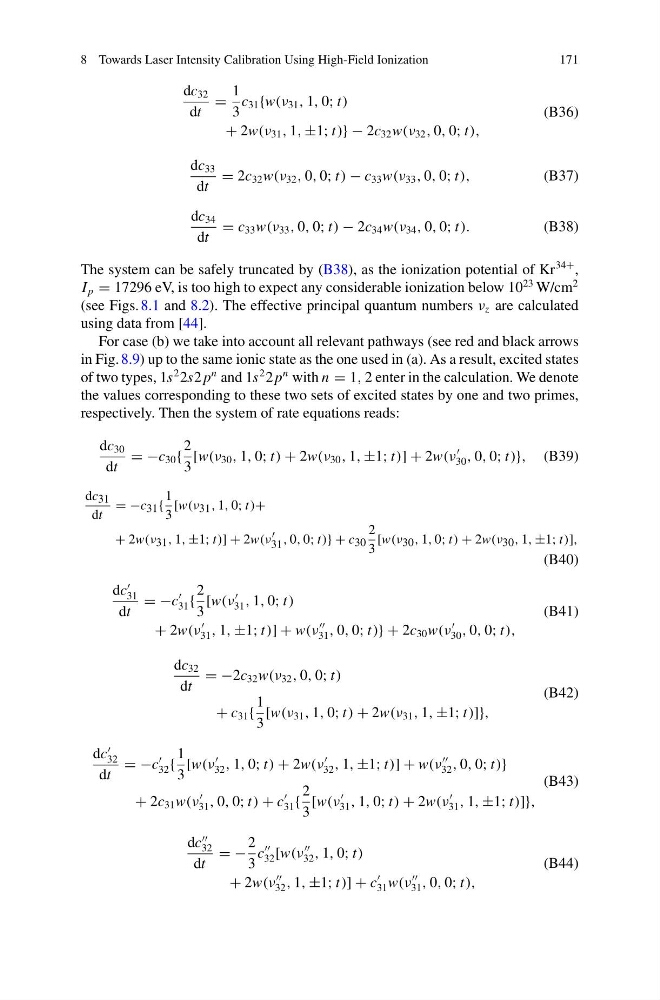
The system can be safely truncated by (B38), as the ionization potential of Kr
34+ ,
I p = 17296 eV, is too high to expect any considerable ionization below 10
23 W/cm
2
(see Figs. 8.1 and 8.2). The effective principal quantum numbers ν z are calculated
using data from [44].
For case (b) we take into account all relevant pathways (see red and black arrows
in Fig. 8.9) up to the same ionic state as the one used in (a). As a result, excited states
of two types, 1s
2 2s2 p
n and 1s
2 2 p
n with n = 1, 2 enter in the calculation. We denote
the values corresponding to these two sets of excited states by one and two primes,
respectively. Then the system of rate equations reads:
dc 30
dt
= −c 30 {
2
3
[w(ν 30 , 1, 0; t) + 2w(ν 30 , 1, ±1; t)] + 2w(ν
30 , 0, 0; t)}, (B39)
dc 31
dt
= −c 31 {
1
3
[w(ν 31 , 1, 0; t)+
+ 2w(ν 31 , 1, ±1; t)] + 2w(ν
31 , 0, 0; t)} + c 30
2
3
[w(ν 30 , 1, 0; t) + 2w(ν 30 , 1, ±1; t)],
(B40)
dc
31
dt
= −c
31 {
2
3
[w(ν
31 , 1, 0; t)
+ 2w(ν
31 , 1, ±1; t)] + w(ν
31 , 0, 0; t)} + 2c 30 w(ν
30 , 0, 0; t),
(B41)
dc 32
dt
= −2c 32 w(ν 32 , 0, 0; t)
+ c 31 {
1
3
[w(ν 31 , 1, 0; t) + 2w(ν 31 , 1, ±1; t)]},
(B42)
dc
32
dt
= −c
32 {
1
3
[w(ν
32 , 1, 0; t) + 2w(ν
32 , 1, ±1; t)] + w(ν
32 , 0, 0; t)}
+ 2c 31 w(ν
31 , 0, 0; t) + c
31 {
2
3
[w(ν
31 , 1, 0; t) + 2w(ν
31 , 1, ±1; t)]},
(B43)
dc
32
dt
= −
2
3
c
32 [w(ν
32 , 1, 0; t)
+ 2w(ν
32 , 1, ±1; t)] + c
31 w(ν
31 , 0, 0; t),
(B44)
171
dc 32
dt
=
1
3
c 31 {w(ν 31 , 1, 0; t)
+ 2w(ν 31 , 1, ±1; t)} − 2c 32 w(ν 32 , 0, 0; t),
(B36)
dc 33
dt
= 2c 32 w(ν 32 , 0, 0; t) − c 33 w(ν 33 , 0, 0; t),
(B37)
dc 34
dt
= c 33 w(ν 33 , 0, 0; t) − 2c 34 w(ν 34 , 0, 0; t).
(B38)
The system can be safely truncated by (B38), as the ionization potential of Kr
34+ ,
I p = 17296 eV, is too high to expect any considerable ionization below 10
23 W/cm
2
(see Figs. 8.1 and 8.2). The effective principal quantum numbers ν z are calculated
using data from [44].
For case (b) we take into account all relevant pathways (see red and black arrows
in Fig. 8.9) up to the same ionic state as the one used in (a). As a result, excited states
of two types, 1s
2 2s2 p
n and 1s
2 2 p
n with n = 1, 2 enter in the calculation. We denote
the values corresponding to these two sets of excited states by one and two primes,
respectively. Then the system of rate equations reads:
dc 30
dt
= −c 30 {
2
3
[w(ν 30 , 1, 0; t) + 2w(ν 30 , 1, ±1; t)] + 2w(ν
30 , 0, 0; t)}, (B39)
dc 31
dt
= −c 31 {
1
3
[w(ν 31 , 1, 0; t)+
+ 2w(ν 31 , 1, ±1; t)] + 2w(ν
31 , 0, 0; t)} + c 30
2
3
[w(ν 30 , 1, 0; t) + 2w(ν 30 , 1, ±1; t)],
(B40)
dc
31
dt
= −c
31 {
2
3
[w(ν
31 , 1, 0; t)
+ 2w(ν
31 , 1, ±1; t)] + w(ν
31 , 0, 0; t)} + 2c 30 w(ν
30 , 0, 0; t),
(B41)
dc 32
dt
= −2c 32 w(ν 32 , 0, 0; t)
+ c 31 {
1
3
[w(ν 31 , 1, 0; t) + 2w(ν 31 , 1, ±1; t)]},
(B42)
dc
32
dt
= −c
32 {
1
3
[w(ν
32 , 1, 0; t) + 2w(ν
32 , 1, ±1; t)] + w(ν
32 , 0, 0; t)}
+ 2c 31 w(ν
31 , 0, 0; t) + c
31 {
2
3
[w(ν
31 , 1, 0; t) + 2w(ν
31 , 1, ±1; t)]},
(B43)
dc
32
dt
= −
2
3
c
32 [w(ν
32 , 1, 0; t)
+ 2w(ν
32 , 1, ±1; t)] + c
31 w(ν
31 , 0, 0; t),
(B44)