

8 Towards Laser Intensity Calibration Using High-Field Ionization
169
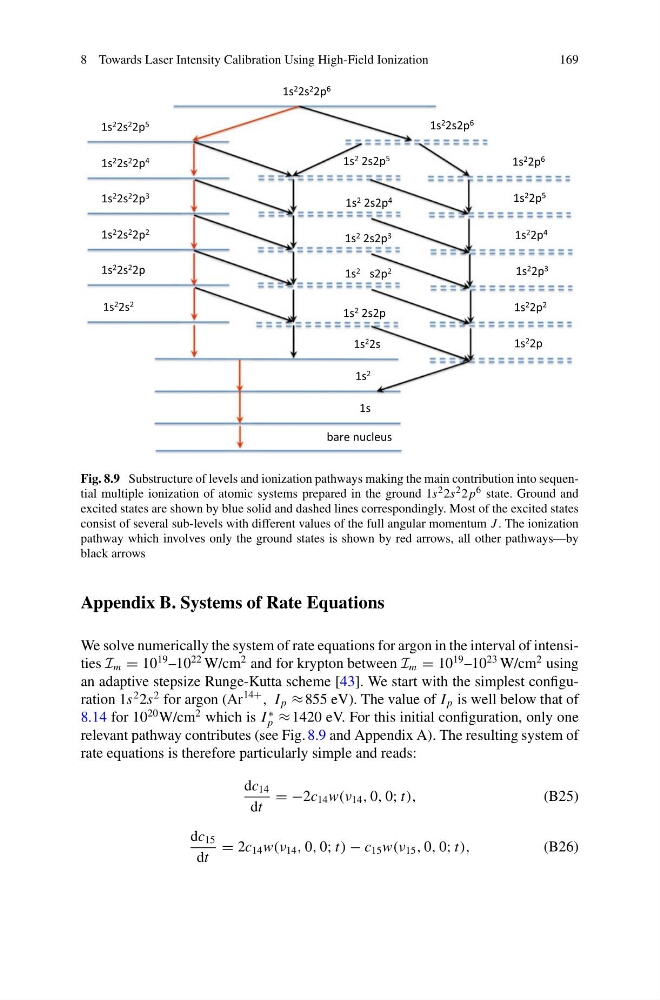
Fig. 8.9 Substructure of levels and ionization pathways making the main contribution into sequential multiple ionization of atomic systems prepared in the ground 1s 2 2s 2 2 p 6 state. Ground and
excited states are shown by blue solid and dashed lines correspondingly. Most of the excited states
consist of several sub-levels with different values of the full angular momentum J . The ionization
pathway which involves only the ground states is shown by red arrows, all other pathways—by
black arrows
Appendix B. Systems of Rate Equations
We solve numerically the system of rate equations for argon in the interval of intensities I m = 10
19 –10
22 W/cm
2 and for krypton between I m = 10
19 –10
23 W/cm
2 using
an adaptive stepsize Runge-Kutta scheme [43]. We start with the simplest configuration 1s
2 2s
2 for argon (Ar
14+
, I p ≈ 855 eV). The value of I p is well below that of
8.14 for 10
20 W/cm
2 which is I
∗
p ≈ 1420 eV. For this initial configuration, only one
relevant pathway contributes (see Fig. 8.9 and Appendix A). The resulting system of
rate equations is therefore particularly simple and reads:
dc 14
dt
= −2c 14 w(ν 14 , 0, 0; t),
(B25)
dc 15
dt
= 2c 14 w(ν 14 , 0, 0; t) − c 15 w(ν 15 , 0, 0; t),
(B26)
169
Fig. 8.9 Substructure of levels and ionization pathways making the main contribution into sequential multiple ionization of atomic systems prepared in the ground 1s 2 2s 2 2 p 6 state. Ground and
excited states are shown by blue solid and dashed lines correspondingly. Most of the excited states
consist of several sub-levels with different values of the full angular momentum J . The ionization
pathway which involves only the ground states is shown by red arrows, all other pathways—by
black arrows
Appendix B. Systems of Rate Equations
We solve numerically the system of rate equations for argon in the interval of intensities I m = 10
19 –10
22 W/cm
2 and for krypton between I m = 10
19 –10
23 W/cm
2 using
an adaptive stepsize Runge-Kutta scheme [43]. We start with the simplest configuration 1s
2 2s
2 for argon (Ar
14+
, I p ≈ 855 eV). The value of I p is well below that of
8.14 for 10
20 W/cm
2 which is I
∗
p ≈ 1420 eV. For this initial configuration, only one
relevant pathway contributes (see Fig. 8.9 and Appendix A). The resulting system of
rate equations is therefore particularly simple and reads:
dc 14
dt
= −2c 14 w(ν 14 , 0, 0; t),
(B25)
dc 15
dt
= 2c 14 w(ν 14 , 0, 0; t) − c 15 w(ν 15 , 0, 0; t),
(B26)