

8 Towards Laser Intensity Calibration Using High-Field Ionization
161
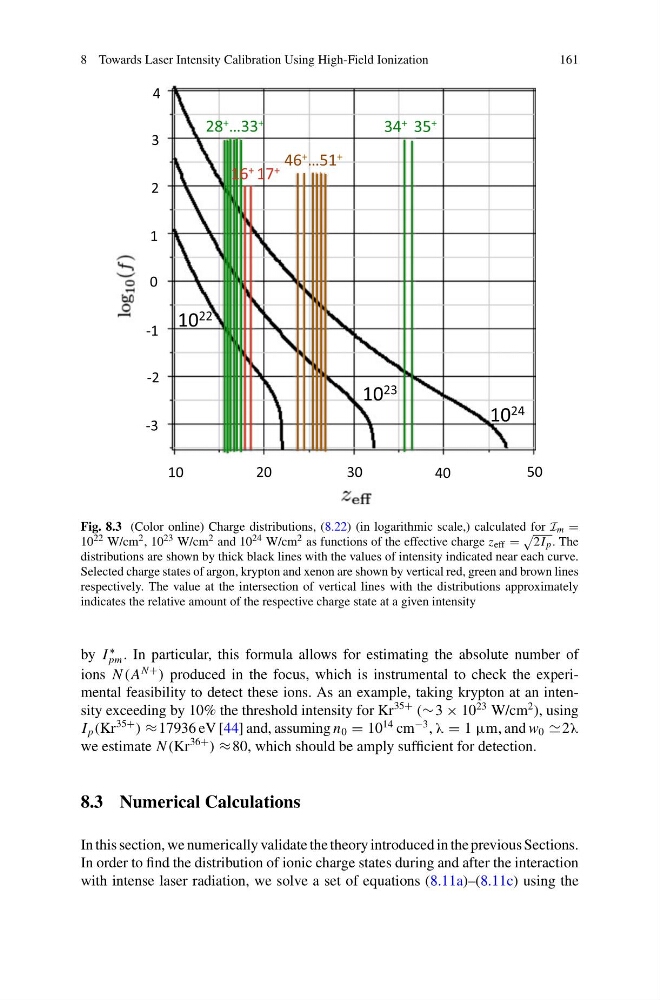
Fig. 8.3 (Color online) Charge distributions, (8.22) (in logarithmic scale,) calculated for I m =
10 22 W/cm 2 , 10 23 W/cm 2 and 10 24 W/cm 2 as functions of the effective charge z eff =
2I p . The
distributions are shown by thick black lines with the values of intensity indicated near each curve.
Selected charge states of argon, krypton and xenon are shown by vertical red, green and brown lines
respectively. The value at the intersection of vertical lines with the distributions approximately
indicates the relative amount of the respective charge state at a given intensity
by I
∗
pm . In particular, this formula allows for estimating the absolute number of
ions N (A
N +
) produced in the focus, which is instrumental to check the experimental feasibility to detect these ions. As an example, taking krypton at an intensity exceeding by 10% the threshold intensity for Kr
35+ (∼ 3 × 10
23 W/cm
2 ), using
I p (Kr
35+
) ≈ 17936 eV [44] and, assuming n 0 = 10
14 cm
−3 , λ = 1 μm, and w 0 2λ
we estimate N (Kr
36+
) ≈ 80, which should be amply sufficient for detection.
8.3 Numerical Calculations
In this section, we numerically validate the theory introduced in the previous Sections.
In order to find the distribution of ionic charge states during and after the interaction
with intense laser radiation, we solve a set of equations (8.11a)–(8.11c) using the
161
Fig. 8.3 (Color online) Charge distributions, (8.22) (in logarithmic scale,) calculated for I m =
10 22 W/cm 2 , 10 23 W/cm 2 and 10 24 W/cm 2 as functions of the effective charge z eff =
2I p . The
distributions are shown by thick black lines with the values of intensity indicated near each curve.
Selected charge states of argon, krypton and xenon are shown by vertical red, green and brown lines
respectively. The value at the intersection of vertical lines with the distributions approximately
indicates the relative amount of the respective charge state at a given intensity
by I
∗
pm . In particular, this formula allows for estimating the absolute number of
ions N (A
N +
) produced in the focus, which is instrumental to check the experimental feasibility to detect these ions. As an example, taking krypton at an intensity exceeding by 10% the threshold intensity for Kr
35+ (∼ 3 × 10
23 W/cm
2 ), using
I p (Kr
35+
) ≈ 17936 eV [44] and, assuming n 0 = 10
14 cm
−3 , λ = 1 μm, and w 0 2λ
we estimate N (Kr
36+
) ≈ 80, which should be amply sufficient for detection.
8.3 Numerical Calculations
In this section, we numerically validate the theory introduced in the previous Sections.
In order to find the distribution of ionic charge states during and after the interaction
with intense laser radiation, we solve a set of equations (8.11a)–(8.11c) using the