

7 Application of CR-39 Solid State Nuclear Track Detectors …
145
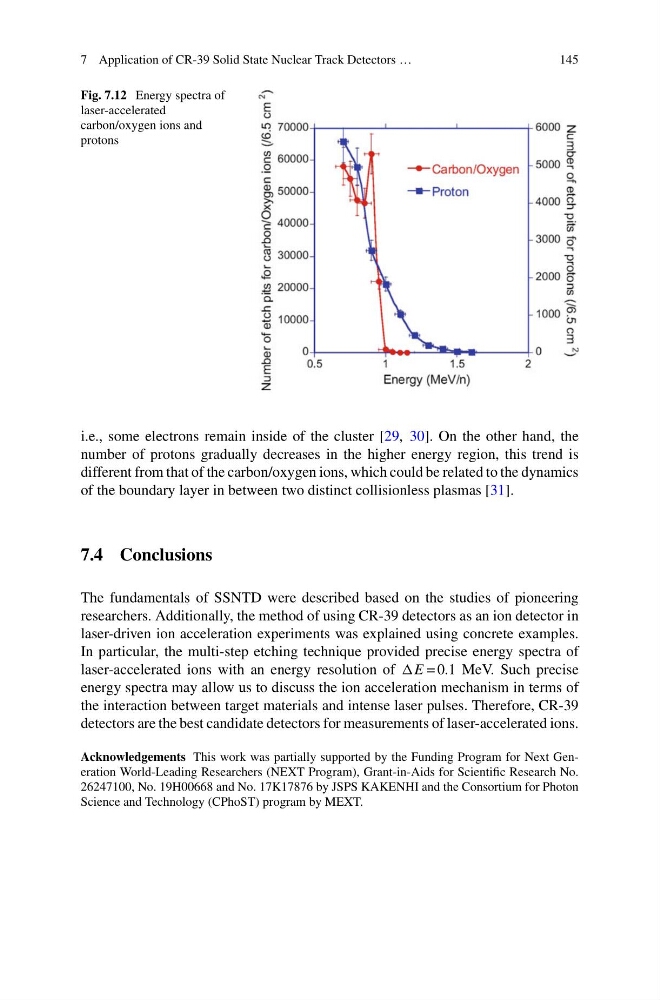
Fig. 7.12 Energy spectra of
laser-accelerated
carbon/oxygen ions and
protons
i.e., some electrons remain inside of the cluster [29, 30]. On the other hand, the
number of protons gradually decreases in the higher energy region, this trend is
different from that of the carbon/oxygen ions, which could be related to the dynamics
of the boundary layer in between two distinct collisionless plasmas [31].
7.4 Conclusions
The fundamentals of SSNTD were described based on the studies of pioneering
researchers. Additionally, the method of using CR-39 detectors as an ion detector in
laser-driven ion acceleration experiments was explained using concrete examples.
In particular, the multi-step etching technique provided precise energy spectra of
laser-accelerated ions with an energy resolution of E = 0.1 MeV. Such precise
energy spectra may allow us to discuss the ion acceleration mechanism in terms of
the interaction between target materials and intense laser pulses. Therefore, CR-39
detectors are the best candidate detectors for measurements of laser-accelerated ions.
Acknowledgements This work was partially supported by the Funding Program for Next Generation World-Leading Researchers (NEXT Program), Grant-in-Aids for Scientific Research No.
26247100, No. 19H00668 and No. 17K17876 by JSPS KAKENHI and the Consortium for Photon
Science and Technology (CPhoST) program by MEXT.
145
Fig. 7.12 Energy spectra of
laser-accelerated
carbon/oxygen ions and
protons
i.e., some electrons remain inside of the cluster [29, 30]. On the other hand, the
number of protons gradually decreases in the higher energy region, this trend is
different from that of the carbon/oxygen ions, which could be related to the dynamics
of the boundary layer in between two distinct collisionless plasmas [31].
7.4 Conclusions
The fundamentals of SSNTD were described based on the studies of pioneering
researchers. Additionally, the method of using CR-39 detectors as an ion detector in
laser-driven ion acceleration experiments was explained using concrete examples.
In particular, the multi-step etching technique provided precise energy spectra of
laser-accelerated ions with an energy resolution of E = 0.1 MeV. Such precise
energy spectra may allow us to discuss the ion acceleration mechanism in terms of
the interaction between target materials and intense laser pulses. Therefore, CR-39
detectors are the best candidate detectors for measurements of laser-accelerated ions.
Acknowledgements This work was partially supported by the Funding Program for Next Generation World-Leading Researchers (NEXT Program), Grant-in-Aids for Scientific Research No.
26247100, No. 19H00668 and No. 17K17876 by JSPS KAKENHI and the Consortium for Photon
Science and Technology (CPhoST) program by MEXT.