

138
M. Kanasaki et al.
G = h(x) + r
S(x)
S(x) 2 − 1
,
(7.7)
h(x) =
x
0
1
S(x)
dx
(7.8)
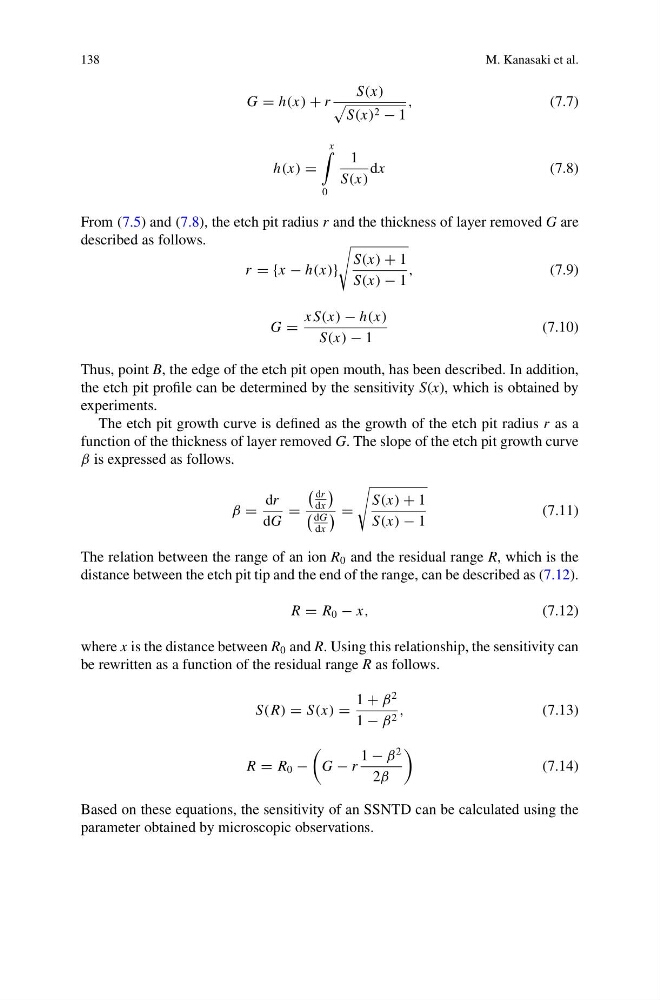
From (7.5) and (7.8), the etch pit radius r and the thickness of layer removed G are
described as follows.
r = {x − h(x)}
S(x) + 1
S(x) − 1
,
(7.9)
G =
x S(x) − h(x)
S(x) − 1
(7.10)
Thus, point B, the edge of the etch pit open mouth, has been described. In addition,
the etch pit profile can be determined by the sensitivity S(x), which is obtained by
experiments.
The etch pit growth curve is defined as the growth of the etch pit radius r as a
function of the thickness of layer removed G. The slope of the etch pit growth curve
β is expressed as follows.
β =
dr
dG
=
dr
dx
dG
dx
=
S(x) + 1
S(x) − 1
(7.11)
The relation between the range of an ion R 0 and the residual range R, which is the
distance between the etch pit tip and the end of the range, can be described as (7.12).
R = R 0 − x,
(7.12)
where x is the distance between R 0 and R. Using this relationship, the sensitivity can
be rewritten as a function of the residual range R as follows.
S(R) = S(x) =
1 + β
2
1 − β 2 ,
(7.13)
R = R 0 −
G − r
1 − β
2
2β
(7.14)
Based on these equations, the sensitivity of an SSNTD can be calculated using the
parameter obtained by microscopic observations.
M. Kanasaki et al.
G = h(x) + r
S(x)
S(x) 2 − 1
,
(7.7)
h(x) =
x
0
1
S(x)
dx
(7.8)
From (7.5) and (7.8), the etch pit radius r and the thickness of layer removed G are
described as follows.
r = {x − h(x)}
S(x) + 1
S(x) − 1
,
(7.9)
G =
x S(x) − h(x)
S(x) − 1
(7.10)
Thus, point B, the edge of the etch pit open mouth, has been described. In addition,
the etch pit profile can be determined by the sensitivity S(x), which is obtained by
experiments.
The etch pit growth curve is defined as the growth of the etch pit radius r as a
function of the thickness of layer removed G. The slope of the etch pit growth curve
β is expressed as follows.
β =
dr
dG
=
dr
dx
dG
dx
=
S(x) + 1
S(x) − 1
(7.11)
The relation between the range of an ion R 0 and the residual range R, which is the
distance between the etch pit tip and the end of the range, can be described as (7.12).
R = R 0 − x,
(7.12)
where x is the distance between R 0 and R. Using this relationship, the sensitivity can
be rewritten as a function of the residual range R as follows.
S(R) = S(x) =
1 + β
2
1 − β 2 ,
(7.13)
R = R 0 −
G − r
1 − β
2
2β
(7.14)
Based on these equations, the sensitivity of an SSNTD can be calculated using the
parameter obtained by microscopic observations.