

114
P. Vasa
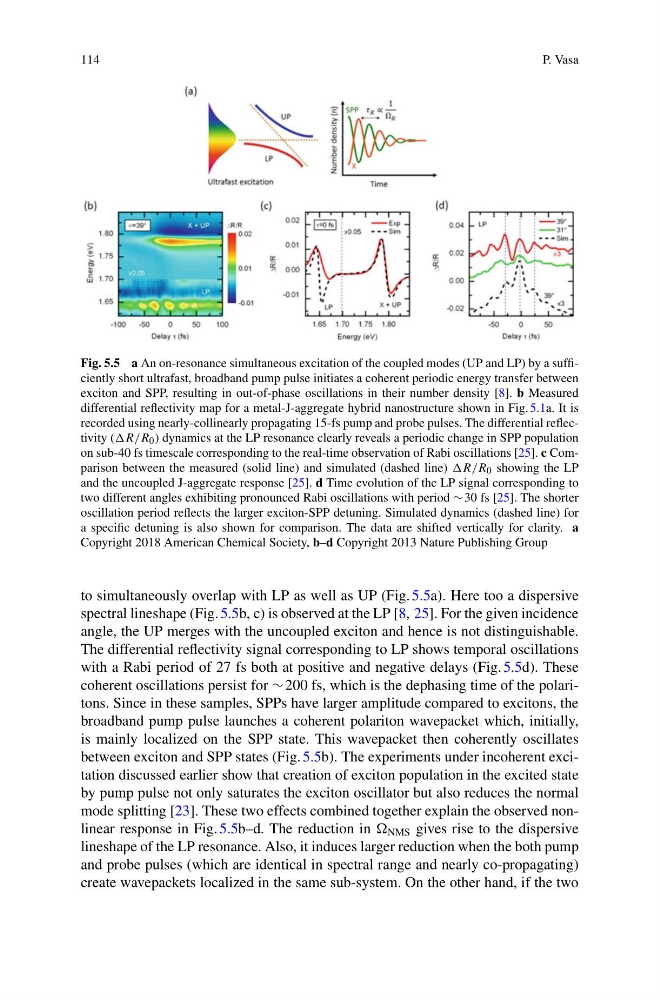
Fig. 5.5 a An on-resonance simultaneous excitation of the coupled modes (UP and LP) by a sufficiently short ultrafast, broadband pump pulse initiates a coherent periodic energy transfer between
exciton and SPP, resulting in out-of-phase oscillations in their number density [8]. b Measured
differential reflectivity map for a metal-J-aggregate hybrid nanostructure shown in Fig. 5.1a. It is
recorded using nearly-collinearly propagating 15-fs pump and probe pulses. The differential reflectivity (R/R 0 ) dynamics at the LP resonance clearly reveals a periodic change in SPP population
on sub-40 fs timescale corresponding to the real-time observation of Rabi oscillations [25]. c Comparison between the measured (solid line) and simulated (dashed line) R/R 0 showing the LP
and the uncoupled J-aggregate response [25]. d Time evolution of the LP signal corresponding to
two different angles exhibiting pronounced Rabi oscillations with period ∼ 30 fs [25]. The shorter
oscillation period reflects the larger exciton-SPP detuning. Simulated dynamics (dashed line) for
a specific detuning is also shown for comparison. The data are shifted vertically for clarity. a
Copyright 2018 American Chemical Society, b–d Copyright 2013 Nature Publishing Group
to simultaneously overlap with LP as well as UP (Fig. 5.5a). Here too a dispersive
spectral lineshape (Fig. 5.5b, c) is observed at the LP [8, 25]. For the given incidence
angle, the UP merges with the uncoupled exciton and hence is not distinguishable.
The differential reflectivity signal corresponding to LP shows temporal oscillations
with a Rabi period of 27 fs both at positive and negative delays (Fig. 5.5d). These
coherent oscillations persist for ∼ 200 fs, which is the dephasing time of the polaritons. Since in these samples, SPPs have larger amplitude compared to excitons, the
broadband pump pulse launches a coherent polariton wavepacket which, initially,
is mainly localized on the SPP state. This wavepacket then coherently oscillates
between exciton and SPP states (Fig. 5.5b). The experiments under incoherent excitation discussed earlier show that creation of exciton population in the excited state
by pump pulse not only saturates the exciton oscillator but also reduces the normal
mode splitting [23]. These two effects combined together explain the observed nonlinear response in Fig. 5.5b–d. The reduction in NMS gives rise to the dispersive
lineshape of the LP resonance. Also, it induces larger reduction when the both pump
and probe pulses (which are identical in spectral range and nearly co-propagating)
create wavepackets localized in the same sub-system. On the other hand, if the two
P. Vasa
Fig. 5.5 a An on-resonance simultaneous excitation of the coupled modes (UP and LP) by a sufficiently short ultrafast, broadband pump pulse initiates a coherent periodic energy transfer between
exciton and SPP, resulting in out-of-phase oscillations in their number density [8]. b Measured
differential reflectivity map for a metal-J-aggregate hybrid nanostructure shown in Fig. 5.1a. It is
recorded using nearly-collinearly propagating 15-fs pump and probe pulses. The differential reflectivity (R/R 0 ) dynamics at the LP resonance clearly reveals a periodic change in SPP population
on sub-40 fs timescale corresponding to the real-time observation of Rabi oscillations [25]. c Comparison between the measured (solid line) and simulated (dashed line) R/R 0 showing the LP
and the uncoupled J-aggregate response [25]. d Time evolution of the LP signal corresponding to
two different angles exhibiting pronounced Rabi oscillations with period ∼ 30 fs [25]. The shorter
oscillation period reflects the larger exciton-SPP detuning. Simulated dynamics (dashed line) for
a specific detuning is also shown for comparison. The data are shifted vertically for clarity. a
Copyright 2018 American Chemical Society, b–d Copyright 2013 Nature Publishing Group
to simultaneously overlap with LP as well as UP (Fig. 5.5a). Here too a dispersive
spectral lineshape (Fig. 5.5b, c) is observed at the LP [8, 25]. For the given incidence
angle, the UP merges with the uncoupled exciton and hence is not distinguishable.
The differential reflectivity signal corresponding to LP shows temporal oscillations
with a Rabi period of 27 fs both at positive and negative delays (Fig. 5.5d). These
coherent oscillations persist for ∼ 200 fs, which is the dephasing time of the polaritons. Since in these samples, SPPs have larger amplitude compared to excitons, the
broadband pump pulse launches a coherent polariton wavepacket which, initially,
is mainly localized on the SPP state. This wavepacket then coherently oscillates
between exciton and SPP states (Fig. 5.5b). The experiments under incoherent excitation discussed earlier show that creation of exciton population in the excited state
by pump pulse not only saturates the exciton oscillator but also reduces the normal
mode splitting [23]. These two effects combined together explain the observed nonlinear response in Fig. 5.5b–d. The reduction in NMS gives rise to the dispersive
lineshape of the LP resonance. Also, it induces larger reduction when the both pump
and probe pulses (which are identical in spectral range and nearly co-propagating)
create wavepackets localized in the same sub-system. On the other hand, if the two