

5 Coherent Nonlinear Processes in Metal-Semiconductor …
113
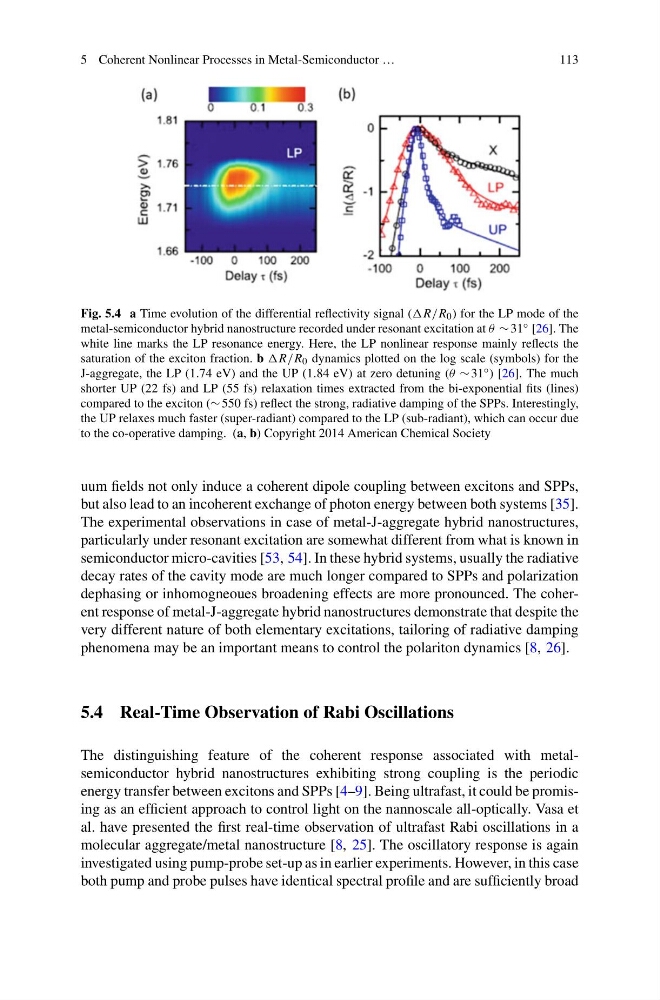
Fig. 5.4 a Time evolution of the differential reflectivity signal (R/R 0 ) for the LP mode of the
metal-semiconductor hybrid nanostructure recorded under resonant excitation at θ ∼ 31 ◦ [26]. The
white line marks the LP resonance energy. Here, the LP nonlinear response mainly reflects the
saturation of the exciton fraction. b R/R 0 dynamics plotted on the log scale (symbols) for the
J-aggregate, the LP (1.74 eV) and the UP (1.84 eV) at zero detuning (θ ∼ 31 ◦ ) [26]. The much
shorter UP (22 fs) and LP (55 fs) relaxation times extracted from the bi-exponential fits (lines)
compared to the exciton (∼ 550 fs) reflect the strong, radiative damping of the SPPs. Interestingly,
the UP relaxes much faster (super-radiant) compared to the LP (sub-radiant), which can occur due
to the co-operative damping. (a, b) Copyright 2014 American Chemical Society
uum fields not only induce a coherent dipole coupling between excitons and SPPs,
but also lead to an incoherent exchange of photon energy between both systems [35].
The experimental observations in case of metal-J-aggregate hybrid nanostructures,
particularly under resonant excitation are somewhat different from what is known in
semiconductor micro-cavities [53, 54]. In these hybrid systems, usually the radiative
decay rates of the cavity mode are much longer compared to SPPs and polarization
dephasing or inhomogneoues broadening effects are more pronounced. The coherent response of metal-J-aggregate hybrid nanostructures demonstrate that despite the
very different nature of both elementary excitations, tailoring of radiative damping
phenomena may be an important means to control the polariton dynamics [8, 26].
5.4 Real-Time Observation of Rabi Oscillations
The distinguishing feature of the coherent response associated with metalsemiconductor hybrid nanostructures exhibiting strong coupling is the periodic
energy transfer between excitons and SPPs [4–9]. Being ultrafast, it could be promising as an efficient approach to control light on the nannoscale all-optically. Vasa et
al. have presented the first real-time observation of ultrafast Rabi oscillations in a
molecular aggregate/metal nanostructure [8, 25]. The oscillatory response is again
investigated using pump-probe set-up as in earlier experiments. However, in this case
both pump and probe pulses have identical spectral profile and are sufficiently broad
113
Fig. 5.4 a Time evolution of the differential reflectivity signal (R/R 0 ) for the LP mode of the
metal-semiconductor hybrid nanostructure recorded under resonant excitation at θ ∼ 31 ◦ [26]. The
white line marks the LP resonance energy. Here, the LP nonlinear response mainly reflects the
saturation of the exciton fraction. b R/R 0 dynamics plotted on the log scale (symbols) for the
J-aggregate, the LP (1.74 eV) and the UP (1.84 eV) at zero detuning (θ ∼ 31 ◦ ) [26]. The much
shorter UP (22 fs) and LP (55 fs) relaxation times extracted from the bi-exponential fits (lines)
compared to the exciton (∼ 550 fs) reflect the strong, radiative damping of the SPPs. Interestingly,
the UP relaxes much faster (super-radiant) compared to the LP (sub-radiant), which can occur due
to the co-operative damping. (a, b) Copyright 2014 American Chemical Society
uum fields not only induce a coherent dipole coupling between excitons and SPPs,
but also lead to an incoherent exchange of photon energy between both systems [35].
The experimental observations in case of metal-J-aggregate hybrid nanostructures,
particularly under resonant excitation are somewhat different from what is known in
semiconductor micro-cavities [53, 54]. In these hybrid systems, usually the radiative
decay rates of the cavity mode are much longer compared to SPPs and polarization
dephasing or inhomogneoues broadening effects are more pronounced. The coherent response of metal-J-aggregate hybrid nanostructures demonstrate that despite the
very different nature of both elementary excitations, tailoring of radiative damping
phenomena may be an important means to control the polariton dynamics [8, 26].
5.4 Real-Time Observation of Rabi Oscillations
The distinguishing feature of the coherent response associated with metalsemiconductor hybrid nanostructures exhibiting strong coupling is the periodic
energy transfer between excitons and SPPs [4–9]. Being ultrafast, it could be promising as an efficient approach to control light on the nannoscale all-optically. Vasa et
al. have presented the first real-time observation of ultrafast Rabi oscillations in a
molecular aggregate/metal nanostructure [8, 25]. The oscillatory response is again
investigated using pump-probe set-up as in earlier experiments. However, in this case
both pump and probe pulses have identical spectral profile and are sufficiently broad