

2 Industrial Plant Oil Extraction
75
2.6.2.2 Optimization of Enzymatic Hydrolysis
Response surface methodology was applied to identify optimum levels of four key
independent variables including hydrolysis temperature (°C), enzyme concentration
(%), ratios of material to water (w/v), and hydrolysis time (h) for the selected enzyme.
Mono-factor tests were done prior to determining the independent variables range
for BBD. Three variables were kept constant at their respective central test range
values and the other variable varied within its experimental ranges.
After a series of preliminary mono-factor tests, a Box–Behnken design (BBD) was
used to survey the effects of independent variables at three levels on the dependent
variable (oil recovering rate). A total of 29 randomized experiments including 24
factorial and 5 zero-point tests were designed. The regression analysis was carried
out to evaluate the response function as a quadratic polynomial:
Y = α 0 +
k
j=1
α j X j +
k
j=1
α j j X
2
j +
i< j
α i j X i X j (k = 4)
(2.5)
where Y is the predicted response; α 0 , α j , α jj, and α ij are the regression coefficients
for intercept, linearity, square, and interaction, respectively. X i and X j represent the
different independent variables, and k represents the number of variables. The actual
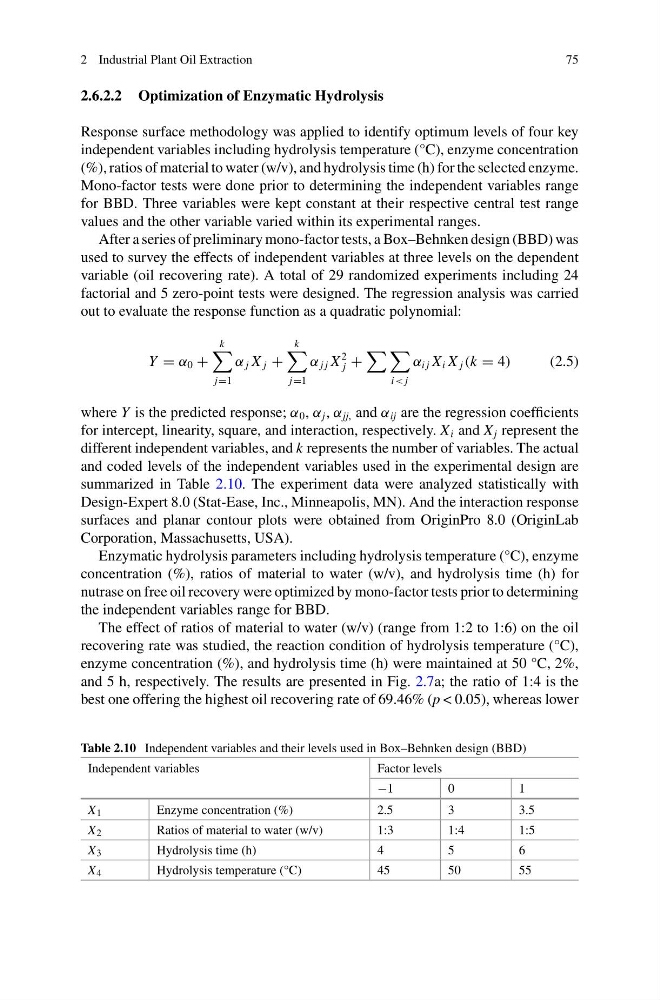
and coded levels of the independent variables used in the experimental design are
summarized in Table 2.10. The experiment data were analyzed statistically with
Design-Expert 8.0 (Stat-Ease, Inc., Minneapolis, MN). And the interaction response
surfaces and planar contour plots were obtained from OriginPro 8.0 (OriginLab
Corporation, Massachusetts, USA).
Enzymatic hydrolysis parameters including hydrolysis temperature (°C), enzyme
concentration (%), ratios of material to water (w/v), and hydrolysis time (h) for
nutrase on free oil recovery were optimized by mono-factor tests prior to determining
the independent variables range for BBD.
The effect of ratios of material to water (w/v) (range from 1:2 to 1:6) on the oil
recovering rate was studied, the reaction condition of hydrolysis temperature (°C),
enzyme concentration (%), and hydrolysis time (h) were maintained at 50 °C, 2%,
and 5 h, respectively. The results are presented in Fig. 2.7a; the ratio of 1:4 is the
best one offering the highest oil recovering rate of 69.46% (p < 0.05), whereas lower
Table 2.10 Independent variables and their levels used in Box–Behnken design (BBD)
Independent variables
Factor levels
−1
0
1
X 1
Enzyme concentration (%)
2.5
3
3.5
X 2
Ratios of material to water (w/v)
1:3
1:4
1:5
X 3
Hydrolysis time (h)
4
5
6
X 4
Hydrolysis temperature (°C)
45
50
55
75
2.6.2.2 Optimization of Enzymatic Hydrolysis
Response surface methodology was applied to identify optimum levels of four key
independent variables including hydrolysis temperature (°C), enzyme concentration
(%), ratios of material to water (w/v), and hydrolysis time (h) for the selected enzyme.
Mono-factor tests were done prior to determining the independent variables range
for BBD. Three variables were kept constant at their respective central test range
values and the other variable varied within its experimental ranges.
After a series of preliminary mono-factor tests, a Box–Behnken design (BBD) was
used to survey the effects of independent variables at three levels on the dependent
variable (oil recovering rate). A total of 29 randomized experiments including 24
factorial and 5 zero-point tests were designed. The regression analysis was carried
out to evaluate the response function as a quadratic polynomial:
Y = α 0 +
k
j=1
α j X j +
k
j=1
α j j X
2
j +
i< j
α i j X i X j (k = 4)
(2.5)
where Y is the predicted response; α 0 , α j , α jj, and α ij are the regression coefficients
for intercept, linearity, square, and interaction, respectively. X i and X j represent the
different independent variables, and k represents the number of variables. The actual
and coded levels of the independent variables used in the experimental design are
summarized in Table 2.10. The experiment data were analyzed statistically with
Design-Expert 8.0 (Stat-Ease, Inc., Minneapolis, MN). And the interaction response
surfaces and planar contour plots were obtained from OriginPro 8.0 (OriginLab
Corporation, Massachusetts, USA).
Enzymatic hydrolysis parameters including hydrolysis temperature (°C), enzyme
concentration (%), ratios of material to water (w/v), and hydrolysis time (h) for
nutrase on free oil recovery were optimized by mono-factor tests prior to determining
the independent variables range for BBD.
The effect of ratios of material to water (w/v) (range from 1:2 to 1:6) on the oil
recovering rate was studied, the reaction condition of hydrolysis temperature (°C),
enzyme concentration (%), and hydrolysis time (h) were maintained at 50 °C, 2%,
and 5 h, respectively. The results are presented in Fig. 2.7a; the ratio of 1:4 is the
best one offering the highest oil recovering rate of 69.46% (p < 0.05), whereas lower
Table 2.10 Independent variables and their levels used in Box–Behnken design (BBD)
Independent variables
Factor levels
−1
0
1
X 1
Enzyme concentration (%)
2.5
3
3.5
X 2
Ratios of material to water (w/v)
1:3
1:4
1:5
X 3
Hydrolysis time (h)
4
5
6
X 4
Hydrolysis temperature (°C)
45
50
55