

68
Z. Xiao et al.
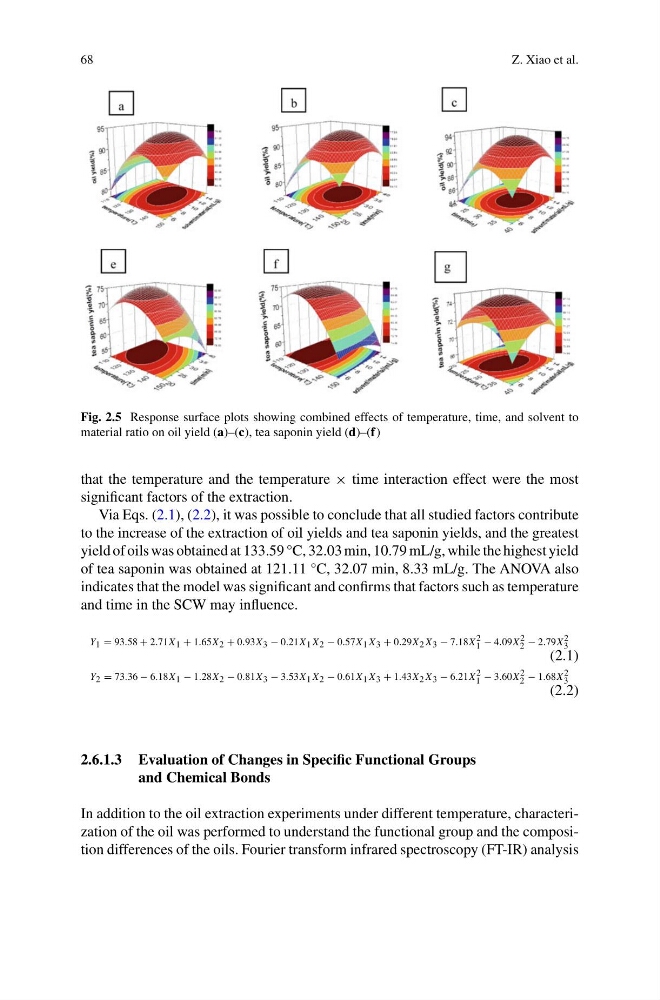
Fig. 2.5 Response surface plots showing combined effects of temperature, time, and solvent to
material ratio on oil yield (a)–(c), tea saponin yield (d)–(f)
that the temperature and the temperature × time interaction effect were the most
significant factors of the extraction.
Via Eqs. (2.1), (2.2), it was possible to conclude that all studied factors contribute
to the increase of the extraction of oil yields and tea saponin yields, and the greatest
yield of oils was obtained at 133.59 °C, 32.03 min, 10.79 mL/g, while the highest yield
of tea saponin was obtained at 121.11 °C, 32.07 min, 8.33 mL/g. The ANOVA also
indicates that the model was significant and confirms that factors such as temperature
and time in the SCW may influence.
Y 1 = 93.58 + 2.71X 1 + 1.65X 2 + 0.93X 3 − 0.21X 1 X 2 − 0.57X 1 X 3 + 0.29X 2 X 3 − 7.18X 2
1 − 4.09X 2
2 − 2.79X 2
3
(2.1)
Y 2 = 73.36 − 6.18X 1 − 1.28X 2 − 0.81X 3 − 3.53X 1 X 2 − 0.61X 1 X 3 + 1.43X 2 X 3 − 6.21X 2
1 − 3.60X 2
2 − 1.68X 2
3
(2.2)
2.6.1.3 Evaluation of Changes in Specific Functional Groups
and Chemical Bonds
In addition to the oil extraction experiments under different temperature, characterization of the oil was performed to understand the functional group and the composition differences of the oils. Fourier transform infrared spectroscopy (FT-IR) analysis
Z. Xiao et al.
Fig. 2.5 Response surface plots showing combined effects of temperature, time, and solvent to
material ratio on oil yield (a)–(c), tea saponin yield (d)–(f)
that the temperature and the temperature × time interaction effect were the most
significant factors of the extraction.
Via Eqs. (2.1), (2.2), it was possible to conclude that all studied factors contribute
to the increase of the extraction of oil yields and tea saponin yields, and the greatest
yield of oils was obtained at 133.59 °C, 32.03 min, 10.79 mL/g, while the highest yield
of tea saponin was obtained at 121.11 °C, 32.07 min, 8.33 mL/g. The ANOVA also
indicates that the model was significant and confirms that factors such as temperature
and time in the SCW may influence.
Y 1 = 93.58 + 2.71X 1 + 1.65X 2 + 0.93X 3 − 0.21X 1 X 2 − 0.57X 1 X 3 + 0.29X 2 X 3 − 7.18X 2
1 − 4.09X 2
2 − 2.79X 2
3
(2.1)
Y 2 = 73.36 − 6.18X 1 − 1.28X 2 − 0.81X 3 − 3.53X 1 X 2 − 0.61X 1 X 3 + 1.43X 2 X 3 − 6.21X 2
1 − 3.60X 2
2 − 1.68X 2
3
(2.2)
2.6.1.3 Evaluation of Changes in Specific Functional Groups
and Chemical Bonds
In addition to the oil extraction experiments under different temperature, characterization of the oil was performed to understand the functional group and the composition differences of the oils. Fourier transform infrared spectroscopy (FT-IR) analysis