

66
Z. Xiao et al.
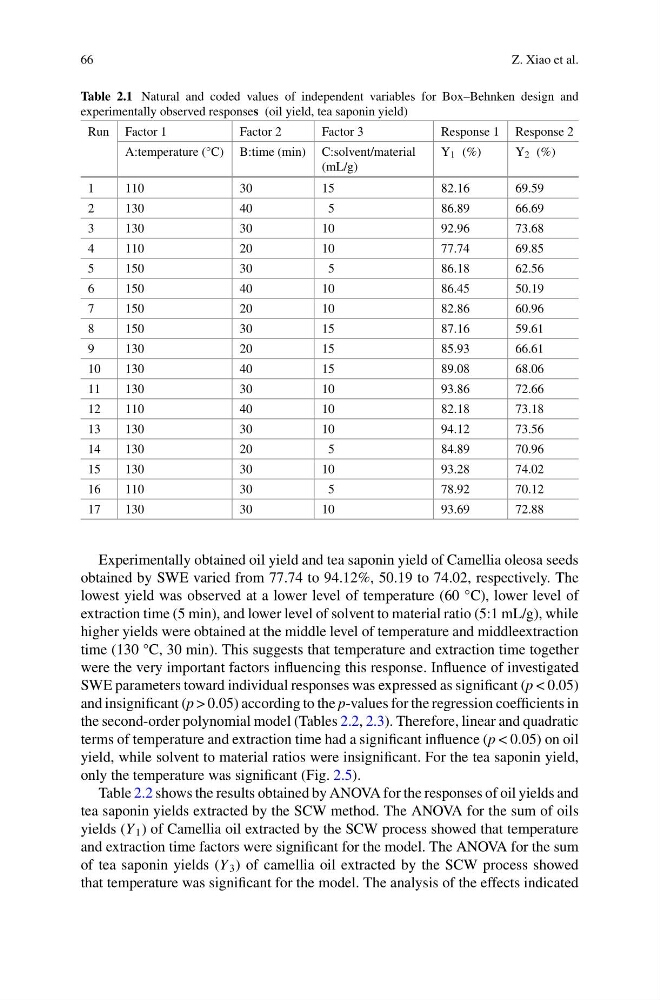
Table 2.1 Natural and coded values of independent variables for Box–Behnken design and
experimentally observed responses (oil yield, tea saponin yield)
Run Factor 1
Factor 2
Factor 3
Response 1 Response 2
A:temperature (°C) B:time (min) C:solvent/material
(mL/g)
Y 1 (%)
Y 2 (%)
1
110
30
15
82.16
69.59
2
130
40
5
86.89
66.69
3
130
30
10
92.96
73.68
4
110
20
10
77.74
69.85
5
150
30
5
86.18
62.56
6
150
40
10
86.45
50.19
7
150
20
10
82.86
60.96
8
150
30
15
87.16
59.61
9
130
20
15
85.93
66.61
10
130
40
15
89.08
68.06
11
130
30
10
93.86
72.66
12
110
40
10
82.18
73.18
13
130
30
10
94.12
73.56
14
130
20
5
84.89
70.96
15
130
30
10
93.28
74.02
16
110
30
5
78.92
70.12
17
130
30
10
93.69
72.88
Experimentally obtained oil yield and tea saponin yield of Camellia oleosa seeds
obtained by SWE varied from 77.74 to 94.12%, 50.19 to 74.02, respectively. The
lowest yield was observed at a lower level of temperature (60 °C), lower level of
extraction time (5 min), and lower level of solvent to material ratio (5:1 mL/g), while
higher yields were obtained at the middle level of temperature and middleextraction
time (130 °C, 30 min). This suggests that temperature and extraction time together
were the very important factors influencing this response. Influence of investigated
SWE parameters toward individual responses was expressed as significant (p < 0.05)
and insignificant (p > 0.05) according to the p-values for the regression coefficients in
the second-order polynomial model (Tables 2.2, 2.3). Therefore, linear and quadratic
terms of temperature and extraction time had a significant influence (p < 0.05) on oil
yield, while solvent to material ratios were insignificant. For the tea saponin yield,
only the temperature was significant (Fig. 2.5).
Table 2.2 shows the results obtained by ANOVA for the responses of oil yields and
tea saponin yields extracted by the SCW method. The ANOVA for the sum of oils
yields (Y 1 ) of Camellia oil extracted by the SCW process showed that temperature
and extraction time factors were significant for the model. The ANOVA for the sum
of tea saponin yields (Y 3 ) of camellia oil extracted by the SCW process showed
that temperature was significant for the model. The analysis of the effects indicated
Z. Xiao et al.
Table 2.1 Natural and coded values of independent variables for Box–Behnken design and
experimentally observed responses (oil yield, tea saponin yield)
Run Factor 1
Factor 2
Factor 3
Response 1 Response 2
A:temperature (°C) B:time (min) C:solvent/material
(mL/g)
Y 1 (%)
Y 2 (%)
1
110
30
15
82.16
69.59
2
130
40
5
86.89
66.69
3
130
30
10
92.96
73.68
4
110
20
10
77.74
69.85
5
150
30
5
86.18
62.56
6
150
40
10
86.45
50.19
7
150
20
10
82.86
60.96
8
150
30
15
87.16
59.61
9
130
20
15
85.93
66.61
10
130
40
15
89.08
68.06
11
130
30
10
93.86
72.66
12
110
40
10
82.18
73.18
13
130
30
10
94.12
73.56
14
130
20
5
84.89
70.96
15
130
30
10
93.28
74.02
16
110
30
5
78.92
70.12
17
130
30
10
93.69
72.88
Experimentally obtained oil yield and tea saponin yield of Camellia oleosa seeds
obtained by SWE varied from 77.74 to 94.12%, 50.19 to 74.02, respectively. The
lowest yield was observed at a lower level of temperature (60 °C), lower level of
extraction time (5 min), and lower level of solvent to material ratio (5:1 mL/g), while
higher yields were obtained at the middle level of temperature and middleextraction
time (130 °C, 30 min). This suggests that temperature and extraction time together
were the very important factors influencing this response. Influence of investigated
SWE parameters toward individual responses was expressed as significant (p < 0.05)
and insignificant (p > 0.05) according to the p-values for the regression coefficients in
the second-order polynomial model (Tables 2.2, 2.3). Therefore, linear and quadratic
terms of temperature and extraction time had a significant influence (p < 0.05) on oil
yield, while solvent to material ratios were insignificant. For the tea saponin yield,
only the temperature was significant (Fig. 2.5).
Table 2.2 shows the results obtained by ANOVA for the responses of oil yields and
tea saponin yields extracted by the SCW method. The ANOVA for the sum of oils
yields (Y 1 ) of Camellia oil extracted by the SCW process showed that temperature
and extraction time factors were significant for the model. The ANOVA for the sum
of tea saponin yields (Y 3 ) of camellia oil extracted by the SCW process showed
that temperature was significant for the model. The analysis of the effects indicated