

62
Z. Xiao et al.
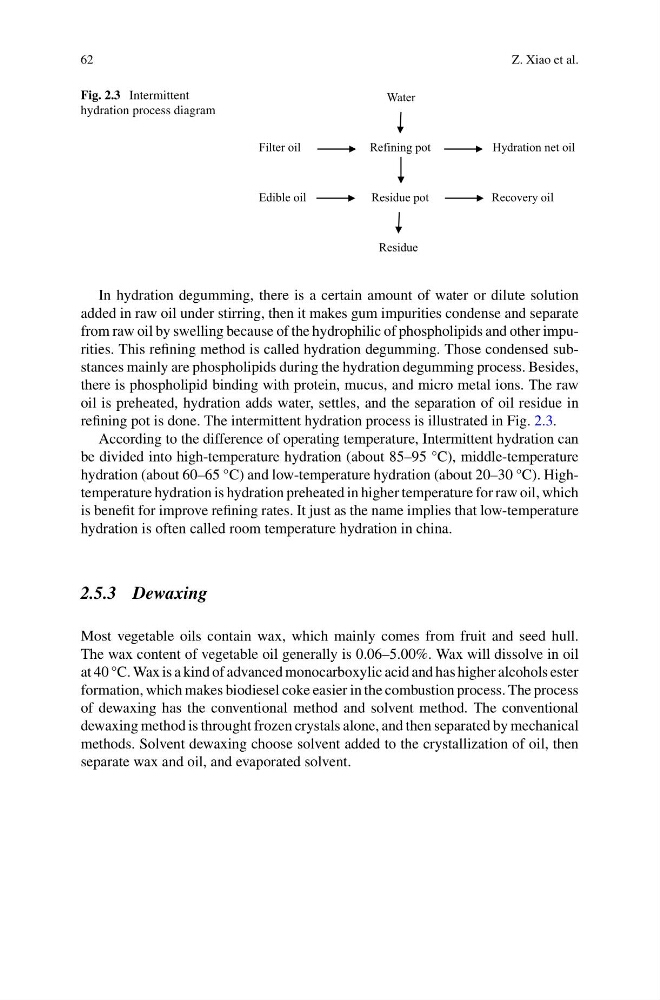
Fig. 2.3 Intermittent
hydration process diagram
Water
Refining pot
Filter oil
Hydration net oil
Residue pot
Residue
Edible oil
Recovery oil
In hydration degumming, there is a certain amount of water or dilute solution
added in raw oil under stirring, then it makes gum impurities condense and separate
from raw oil by swelling because of the hydrophilic of phospholipids and other impurities. This refining method is called hydration degumming. Those condensed substances mainly are phospholipids during the hydration degumming process. Besides,
there is phospholipid binding with protein, mucus, and micro metal ions. The raw
oil is preheated, hydration adds water, settles, and the separation of oil residue in
refining pot is done. The intermittent hydration process is illustrated in Fig. 2.3.
According to the difference of operating temperature, Intermittent hydration can
be divided into high-temperature hydration (about 85–95 °C), middle-temperature
hydration (about 60–65 °C) and low-temperature hydration (about 20–30 °C). Hightemperature hydration is hydration preheated in higher temperature for raw oil, which
is benefit for improve refining rates. It just as the name implies that low-temperature
hydration is often called room temperature hydration in china.
2.5.3 Dewaxing
Most vegetable oils contain wax, which mainly comes from fruit and seed hull.
The wax content of vegetable oil generally is 0.06–5.00%. Wax will dissolve in oil
at 40 °C. Wax is a kind of advanced monocarboxylic acid and has higher alcohols ester
formation, which makes biodiesel coke easier in the combustion process. The process
of dewaxing has the conventional method and solvent method. The conventional
dewaxing method is throught frozen crystals alone, and then separated by mechanical
methods. Solvent dewaxing choose solvent added to the crystallization of oil, then
separate wax and oil, and evaporated solvent.
Z. Xiao et al.
Fig. 2.3 Intermittent
hydration process diagram
Water
Refining pot
Filter oil
Hydration net oil
Residue pot
Residue
Edible oil
Recovery oil
In hydration degumming, there is a certain amount of water or dilute solution
added in raw oil under stirring, then it makes gum impurities condense and separate
from raw oil by swelling because of the hydrophilic of phospholipids and other impurities. This refining method is called hydration degumming. Those condensed substances mainly are phospholipids during the hydration degumming process. Besides,
there is phospholipid binding with protein, mucus, and micro metal ions. The raw
oil is preheated, hydration adds water, settles, and the separation of oil residue in
refining pot is done. The intermittent hydration process is illustrated in Fig. 2.3.
According to the difference of operating temperature, Intermittent hydration can
be divided into high-temperature hydration (about 85–95 °C), middle-temperature
hydration (about 60–65 °C) and low-temperature hydration (about 20–30 °C). Hightemperature hydration is hydration preheated in higher temperature for raw oil, which
is benefit for improve refining rates. It just as the name implies that low-temperature
hydration is often called room temperature hydration in china.
2.5.3 Dewaxing
Most vegetable oils contain wax, which mainly comes from fruit and seed hull.
The wax content of vegetable oil generally is 0.06–5.00%. Wax will dissolve in oil
at 40 °C. Wax is a kind of advanced monocarboxylic acid and has higher alcohols ester
formation, which makes biodiesel coke easier in the combustion process. The process
of dewaxing has the conventional method and solvent method. The conventional
dewaxing method is throught frozen crystals alone, and then separated by mechanical
methods. Solvent dewaxing choose solvent added to the crystallization of oil, then
separate wax and oil, and evaporated solvent.