

216
R. Tesser et al.
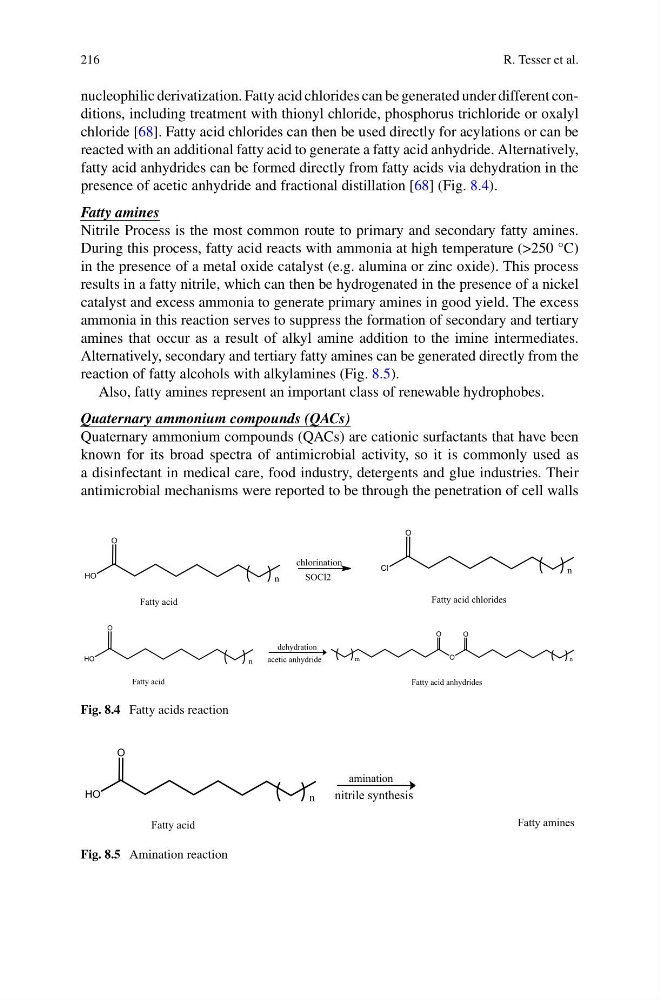
nucleophilic derivatization. Fatty acid chlorides can be generated under different conditions, including treatment with thionyl chloride, phosphorus trichloride or oxalyl
chloride [68]. Fatty acid chlorides can then be used directly for acylations or can be
reacted with an additional fatty acid to generate a fatty acid anhydride. Alternatively,
fatty acid anhydrides can be formed directly from fatty acids via dehydration in the
presence of acetic anhydride and fractional distillation [68] (Fig. 8.4).
Fatty amines
Nitrile Process is the most common route to primary and secondary fatty amines.
During this process, fatty acid reacts with ammonia at high temperature (>250 °C)
in the presence of a metal oxide catalyst (e.g. alumina or zinc oxide). This process
results in a fatty nitrile, which can then be hydrogenated in the presence of a nickel
catalyst and excess ammonia to generate primary amines in good yield. The excess
ammonia in this reaction serves to suppress the formation of secondary and tertiary
amines that occur as a result of alkyl amine addition to the imine intermediates.
Alternatively, secondary and tertiary fatty amines can be generated directly from the
reaction of fatty alcohols with alkylamines (Fig. 8.5).
Also, fatty amines represent an important class of renewable hydrophobes.
Quaternary ammonium compounds (QACs)
Quaternary ammonium compounds (QACs) are cationic surfactants that have been
known for its broad spectra of antimicrobial activity, so it is commonly used as
a disinfectant in medical care, food industry, detergents and glue industries. Their
antimicrobial mechanisms were reported to be through the penetration of cell walls
HO
O
n
Fatty acid
chlorination
Cl
O
n
Fatty acid chlorides
SOCl2
HO
O
n
Fatty acid
dehydration
O
O
n
Fatty acid anhydrides
acetic anhydride
O
m
Fig. 8.4 Fatty acids reaction
HO
O
n
Fatty acid
amination
Fatty amines
nitrile synthesis
Fig. 8.5 Amination reaction
R. Tesser et al.
nucleophilic derivatization. Fatty acid chlorides can be generated under different conditions, including treatment with thionyl chloride, phosphorus trichloride or oxalyl
chloride [68]. Fatty acid chlorides can then be used directly for acylations or can be
reacted with an additional fatty acid to generate a fatty acid anhydride. Alternatively,
fatty acid anhydrides can be formed directly from fatty acids via dehydration in the
presence of acetic anhydride and fractional distillation [68] (Fig. 8.4).
Fatty amines
Nitrile Process is the most common route to primary and secondary fatty amines.
During this process, fatty acid reacts with ammonia at high temperature (>250 °C)
in the presence of a metal oxide catalyst (e.g. alumina or zinc oxide). This process
results in a fatty nitrile, which can then be hydrogenated in the presence of a nickel
catalyst and excess ammonia to generate primary amines in good yield. The excess
ammonia in this reaction serves to suppress the formation of secondary and tertiary
amines that occur as a result of alkyl amine addition to the imine intermediates.
Alternatively, secondary and tertiary fatty amines can be generated directly from the
reaction of fatty alcohols with alkylamines (Fig. 8.5).
Also, fatty amines represent an important class of renewable hydrophobes.
Quaternary ammonium compounds (QACs)
Quaternary ammonium compounds (QACs) are cationic surfactants that have been
known for its broad spectra of antimicrobial activity, so it is commonly used as
a disinfectant in medical care, food industry, detergents and glue industries. Their
antimicrobial mechanisms were reported to be through the penetration of cell walls
HO
O
n
Fatty acid
chlorination
Cl
O
n
Fatty acid chlorides
SOCl2
HO
O
n
Fatty acid
dehydration
O
O
n
Fatty acid anhydrides
acetic anhydride
O
m
Fig. 8.4 Fatty acids reaction
HO
O
n
Fatty acid
amination
Fatty amines
nitrile synthesis
Fig. 8.5 Amination reaction