

8 Oleochemistry Products
215
glycosidation
H2SO4
glucose
high temperature
HO
n
Fatty alcohols
Alkyl polyglucosides
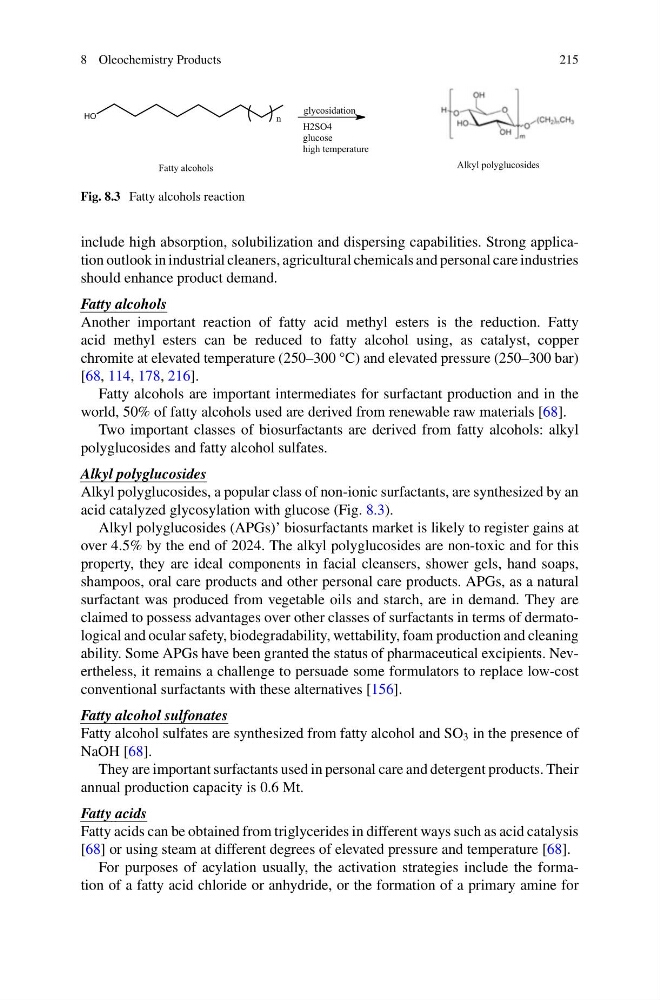
Fig. 8.3 Fatty alcohols reaction
include high absorption, solubilization and dispersing capabilities. Strong application outlook in industrial cleaners, agricultural chemicals and personal care industries
should enhance product demand.
Fatty alcohols
Another important reaction of fatty acid methyl esters is the reduction. Fatty
acid methyl esters can be reduced to fatty alcohol using, as catalyst, copper
chromite at elevated temperature (250–300 °C) and elevated pressure (250–300 bar)
[68, 114, 178, 216].
Fatty alcohols are important intermediates for surfactant production and in the
world, 50% of fatty alcohols used are derived from renewable raw materials [68].
Two important classes of biosurfactants are derived from fatty alcohols: alkyl
polyglucosides and fatty alcohol sulfates.
Alkyl polyglucosides
Alkyl polyglucosides, a popular class of non-ionic surfactants, are synthesized by an
acid catalyzed glycosylation with glucose (Fig. 8.3).
Alkyl polyglucosides (APGs)’ biosurfactants market is likely to register gains at
over 4.5% by the end of 2024. The alkyl polyglucosides are non-toxic and for this
property, they are ideal components in facial cleansers, shower gels, hand soaps,
shampoos, oral care products and other personal care products. APGs, as a natural
surfactant was produced from vegetable oils and starch, are in demand. They are
claimed to possess advantages over other classes of surfactants in terms of dermatological and ocular safety, biodegradability, wettability, foam production and cleaning
ability. Some APGs have been granted the status of pharmaceutical excipients. Nevertheless, it remains a challenge to persuade some formulators to replace low-cost
conventional surfactants with these alternatives [156].
Fatty alcohol sulfonates
Fatty alcohol sulfates are synthesized from fatty alcohol and SO 3 in the presence of
NaOH [68].
They are important surfactants used in personal care and detergent products. Their
annual production capacity is 0.6 Mt.
Fatty acids
Fatty acids can be obtained from triglycerides in different ways such as acid catalysis
[68] or using steam at different degrees of elevated pressure and temperature [68].
For purposes of acylation usually, the activation strategies include the formation of a fatty acid chloride or anhydride, or the formation of a primary amine for
215
glycosidation
H2SO4
glucose
high temperature
HO
n
Fatty alcohols
Alkyl polyglucosides
Fig. 8.3 Fatty alcohols reaction
include high absorption, solubilization and dispersing capabilities. Strong application outlook in industrial cleaners, agricultural chemicals and personal care industries
should enhance product demand.
Fatty alcohols
Another important reaction of fatty acid methyl esters is the reduction. Fatty
acid methyl esters can be reduced to fatty alcohol using, as catalyst, copper
chromite at elevated temperature (250–300 °C) and elevated pressure (250–300 bar)
[68, 114, 178, 216].
Fatty alcohols are important intermediates for surfactant production and in the
world, 50% of fatty alcohols used are derived from renewable raw materials [68].
Two important classes of biosurfactants are derived from fatty alcohols: alkyl
polyglucosides and fatty alcohol sulfates.
Alkyl polyglucosides
Alkyl polyglucosides, a popular class of non-ionic surfactants, are synthesized by an
acid catalyzed glycosylation with glucose (Fig. 8.3).
Alkyl polyglucosides (APGs)’ biosurfactants market is likely to register gains at
over 4.5% by the end of 2024. The alkyl polyglucosides are non-toxic and for this
property, they are ideal components in facial cleansers, shower gels, hand soaps,
shampoos, oral care products and other personal care products. APGs, as a natural
surfactant was produced from vegetable oils and starch, are in demand. They are
claimed to possess advantages over other classes of surfactants in terms of dermatological and ocular safety, biodegradability, wettability, foam production and cleaning
ability. Some APGs have been granted the status of pharmaceutical excipients. Nevertheless, it remains a challenge to persuade some formulators to replace low-cost
conventional surfactants with these alternatives [156].
Fatty alcohol sulfonates
Fatty alcohol sulfates are synthesized from fatty alcohol and SO 3 in the presence of
NaOH [68].
They are important surfactants used in personal care and detergent products. Their
annual production capacity is 0.6 Mt.
Fatty acids
Fatty acids can be obtained from triglycerides in different ways such as acid catalysis
[68] or using steam at different degrees of elevated pressure and temperature [68].
For purposes of acylation usually, the activation strategies include the formation of a fatty acid chloride or anhydride, or the formation of a primary amine for