

6 By-Products of Biodiesel and Their Recycling
169
as such because the heating chamber looks like a basket hanging in the lower section
of the evaporator casing. The solution circulation in this evaporator is similar to
that in a standard-type evaporator. But the circulating route is descending along the
crevice between the heating chamber and the evaporator casing, and ascending along
the heating tube. The circular cross section area of this evaporator is 100–150% of
the heating tube. Therefore, the circulating speed of the solution is faster than that
in a standard-type evaporator at 1–1.5 m/s. Since the evaporator casing is in direct
contact with the boiling liquid of a relatively low temperature, the heat loss is small.
Additionally, since the heating chamber is removable from the top of the evaporator,
it is easy to wash, overhaul, and replace. The disadvantages of this evaporator lie
in its complicated structure and higher metal consumption for per unit heat transfer
area. This design is applicable to solutions that tend to form fouling or crystallize
during evaporation.
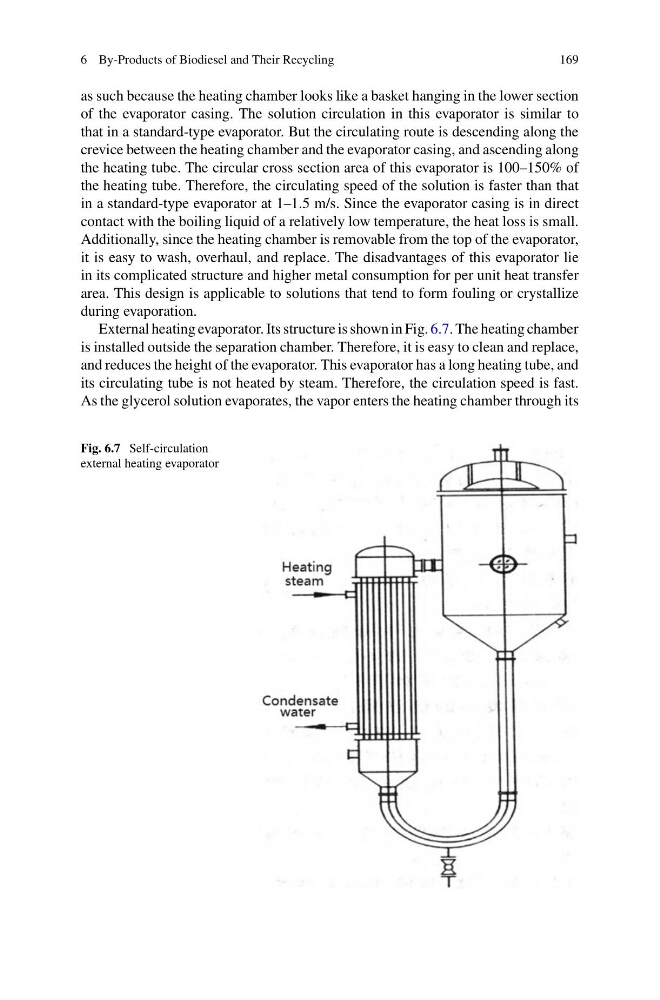
External heating evaporator. Its structure is shown in Fig. 6.7. The heating chamber
is installed outside the separation chamber. Therefore, it is easy to clean and replace,
and reduces the height of the evaporator. This evaporator has a long heating tube, and
its circulating tube is not heated by steam. Therefore, the circulation speed is fast.
As the glycerol solution evaporates, the vapor enters the heating chamber through its
Fig. 6.7 Self-circulation
external heating evaporator
169
as such because the heating chamber looks like a basket hanging in the lower section
of the evaporator casing. The solution circulation in this evaporator is similar to
that in a standard-type evaporator. But the circulating route is descending along the
crevice between the heating chamber and the evaporator casing, and ascending along
the heating tube. The circular cross section area of this evaporator is 100–150% of
the heating tube. Therefore, the circulating speed of the solution is faster than that
in a standard-type evaporator at 1–1.5 m/s. Since the evaporator casing is in direct
contact with the boiling liquid of a relatively low temperature, the heat loss is small.
Additionally, since the heating chamber is removable from the top of the evaporator,
it is easy to wash, overhaul, and replace. The disadvantages of this evaporator lie
in its complicated structure and higher metal consumption for per unit heat transfer
area. This design is applicable to solutions that tend to form fouling or crystallize
during evaporation.
External heating evaporator. Its structure is shown in Fig. 6.7. The heating chamber
is installed outside the separation chamber. Therefore, it is easy to clean and replace,
and reduces the height of the evaporator. This evaporator has a long heating tube, and
its circulating tube is not heated by steam. Therefore, the circulation speed is fast.
As the glycerol solution evaporates, the vapor enters the heating chamber through its
Fig. 6.7 Self-circulation
external heating evaporator