

4 Current Status of the Biodiesel Industry and Its Assessment …
123
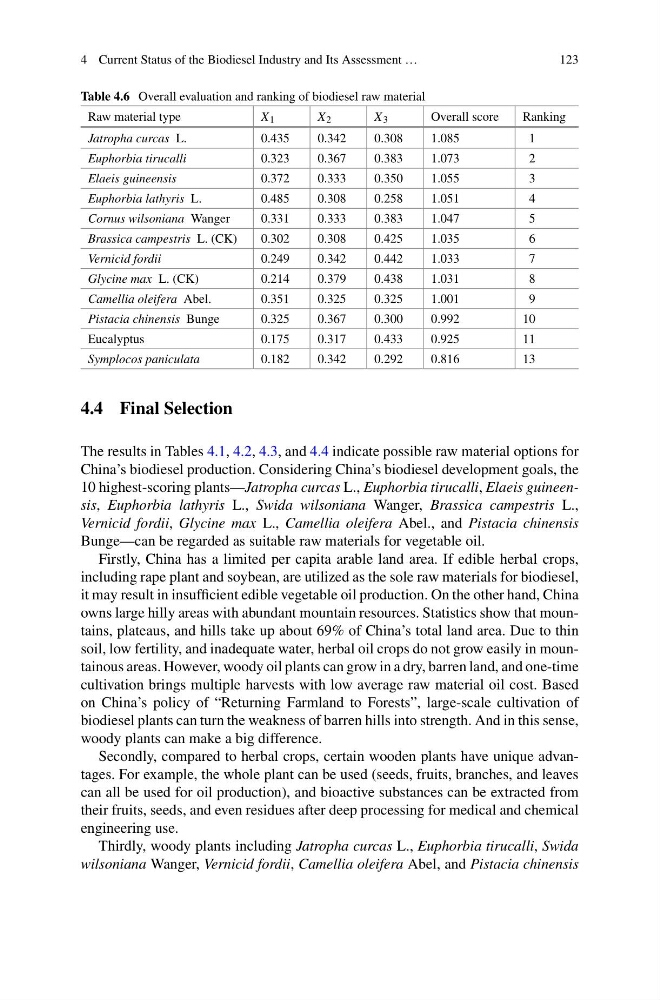
Table 4.6 Overall evaluation and ranking of biodiesel raw material
Raw material type
X 1
X 2
X 3
Overall score
Ranking
Jatropha curcas L.
0.435
0.342
0.308
1.085
1
Euphorbia tirucalli
0.323
0.367
0.383
1.073
2
Elaeis guineensis
0.372
0.333
0.350
1.055
3
Euphorbia lathyris L.
0.485
0.308
0.258
1.051
4
Cornus wilsoniana Wanger
0.331
0.333
0.383
1.047
5
Brassica campestris L. (CK)
0.302
0.308
0.425
1.035
6
Vernicid fordii
0.249
0.342
0.442
1.033
7
Glycine max L. (CK)
0.214
0.379
0.438
1.031
8
Camellia oleifera Abel.
0.351
0.325
0.325
1.001
9
Pistacia chinensis Bunge
0.325
0.367
0.300
0.992
10
Eucalyptus
0.175
0.317
0.433
0.925
11
Symplocos paniculata
0.182
0.342
0.292
0.816
13
4.4 Final Selection
The results in Tables 4.1, 4.2, 4.3, and 4.4 indicate possible raw material options for
China’s biodiesel production. Considering China’s biodiesel development goals, the
10 highest-scoring plants—Jatropha curcas L., Euphorbia tirucalli, Elaeis guineensis, Euphorbia lathyris L., Swida wilsoniana Wanger, Brassica campestris L.,
Vernicid fordii, Glycine max L., Camellia oleifera Abel., and Pistacia chinensis
Bunge—can be regarded as suitable raw materials for vegetable oil.
Firstly, China has a limited per capita arable land area. If edible herbal crops,
including rape plant and soybean, are utilized as the sole raw materials for biodiesel,
it may result in insufficient edible vegetable oil production. On the other hand, China
owns large hilly areas with abundant mountain resources. Statistics show that mountains, plateaus, and hills take up about 69% of China’s total land area. Due to thin
soil, low fertility, and inadequate water, herbal oil crops do not grow easily in mountainous areas. However, woody oil plants can grow in a dry, barren land, and one-time
cultivation brings multiple harvests with low average raw material oil cost. Based
on China’s policy of “Returning Farmland to Forests”, large-scale cultivation of
biodiesel plants can turn the weakness of barren hills into strength. And in this sense,
woody plants can make a big difference.
Secondly, compared to herbal crops, certain wooden plants have unique advantages. For example, the whole plant can be used (seeds, fruits, branches, and leaves
can all be used for oil production), and bioactive substances can be extracted from
their fruits, seeds, and even residues after deep processing for medical and chemical
engineering use.
Thirdly, woody plants including Jatropha curcas L., Euphorbia tirucalli, Swida
wilsoniana Wanger, Vernicid fordii, Camellia oleifera Abel, and Pistacia chinensis
123
Table 4.6 Overall evaluation and ranking of biodiesel raw material
Raw material type
X 1
X 2
X 3
Overall score
Ranking
Jatropha curcas L.
0.435
0.342
0.308
1.085
1
Euphorbia tirucalli
0.323
0.367
0.383
1.073
2
Elaeis guineensis
0.372
0.333
0.350
1.055
3
Euphorbia lathyris L.
0.485
0.308
0.258
1.051
4
Cornus wilsoniana Wanger
0.331
0.333
0.383
1.047
5
Brassica campestris L. (CK)
0.302
0.308
0.425
1.035
6
Vernicid fordii
0.249
0.342
0.442
1.033
7
Glycine max L. (CK)
0.214
0.379
0.438
1.031
8
Camellia oleifera Abel.
0.351
0.325
0.325
1.001
9
Pistacia chinensis Bunge
0.325
0.367
0.300
0.992
10
Eucalyptus
0.175
0.317
0.433
0.925
11
Symplocos paniculata
0.182
0.342
0.292
0.816
13
4.4 Final Selection
The results in Tables 4.1, 4.2, 4.3, and 4.4 indicate possible raw material options for
China’s biodiesel production. Considering China’s biodiesel development goals, the
10 highest-scoring plants—Jatropha curcas L., Euphorbia tirucalli, Elaeis guineensis, Euphorbia lathyris L., Swida wilsoniana Wanger, Brassica campestris L.,
Vernicid fordii, Glycine max L., Camellia oleifera Abel., and Pistacia chinensis
Bunge—can be regarded as suitable raw materials for vegetable oil.
Firstly, China has a limited per capita arable land area. If edible herbal crops,
including rape plant and soybean, are utilized as the sole raw materials for biodiesel,
it may result in insufficient edible vegetable oil production. On the other hand, China
owns large hilly areas with abundant mountain resources. Statistics show that mountains, plateaus, and hills take up about 69% of China’s total land area. Due to thin
soil, low fertility, and inadequate water, herbal oil crops do not grow easily in mountainous areas. However, woody oil plants can grow in a dry, barren land, and one-time
cultivation brings multiple harvests with low average raw material oil cost. Based
on China’s policy of “Returning Farmland to Forests”, large-scale cultivation of
biodiesel plants can turn the weakness of barren hills into strength. And in this sense,
woody plants can make a big difference.
Secondly, compared to herbal crops, certain wooden plants have unique advantages. For example, the whole plant can be used (seeds, fruits, branches, and leaves
can all be used for oil production), and bioactive substances can be extracted from
their fruits, seeds, and even residues after deep processing for medical and chemical
engineering use.
Thirdly, woody plants including Jatropha curcas L., Euphorbia tirucalli, Swida
wilsoniana Wanger, Vernicid fordii, Camellia oleifera Abel, and Pistacia chinensis