

122
C. Li et al.
As to the preselected biodiesel raw material plants (woody or herbal), their standing does not necessarily determine their value. Their production cost, adaptability to
people’s cultivation habits and ecological system, and social functions also require
further analysis. Therefore, it is necessary to build on the preliminary selection to
evaluate the raw materials from the perspectives of economic cost, ecological impact,
and social benefits.
(1) Evaluation of economic cost (X 1 )
The pretax production cost of biodiesel per liter by energy plants is used as the
baseline for comparative analysis. The cost analysis of oil plants refers to the
model in “Current Research Progress of Biodiesel Development and Its Commercial
Application” (Li et al. 2002). The lower the cost, the higher X 1 scores.
X 1 = 1/pretax production cost of biodiesel per liter.
(2) Ecological functions (X 2 )
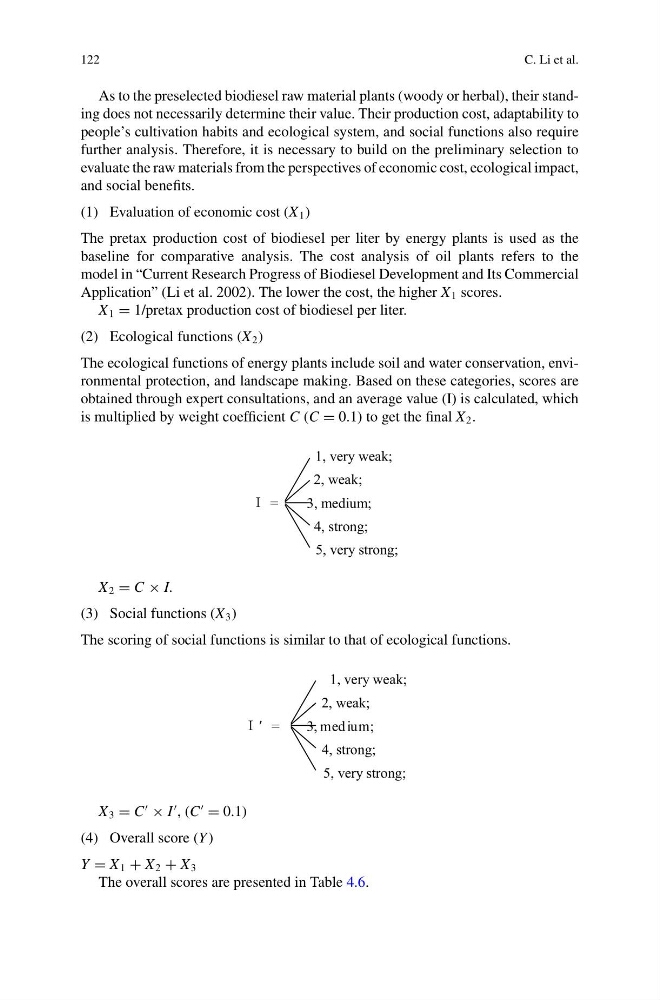
The ecological functions of energy plants include soil and water conservation, environmental protection, and landscape making. Based on these categories, scores are
obtained through expert consultations, and an average value (I) is calculated, which
is multiplied by weight coefficient C (C = 0.1) to get the final X 2 .
1, very weak;
2, weak;
=
3, medium;
4, strong;
5, very strong;
X 2 = C × I.
(3) Social functions (X 3 )
The scoring of social functions is similar to that of ecological functions.
1, very weak;
2, weak;
=
3, med ium;
4, strong;
5, very strong;
X 3 = C
× I
, (C
= 0.1)
(4) Overall score (Y )
Y = X 1 + X 2 + X 3
The overall scores are presented in Table 4.6.
C. Li et al.
As to the preselected biodiesel raw material plants (woody or herbal), their standing does not necessarily determine their value. Their production cost, adaptability to
people’s cultivation habits and ecological system, and social functions also require
further analysis. Therefore, it is necessary to build on the preliminary selection to
evaluate the raw materials from the perspectives of economic cost, ecological impact,
and social benefits.
(1) Evaluation of economic cost (X 1 )
The pretax production cost of biodiesel per liter by energy plants is used as the
baseline for comparative analysis. The cost analysis of oil plants refers to the
model in “Current Research Progress of Biodiesel Development and Its Commercial
Application” (Li et al. 2002). The lower the cost, the higher X 1 scores.
X 1 = 1/pretax production cost of biodiesel per liter.
(2) Ecological functions (X 2 )
The ecological functions of energy plants include soil and water conservation, environmental protection, and landscape making. Based on these categories, scores are
obtained through expert consultations, and an average value (I) is calculated, which
is multiplied by weight coefficient C (C = 0.1) to get the final X 2 .
1, very weak;
2, weak;
=
3, medium;
4, strong;
5, very strong;
X 2 = C × I.
(3) Social functions (X 3 )
The scoring of social functions is similar to that of ecological functions.
1, very weak;
2, weak;
=
3, med ium;
4, strong;
5, very strong;
X 3 = C
× I
, (C
= 0.1)
(4) Overall score (Y )
Y = X 1 + X 2 + X 3
The overall scores are presented in Table 4.6.