

768
8 Modern Weapons: Possibilities and Limitations
[4]. In such microwave units, capacitive accumulators and explosive magnetic generators with a conventional explosive can be used as power sources, while generators
based on super-powerful microwave devices can be used as sources of microwave
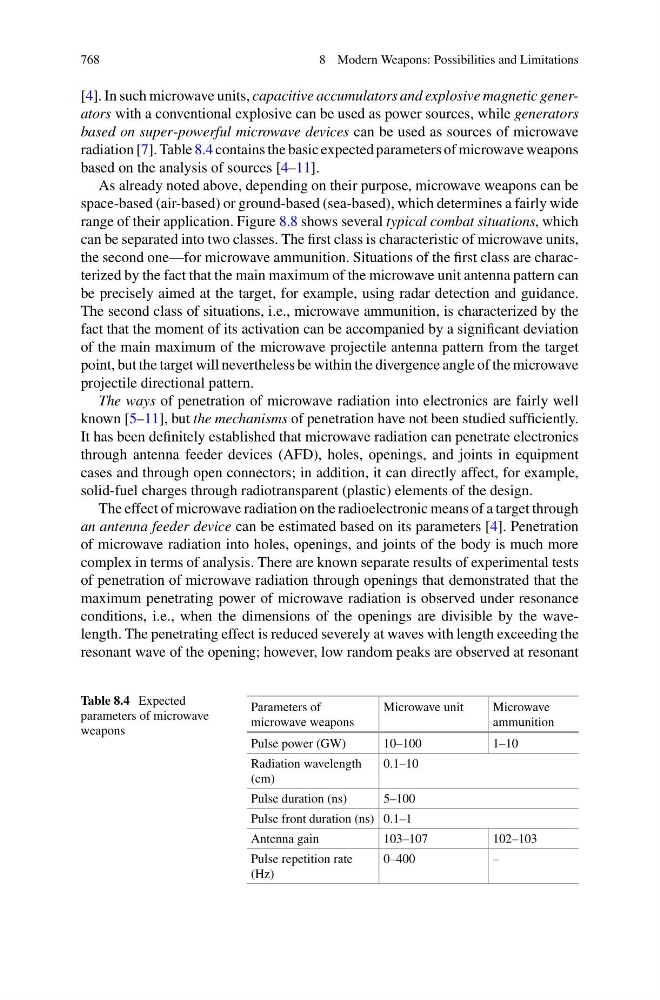
radiation [7]. Table 8.4 contains the basic expected parameters of microwave weapons
based on the analysis of sources [4–11].
As already noted above, depending on their purpose, microwave weapons can be
space-based (air-based) or ground-based (sea-based), which determines a fairly wide
range of their application. Figure 8.8 shows several typical combat situations, which
can be separated into two classes. The first class is characteristic of microwave units,
the second one—for microwave ammunition. Situations of the first class are characterized by the fact that the main maximum of the microwave unit antenna pattern can
be precisely aimed at the target, for example, using radar detection and guidance.
The second class of situations, i.e., microwave ammunition, is characterized by the
fact that the moment of its activation can be accompanied by a significant deviation
of the main maximum of the microwave projectile antenna pattern from the target
point, but the target will nevertheless be within the divergence angle of the microwave
projectile directional pattern.
The ways of penetration of microwave radiation into electronics are fairly well
known [5–11], but the mechanisms of penetration have not been studied sufficiently.
It has been definitely established that microwave radiation can penetrate electronics
through antenna feeder devices (AFD), holes, openings, and joints in equipment
cases and through open connectors; in addition, it can directly affect, for example,
solid-fuel charges through radiotransparent (plastic) elements of the design.
The effect of microwave radiation on the radioelectronic means of a target through
an antenna feeder device can be estimated based on its parameters [4]. Penetration
of microwave radiation into holes, openings, and joints of the body is much more
complex in terms of analysis. There are known separate results of experimental tests
of penetration of microwave radiation through openings that demonstrated that the
maximum penetrating power of microwave radiation is observed under resonance
conditions, i.e., when the dimensions of the openings are divisible by the wavelength. The penetrating effect is reduced severely at waves with length exceeding the
resonant wave of the opening; however, low random peaks are observed at resonant
Table 8.4 Expected
parameters of microwave
weapons
Parameters of
microwave weapons
Microwave unit
Microwave
ammunition
Pulse power (GW)
10–100
1–10
Radiation wavelength
(cm)
0.1–10
Pulse duration (ns)
5–100
Pulse front duration (ns) 0.1–1
Antenna gain
103–107
102–103
Pulse repetition rate
(Hz)
0–400
–