

766
8 Modern Weapons: Possibilities and Limitations
Switzerland AG 2019-390, ISBN: 978-3-030-04157-1] is virtually useless for protection from microwave radiation, since the character of microwave radiation pulses
is quite different from the effect of electromagnetic pulse of a nuclear explosion. EMR does not have a high-frequency fill (i.e., this is a video pulse), and
its spectrum is mainly concentrated in the region of relatively low frequencies 1–
100 MHz, and microwave pulses are generated at a certain carrier frequency; their
spectrum ranges from units to hundreds of gigahertz. The low-frequency nature of
EMR creates serious problems for its directional sewage in space to the object of
destruction, while for microwave radiation such sewage is easily implemented using
special antenna systems (horn, mirror, and phased antenna arrays), which significantly increases the level of microwave power acting on electronics. EMR penetrates
directly through the walls of bodies of radioelectronic equipment, while microwave
radiation can enter electronics through holes, interfaces, and irregularities of bases,
as well as open connectors of quick-disconnect cable lines. Therefore, the assessment of degrading effect of microwave radiation on objects containing elements and
devices of computing equipment and control system, as well as search of protection
means and methods, is a complex but relevant task.
The levels of energy required for destruction (irreversible degradation) of semiconductor elements (diodes, transistors, microcircuits) of electronics by microwave
radiation are quite well-known today [5–7]. The article contains the known experimental data on the value of energy required to destroy certain semiconductor elements
depending on the length of the microwave pulse.
For example, the energy required to damage PIN diodes used in limiters and
antenna switches of radioelectronic means lies within 5 × 10
−5 –10
−4 J with a pulse
duration of tens of nanoseconds [7]. In some cases, failure of the receiver module of
radioelectronic means is determined by the failure of a low-noise amplifier, which
in modern microwave equipment is based on a field-effect transistor with a Schottky
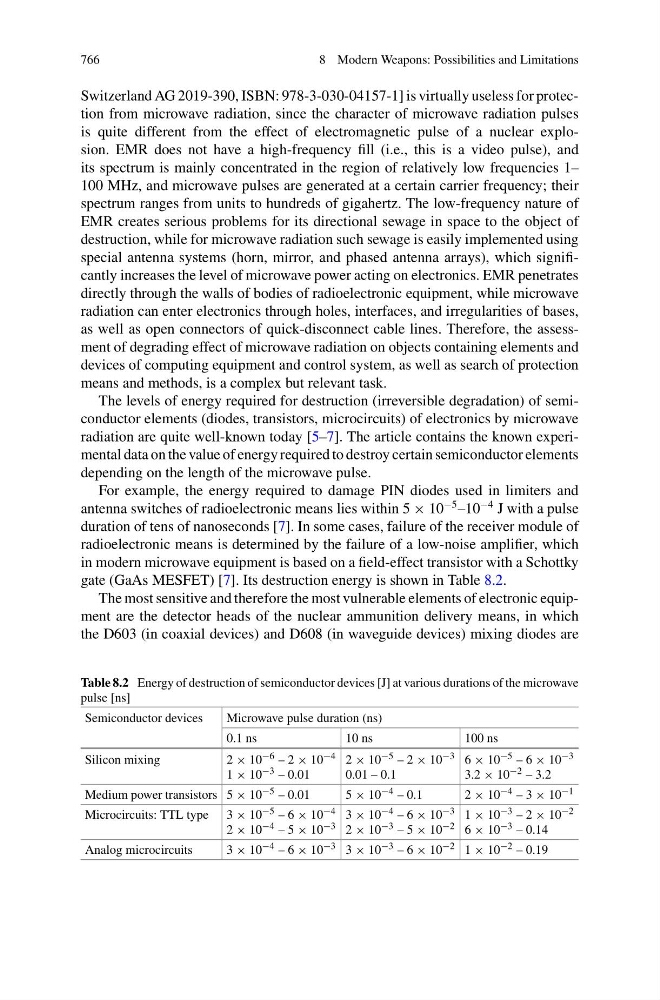
gate (GaAs MESFET) [7]. Its destruction energy is shown in Table 8.2.
The most sensitive and therefore the most vulnerable elements of electronic equipment are the detector heads of the nuclear ammunition delivery means, in which
the D603 (in coaxial devices) and D608 (in waveguide devices) mixing diodes are
Table 8.2 Energy of destruction of semiconductor devices [J] at various durations of the microwave
pulse [ns]
Semiconductor devices
Microwave pulse duration (ns)
0.1 ns
10 ns
100 ns
Silicon mixing
2 × 10 −6 – 2 × 10 −4
1 × 10 −3 – 0.01
2 × 10 −5 – 2 × 10 −3
0.01 – 0.1
6 × 10 −5 – 6 × 10 −3
3.2 × 10 −2 – 3.2
Medium power transistors 5 × 10 −5 – 0.01
5 × 10 −4 – 0.1
2 × 10 −4 – 3 × 10 −1
Microcircuits: TTL type 3 × 10 −5 – 6 × 10 −4
2 × 10 −4 – 5 × 10 −3
3 × 10 −4 – 6 × 10 −3
2 × 10 −3 – 5 × 10 −2
1 × 10 −3 – 2 × 10 −2
6 × 10 −3 – 0.14
Analog microcircuits
3 × 10 −4 – 6 × 10 −3 3 × 10 −3 – 6 × 10 −2 1 × 10 −2 – 0.19