

680
7 Countermeasures Against Hardware Trojans
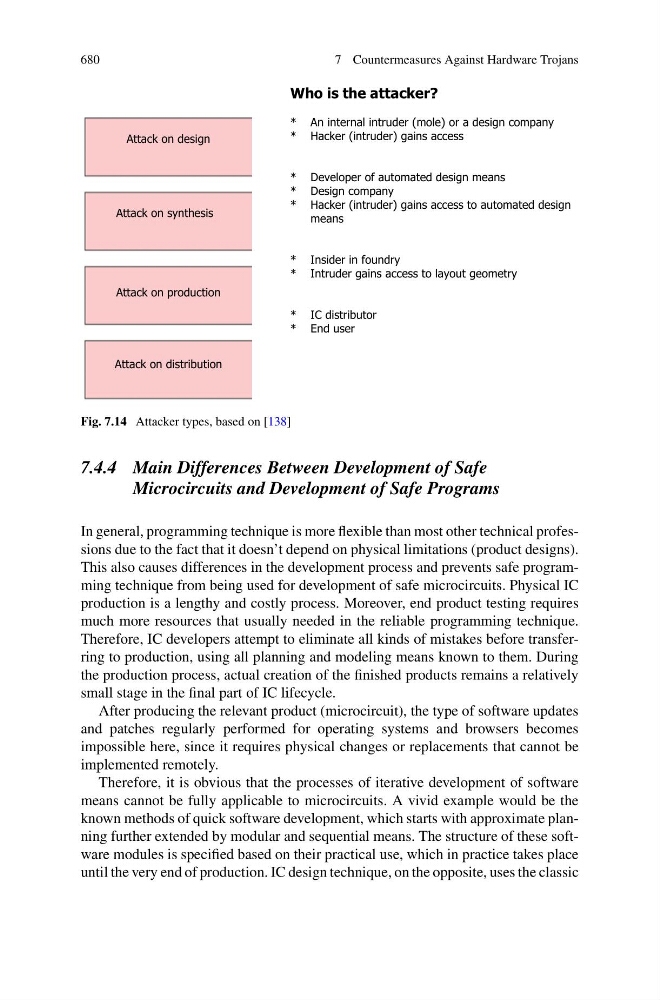
Who is the attacker?
* An internal intruder (mole) or a design company
* Hacker (intruder) gains access
* Developer of automated design means
* Design company
* Hacker (intruder) gains access to automated design
means
* Insider in foundry
* Intruder gains access to layout geometry
* IC distributor
* End user
Attack on design
Attack on synthesis
Attack on production
Attack on distribution
Fig. 7.14 Attacker types, based on [138]
7.4.4 Main Differences Between Development of Safe
Microcircuits and Development of Safe Programs
In general, programming technique is more flexible than most other technical professions due to the fact that it doesn’t depend on physical limitations (product designs).
This also causes differences in the development process and prevents safe programming technique from being used for development of safe microcircuits. Physical IC
production is a lengthy and costly process. Moreover, end product testing requires
much more resources that usually needed in the reliable programming technique.
Therefore, IC developers attempt to eliminate all kinds of mistakes before transferring to production, using all planning and modeling means known to them. During
the production process, actual creation of the finished products remains a relatively
small stage in the final part of IC lifecycle.
After producing the relevant product (microcircuit), the type of software updates
and patches regularly performed for operating systems and browsers becomes
impossible here, since it requires physical changes or replacements that cannot be
implemented remotely.
Therefore, it is obvious that the processes of iterative development of software
means cannot be fully applicable to microcircuits. A vivid example would be the
known methods of quick software development, which starts with approximate planning further extended by modular and sequential means. The structure of these software modules is specified based on their practical use, which in practice takes place
until the very end of production. IC design technique, on the opposite, uses the classic