

546
6 Reverse Engineering of Microcircuits
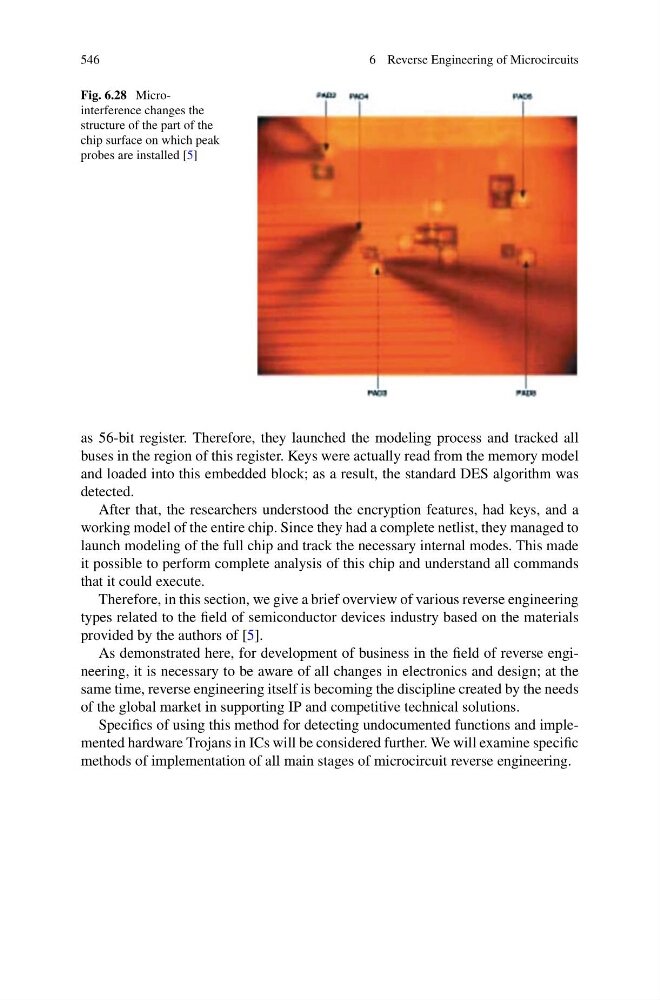
Fig. 6.28 Microinterference changes the
structure of the part of the
chip surface on which peak
probes are installed [5]
as 56-bit register. Therefore, they launched the modeling process and tracked all
buses in the region of this register. Keys were actually read from the memory model
and loaded into this embedded block; as a result, the standard DES algorithm was
detected.
After that, the researchers understood the encryption features, had keys, and a
working model of the entire chip. Since they had a complete netlist, they managed to
launch modeling of the full chip and track the necessary internal modes. This made
it possible to perform complete analysis of this chip and understand all commands
that it could execute.
Therefore, in this section, we give a brief overview of various reverse engineering
types related to the field of semiconductor devices industry based on the materials
provided by the authors of [5].
As demonstrated here, for development of business in the field of reverse engineering, it is necessary to be aware of all changes in electronics and design; at the
same time, reverse engineering itself is becoming the discipline created by the needs
of the global market in supporting IP and competitive technical solutions.
Specifics of using this method for detecting undocumented functions and implemented hardware Trojans in ICs will be considered further. We will examine specific
methods of implementation of all main stages of microcircuit reverse engineering.
6 Reverse Engineering of Microcircuits
Fig. 6.28 Microinterference changes the
structure of the part of the
chip surface on which peak
probes are installed [5]
as 56-bit register. Therefore, they launched the modeling process and tracked all
buses in the region of this register. Keys were actually read from the memory model
and loaded into this embedded block; as a result, the standard DES algorithm was
detected.
After that, the researchers understood the encryption features, had keys, and a
working model of the entire chip. Since they had a complete netlist, they managed to
launch modeling of the full chip and track the necessary internal modes. This made
it possible to perform complete analysis of this chip and understand all commands
that it could execute.
Therefore, in this section, we give a brief overview of various reverse engineering
types related to the field of semiconductor devices industry based on the materials
provided by the authors of [5].
As demonstrated here, for development of business in the field of reverse engineering, it is necessary to be aware of all changes in electronics and design; at the
same time, reverse engineering itself is becoming the discipline created by the needs
of the global market in supporting IP and competitive technical solutions.
Specifics of using this method for detecting undocumented functions and implemented hardware Trojans in ICs will be considered further. We will examine specific
methods of implementation of all main stages of microcircuit reverse engineering.