

6.1 Introduction to the Problem of Reverse Engineering …
509
RE is usually defined as a basic concept of organization of producing a product or
a part of it based on an original or physical model without using the entire engineering
design process.
While RE previously was a process of reproducing new product geometry to
organize its production based on digitalization and modification of a CAD model
recovery, in the last decade it has been widely used in other various spheres of
human activity.
For example, if a new car model is introduced in the market, the competing vehicle
manufacturers clearly want to know how new units of this new car are made, how they
operate, what their actual specifications are and whether they have any hidden defects
that can be presented in “independent” media or used in the struggle with competitors.
For example, in such specific field of car electronics as software engineering, it is
easily possible to study software and extract the flavor that is referred to by vehicle
manufacturers as Good Source Code—the most effective software solution from the
field of auto electronics.
In specific situations, e.g., when selecting the best exterior design for a car, the
developers usually require a lot of time, materials, and money to ultimately obtain
the required solution, while here the CAD model can do everything for them in a
quick and cheap fashion.
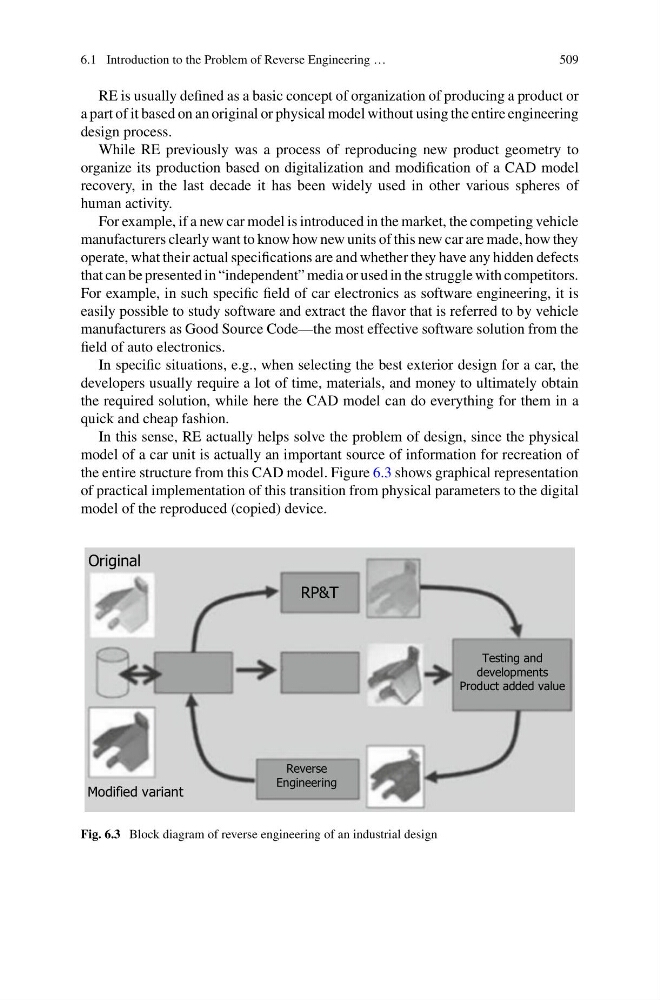
In this sense, RE actually helps solve the problem of design, since the physical
model of a car unit is actually an important source of information for recreation of
the entire structure from this CAD model. Figure 6.3 shows graphical representation
of practical implementation of this transition from physical parameters to the digital
model of the reproduced (copied) device.
Original
RP&T
Modified variant
Reverse
Engineering
Testing and
developments
Product added value
Fig. 6.3 Block diagram of reverse engineering of an industrial design
509
RE is usually defined as a basic concept of organization of producing a product or
a part of it based on an original or physical model without using the entire engineering
design process.
While RE previously was a process of reproducing new product geometry to
organize its production based on digitalization and modification of a CAD model
recovery, in the last decade it has been widely used in other various spheres of
human activity.
For example, if a new car model is introduced in the market, the competing vehicle
manufacturers clearly want to know how new units of this new car are made, how they
operate, what their actual specifications are and whether they have any hidden defects
that can be presented in “independent” media or used in the struggle with competitors.
For example, in such specific field of car electronics as software engineering, it is
easily possible to study software and extract the flavor that is referred to by vehicle
manufacturers as Good Source Code—the most effective software solution from the
field of auto electronics.
In specific situations, e.g., when selecting the best exterior design for a car, the
developers usually require a lot of time, materials, and money to ultimately obtain
the required solution, while here the CAD model can do everything for them in a
quick and cheap fashion.
In this sense, RE actually helps solve the problem of design, since the physical
model of a car unit is actually an important source of information for recreation of
the entire structure from this CAD model. Figure 6.3 shows graphical representation
of practical implementation of this transition from physical parameters to the digital
model of the reproduced (copied) device.
Original
RP&T
Modified variant
Reverse
Engineering
Testing and
developments
Product added value
Fig. 6.3 Block diagram of reverse engineering of an industrial design