

494
5 Methods of Detecting Hardware Trojans in Microcircuits
Die-to-Database. Application of the Die-to-Database method during testing of wafers
increases the number of false defects that cannot be sorted by software methods. In
serial level stations, most comparison operations are performed on the hardware
level in real time; therefore, some extremely difficult comparison algorithms here
are considered last of all.
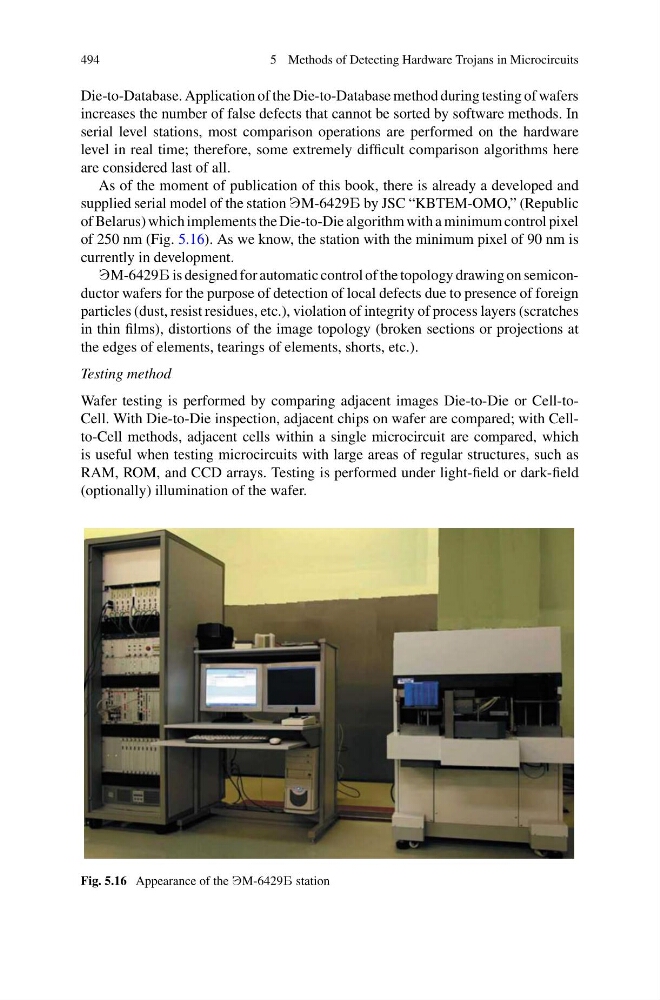
As of the moment of publication of this book, there is already a developed and
supplied serial model of the station M-6429B by JSC “KBTEM-OMO,” (Republic
of Belarus) which implements the Die-to-Die algorithm with a minimum control pixel
of 250 nm (Fig. 5.16). As we know, the station with the minimum pixel of 90 nm is
currently in development.
M-6429B is designed for automatic control of the topology drawing on semiconductor wafers for the purpose of detection of local defects due to presence of foreign
particles (dust, resist residues, etc.), violation of integrity of process layers (scratches
in thin films), distortions of the image topology (broken sections or projections at
the edges of elements, tearings of elements, shorts, etc.).
Testing method
Wafer testing is performed by comparing adjacent images Die-to-Die or Cell-toCell. With Die-to-Die inspection, adjacent chips on wafer are compared; with Cellto-Cell methods, adjacent cells within a single microcircuit are compared, which
is useful when testing microcircuits with large areas of regular structures, such as
RAM, ROM, and CCD arrays. Testing is performed under light-field or dark-field
(optionally) illumination of the wafer.
Fig. 5.16 Appearance of the M-6429B station
5 Methods of Detecting Hardware Trojans in Microcircuits
Die-to-Database. Application of the Die-to-Database method during testing of wafers
increases the number of false defects that cannot be sorted by software methods. In
serial level stations, most comparison operations are performed on the hardware
level in real time; therefore, some extremely difficult comparison algorithms here
are considered last of all.
As of the moment of publication of this book, there is already a developed and
supplied serial model of the station M-6429B by JSC “KBTEM-OMO,” (Republic
of Belarus) which implements the Die-to-Die algorithm with a minimum control pixel
of 250 nm (Fig. 5.16). As we know, the station with the minimum pixel of 90 nm is
currently in development.
M-6429B is designed for automatic control of the topology drawing on semiconductor wafers for the purpose of detection of local defects due to presence of foreign
particles (dust, resist residues, etc.), violation of integrity of process layers (scratches
in thin films), distortions of the image topology (broken sections or projections at
the edges of elements, tearings of elements, shorts, etc.).
Testing method
Wafer testing is performed by comparing adjacent images Die-to-Die or Cell-toCell. With Die-to-Die inspection, adjacent chips on wafer are compared; with Cellto-Cell methods, adjacent cells within a single microcircuit are compared, which
is useful when testing microcircuits with large areas of regular structures, such as
RAM, ROM, and CCD arrays. Testing is performed under light-field or dark-field
(optionally) illumination of the wafer.
Fig. 5.16 Appearance of the M-6429B station